Qiuyan Chen sued the Chinese ministry of education over homophobic textbooks. She writes about her battle for LGBTQ+ rights in China and the UK
February 25, 2022 · 6 min read
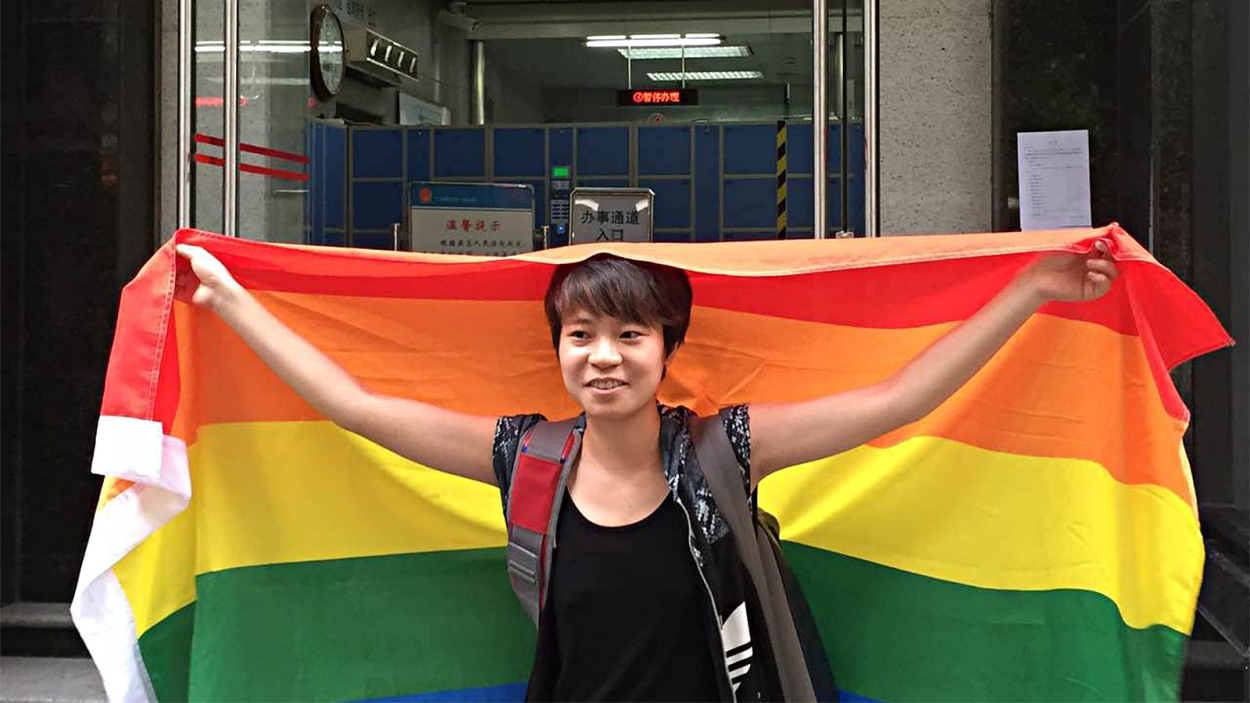
 Qiuyan Chen outside the Intermediate People’s Court in Beijing in 2015. Photo credit: Qiuyan Chen
On 16 July 2021, 18 LGBTQ+ public accounts run by the members of ‘underground’ student rainbow societies were shut down by WeChat. These accounts now only appear on the app as ‘unnamed’. When supporters voiced their anger about the closure on social media, their posts were swiftly deleted and some of their accounts were also shut down.
The closure of LGBTQ+ led social media accounts marks another turn in the long-term suppression of grassroots LGBTQ+ groups by public authorities in China. It is a concerning time for queer activists. How can we possibly promote LGBTQ+ rights in this context? How can we forge a space for ourselves in a society dominated by cisgenderism and heterosexuality?
Censorship on campus
I enrolled for undergraduate study at Sun Yat-sen University which, in 2006, set up the first rainbow society in mainland China. The university offered a public elective course on ‘social culture and gender diversity’, it had a ‘vagina monologues’ group, and so on. Despite the fact that these courses and groups were banned from campus by the university, those stories like seeds, were planted in my heart already.
In 2014, as a fresher, I discovered that the textbooks used in school described homosexuality as a form of mental illness.
Although homosexuality has been removed from the list of mental illness in 2001, there were still plenty of stigmatised depictions of homosexuality and bisexuality in psychology, mental health, and medical textbooks published in mainland China.
The descriptions in these books typically stated that ‘homosexuality represents a sexual orientation disorder’, ‘being bisexual means being homosexual while being heterosexual at different occasions’ and ‘being gay degrades social morality.’
I decided to push for the correction of these homophobic texts. After failed attempts at engaging with editors, publishers and librarians, I chose to purse change through the courts. I sued the Chinese education ministry three times between 2015 and 2017, and tried to sue individual publishers on a number of occasions.
Continue reading “Fighting for LGBTQ+ rights in China”