Basándose en la experiencia de primera mano en Rojava, Ramazan Mendanlioglu explora cómo se ven en la práctica la descentralización radical y la autoadministración. 4 de junio de 2021 · 6 min de lectura
Fuera de un Komîngeh (credit: Ramazan Mendanlioglu)
En los pueblos, ciudades y regiones de Rojava, en el noreste predominantemente kurdo de Siria, la agitación política ha resultado en la autoadministración en gran parte descentralizada de muchas áreas, incluida la salud, la economía, el derecho, la educación y la seguridad interna.
In the villages, cities and regions of Rojava, in the predominantly Kurdish north east of Syria, political upheaval has resulted in the largely decentralised self-administration of many areas, including health, economy, law, education and internal security.
Covid vaccines: Concerns that make more research essential.. Vaccines have become such a holy cow that critical studies have little chance of being accepted in the mainstream journals.
DOCTORS and scientists can behave at times like religious zealots, despite the noble aims of their professions. Heretics are not burned at the stake these days, but professionals marginalise and deride those who challenge their beliefs when these become a matter of faith (and self-interest) rather than science.
An apparent persistent attempt, at the highest level, to hide the Covid virus’s genetically engineered laboratory origins, and to persuade us that it simply jumped from an animal host into humans, is a case in point.
Vaccines are another. Taxpayers provide billions for products which in some cases have done wonders, such as eliminating smallpox, but whose value, in the opinion of some experts, became grossly over-estimated when their introduction coincided with social, political and economic advances in wellbeing.
Just as we tend to react strongly to criticism when living a lie as individuals, vaccines have become such a holy cow that critical studies have little chance of being accepted in the mainstream journals.
All this is by way of introducing the International Journal of Vaccine Theory, Practice and Research, founded last year ‘to enable independent theoreticians, practitioners and researchers’ to publish ‘critical uncensored peer-reviewed theory and research about every aspect of vaccines’.
As with findings described here at TCWyesterday, it makes worrying reading. Most of the long-term hazards described are speculative, but the paper argues that the evidence cited makes it vital for regulators to do much more to track adverse events in people who have received the experimental Covid vaccines.
The main author is Dr Stephanie Seneff, a senior research scientist at the Massachusetts Institute of Technology, working with Dr Greg Nigh, a naturopath pioneering alternative approaches to cancer.
Seneff has spent much of her career developing human-computer communication through spoken language. She has a degree in biology as well as degrees in engineering and computer science, and since 2010 has shifted her research focus toward the effects of drugs, toxic chemicals, and diet on human health and disease.
The study claims that many aspects of the widespread use of RNA vaccines merit safety concerns, some of which ‘might not be evident for years or even transgenerationally’.
A toxin known as the spike protein makes the Covid virus uniquely dangerous compared with its predecessors in the coronavirus family. The vaccines, including those produced by Pfizer, Moderna, and Oxford AstraZeneca, deliver a genetic code into our body cells instructing them to manufacture this protein, to train the immune system to minimise the impact of exposure to the actual virus.
‘While the promises of this technology have been widely heralded, the objectively assessed risks and safety concerns have received far less detailed attention,’ the study authors say.
Reviewing the various components of the new vaccines, they conclude that there is potential for ‘a wide range of both acute and long-term induced pathologies, such as blood disorders, neurodegenerative diseases and autoimmune diseases’.
Lack of standard trials of the vaccines means many questions about safety and effectiveness can be answered only through data gathered from the mass public rollout, ‘and this is only possible if there is free access to unbiased reporting of outcomes – something that seems unlikely given the widespread censorship of vaccine-related information because of the perceived need to declare success at all cost’.
Regulators internationally continue to maintain that the vaccines bring more benefits than dangers, but there have been many claims of sudden clusters of deaths immediately in the wake of vaccination drives.
Seneff and Nigh argue that we may not be realising the complexity of the body’s potential for reactions to foreign mRNA, and to other ingredients in the vaccines ‘that go far beyond the simple goal of tricking the body into producing antibodies to the spike protein’. The ‘tricks’ include a modification in the RNA code aimed at synthesising abundant copies of the protein.
Yet the protein alone has been shown to be enough to cause damage to blood vessel linings and blood clotting processes. There is also a risk that antibodies to the protein arising either from vaccination, or previous exposure to the virus, may ‘prime’ the immune system in such a way as to provoke chronic autoimmune and inflammatory reactions on subsequent exposure, a particular concern with the booster shots of the vaccine.
Studies indicate that the protein is able to gain access to cells in the testicles, and may disrupt male reproduction.
Furthermore, the genetic code the virus carries contains inserts that make it ‘extremely plausible’ that the protein could misfold into a prion (such as held responsible for mad cow disease in the 1980s), causing widespread damage to brain cells and increasing the risk of conditions including Alzheimer’s and Parkinson’s disease.
The researchers even discuss the possibility of vaccinated people causing disease in the unvaccinated, through vaccine ‘shedding’. There is a plausible process, they say, by which exosomes (particles which transport DNA and RNA between cells) carrying the spike protein instructions could be released from the lungs and inhaled by someone nearby.
They express concern that continued infection of patients with poor immunity will generate resistant strains of the virus, leading to arguments for repeated rounds of vaccines every few months, ‘with increasing numbers of viral variants coded into the vaccines. This is an arms race that we will probably lose’.
The jabs have the potential to incorporate the genetic code for the Covid virus’s spike protein into our DNA, they say, where it ‘could instruct the synthesis of large numbers of copies of proteinaceous infectious particles, with potentially tragic and even catastrophic unforeseen consequences.’
To rule out or minimise these risks, the paper recommends a well-funded effort to collect detailed data on adverse events associated with the RNA vaccines, ‘tracked well beyond the first couple of weeks after vaccination’.
There should be repeated testing of vaccine recipients to check for signs of autoimmune disease; studies to understand better the toxicity of the spike protein to the brain, heart, testicles and other organs; and to determine whether vaccination just before conception can result in offspring carrying mechanisms for producing the spike protein, possibly integrated into their genome.
Finally, ‘as an obvious but tragically ignored suggestion’, governments should encourage people to take safe and affordable steps to boost their immune systems naturally, such as getting out in the sunlight to raise vitamin D levels, and eating mainly organic whole foods rather than chemical-laden processed foods.
‘We have rushed into vaccine experiments on a world-wide scale. At the very least, we should take advantage of the data that are available from these experiments to learn more about this new and untested technology,’ the paper concludes.
The following zines were published in the broad anarchist space over the past month. We encourage folks to read, discuss, debate, and circulate the zines they find relevant. We have heard of folks using these round-ups as a way of staying informed, as the basis for sending mailings to prisons, and for reading groups.
Amsterdam. On Saturday June 12 (02:00 p. m. 14:00), the Vrije Bond Amsterdam is organising a demonstration for anarchy at the Mercatorplein in Amsterdam.
We’ve seen the anarchist movement growing for quite a while now and we want to show our strength on the streets. The Vrije Bond is growing with more members, expanding is functions and more and more local and thematic groups are joining up!
by Health Impact News 7th June 2021 by Brian Shilhavy Editor, Health Impact News .. shared with thanks
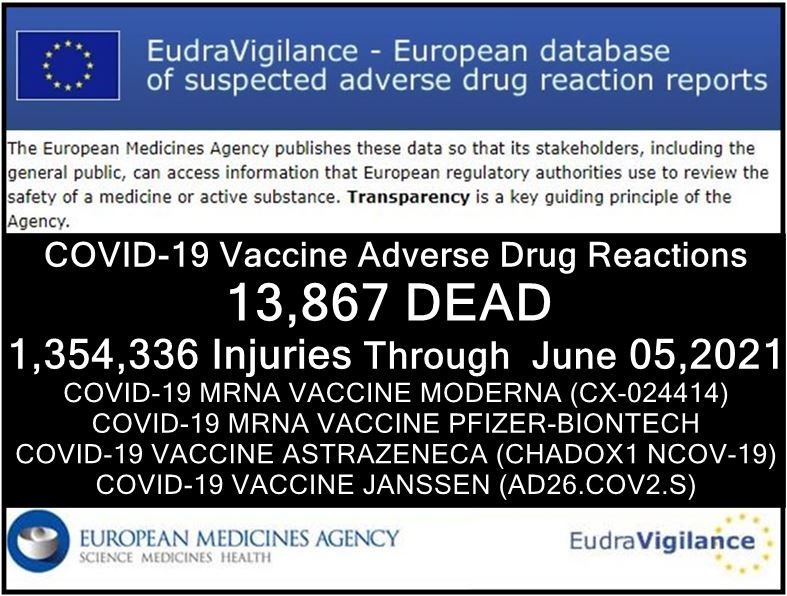
Worldwide Massacre Continues: 13,867 DEAD and 1,354,336 Injuries in European Database of Adverse Drug Reactions for COVID-19 Shots .., Views : 1,679
*These totals are estimates based on reports submitted to EudraVigilance. Totals may be much higher based on percentage of adverse reactions that are reported. Some of these reports may also be reported to the individual country’s adverse reaction databases, such as the U.S. VAERS database, and the UK Yellow Card system. The fatalities are grouped by symptoms, and some fatalities may have resulted from multiple symptoms.
*****
The European database of suspected drug reaction reports is EudraVigilance, which also tracks reports of injuries and deaths following the experimental COVID-19 “vaccines.”
Here is what EudraVigilance states about their database:
This website was launched by the European Medicines Agency in 2012 to provide public access to reports of suspected side effects (also known as suspected adverse drug reactions). These reports are submitted electronically to EudraVigilance by national medicines regulatory authorities and by pharmaceutical companies that hold marketing authorisations (licences) for the medicines.