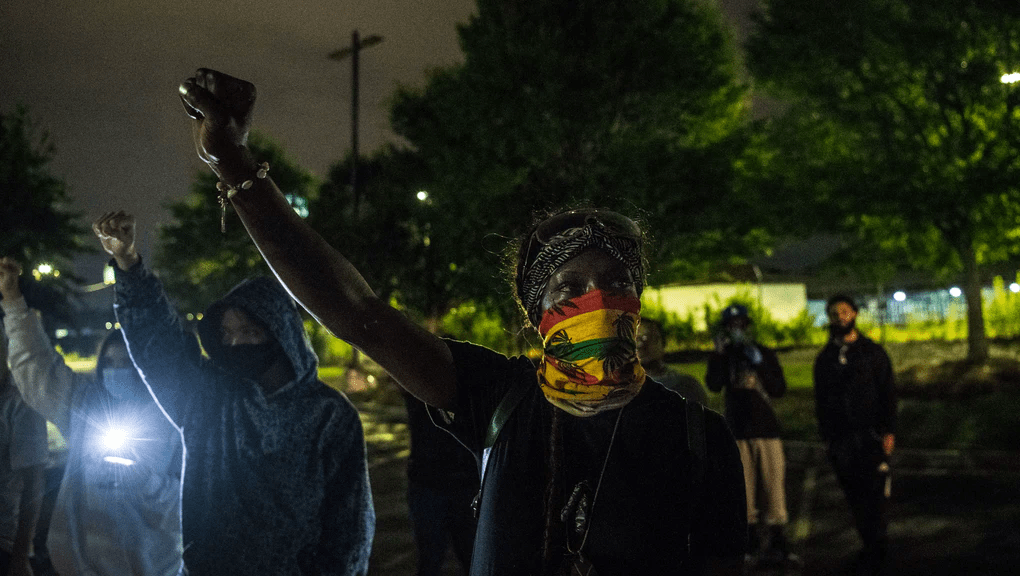
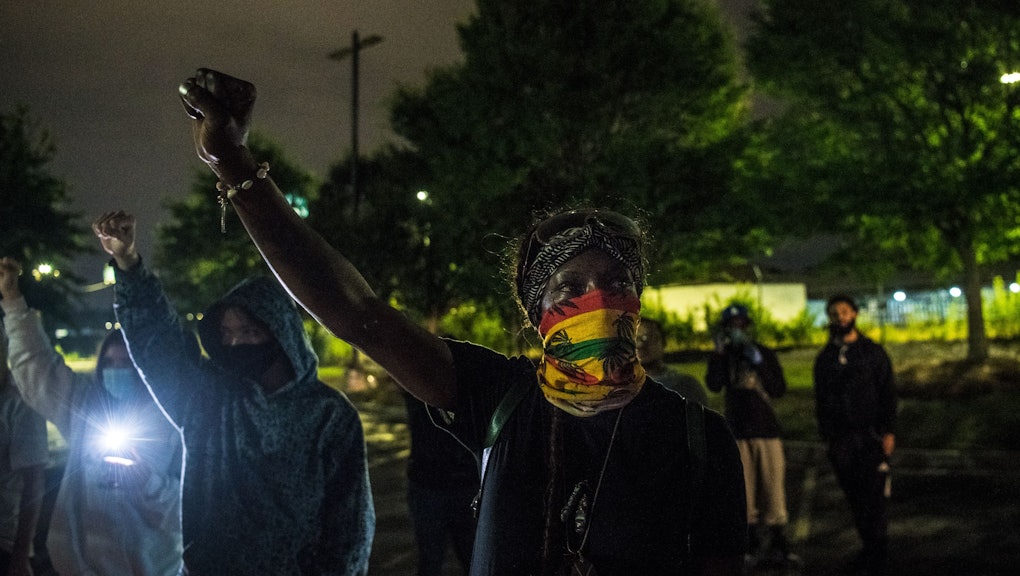
With a series of uprisings gripping the United States, President Trump has not hidden his disdain for protesters. Beyond his threats to Minneapolis protesters and questionable executive orders, Trump has timeandtimeagain directed his ire at one particular group: “anarchists.” Trump’s constant invoking of anarchists to describe all protesters generally is a calculated attempt to delegitimize ongoing struggles — that much can clearly be seen in one of Trump’s tweets from earlier this week, where he wrote that protesters in Portland and Seattle were “actually … sick and deranged anarchists and agitators.”
Kimberly Jones gives a powerful, eloquent speech that needs to be heard by everyone, she explains in detail why this is happening (racism across 450 years) and the difference between protesting, rioting and looting in 2020. End Racism Now! #BLM Kimberly Jones social contract is the person whom John Oliver Last Week Tonight featured on his show. If you want to support her and she should be supported and is the co-author of I’m Not Dying With You Tonight,
The immediate knee-jerk reaction to Trump’s baiting is to often argue that the people taking to the streets in Portland — a city that has been under siege by mysterious federal agents — and Seattle are merely “protesters” and not “anarchists.” But remember the old saying: A broken clock is right twice a day. Trump may not be honest in his portrayal of anarchists, and he certainly does not have a clear view of the ongoing protests, but to deny anarchists’ presence altogether would be just as bold of a lie as the president’s.
Anarchists have been involved in protests across the country since the current social justice movement began in May. Rather than deny that anarchists exist, it’s more useful to acknowledge that in the middle of an insurrection summer best defined by a pursuit for Black liberation, Black anarchists are key to sustaining many of the ongoing uprisings. And while Trump may be out to scapegoat anarchy, Black anarchists are not allowing the president to scare them away from the work that has to be done.
It shouldn’t be a secret, though it still seems to be, that neither of the two World Wars were started (or desired) by Germany, but were the creation of a group of European Zionist Jews with the stated intent of the total destruction of Germany.[1][2][3][4][5][6][7]
However, that thesis is not the purpose of this essay and I will not expand on it here, but the content should prove to the average reader that World War I certainly fits this description.
The main purpose of this essay is to demonstrate not only that ‘history repeats itself’ but that the history being repeated today is a mass grooming of the Western world’s people (but most especially Americans) in preparation for World War III – which I believe is now imminent.
In 1940, these European Zionist and media owners (hiding behind the stage-set of the UK government) initiated what they called an “anger campaign” with the stated cause of “instilling personal hatred against the German people and Germany”, the related parties pleased that the original 6% of the British population that ‘hated Germany’ increased to over 50% by the end of the campaign, and it didn’t stop there. The radio waves were full of descriptions of the “cruelty and blackness of the German soul”.[8] There were articles in the British newspapers advocating the “systematic extermination of the entire German nation” to be carried out after the war ended. /continues below..
… ……. ……….. ……. ….. just fill in the dotted line whatever lies you can imagine to claim your prize as a True Blue Amerikkan and qualify with Honours as a disgusting, sexist, bullying, racist, climate destroying, elitist, greedy, male, blackmailing, cheating, lying, patriarchal, narcissistic, warmongering, spoiled, corrupt, incompetent, white, infantile, xenophobic TRUMP SUPPORTER…. WOW
**********************************************
Thus, after victory over Germany, every person of German extraction was to be executed and the nation of Germany itself to disappear forever. Those executions were actually begun – Eisenhower’s Death Camps, followed by the Morgenthau Plan, both of which eventually failed. The methods of “instilling personal hatred” of Germany was perhaps too successful. The anti-German hysteria became so severe that King George V had to change his German name of ‘Saxe-Coburg’ to ‘Windsor’, and relinquish all his German titles.
It wasn’t only the US and UK where this hatred of Germans was being propagated. In countries all around the world, the media spread the same message of hatred against Germany and the Germans. Teams of ‘specialists’ were following the same script in most other nations, all instilling massive hatred for the Germans who were in every nation vehemently portrayed as evil incarnate, this nature stemming merely from the fact of their being of German origin.
In Brazil, anti-German demonstrations and riots consumed the country, with German businesses being destroyed and Germans being assaulted and killed. In almost every nation, the German-language press and use of the German language completely disappeared during the war from fear of reprisal, as did all German schools and most businesses.
None re-opened. Brazil initially was determined to remain neutral, but a newly-created university student union was co-opted and used with such great effectiveness that within a year Brazil declared war on Germany.[9] In Brazil, the US, Canada and Australia, many names of towns, streets, foods, were changed to eliminate their German origin.
Throughout the world, as in the US, false wartime propaganda was used during both World Wars to incite entire populations into an irrational hatred of everything German, even to the extent of powerful media recommendations that the entire German race be exterminated – in all nations.
With all of this and much more, America was a hotbed of hatred for the entire German population. After the Second World War, Germany was widely accused of using propaganda against the Jews, while our history books have airbrushed out the massive and unspeakably evil storm of worldwide hate propaganda against Germans by the Jews prior to and during both World Wars. Details below.
The Origins of Mass Manipulation of the Public Mind
Many years ago, the Jewish-American political commentator Walter Lippmann realised that political ideology could be completely fabricated, using the media to control both presentation and conceptualisation, not only to create deeply-ingrained false beliefs in a population, but also to entirely erase undesirable political ideas from the public mind. This was the beginning of not only the American hysteria for freedom, democracy and patriotism, but of all manufactured political opinion, a process that has been operative ever since.
Lippmann created these theories of mass persuasion of the public, using totally fabricated “facts” deeply insinuated into the minds of a gullible public, but there is much more to this story. An Austrian Jew named Edward Louis Bernays who was the nephew of Sigmund Freud, was one of Lippmann’s most precocious students and it was he who put Lippmann’s theories into practice. Bernays is widely known in America as the father of Public Relations, but he would be much more accurately described as the father of American war marketing as well as the father of mass manipulation of the public mind.
Bernays claimed “If we understand the mechanism and motives of the group mind” it will be possible “to control and regiment the masses according to our will without their knowing about it”. He called this scientific technique of opinion-molding the ‘engineering of consent’, and to accomplish it he merged theories of crowd psychology with the psychoanalytical ideas of his uncle Sigmund Freud.[10][11]
Bernays regarded society as irrational and dangerous, with a “herd instinct”, and that if the multi-party electoral system (which evidence indicates was created by a group of European elites as a population control mechanism) were to survive and continue to serve those elites, massive manipulation of the public mind was necessary.
The terrible accounts of the torture of people in police custody at an unofficial detention site in Turkey, related by multiple victims in court hearings, reveal how the religious and ideological conviction of the Turkish regime nurtures a dangerous jihadist, xenophobic mindset in the country’s main law enforcement agency, Nordic Monitor reported.
Amid the fear of Turkey’s possible withdrawal from the Istanbul Convention, a Council of Europe treaty designed to prevent violence and domestic abuse against…
“I found it quite bizarre to hear the mindset that held, ‘You are prisoners of war, your possessions are our spoils, your wives, your daughters are also our wives, remove your [wedding] rings,’ because these are statements of the ISIS [Islamic State in Iraq and Syria] terrorist organization,” said Mehmet Sezgin, a 33-year-old first lieutenant who testified in court on December 12, 2017, revealing brutal torture practices at an Ankara Police Department sports hall that was turned into a makeshift detention site in the aftermath of a failed coup in 2016.
Unofficial detention site where brutal torture was inflicted on victims by the Turkish police.
Sezgin had worked in the intelligence section of the Gendarmerie General Command in Ankara, tracking jihadists including ISIS and al-Qaeda militants for years. Yet he was unlawfully detained with no charges, held at an unofficial site for days, tortured and subjected to the ISIS narrative of using women and girls as sex slaves in conflict. He is one of many who experienced the terrible ordeal while in police custody.
The victim statements, corroborated by rare medical reports and photographic evidence, have uncovered how the police officers who systematically tortured detainees often used the narrative employed by ISIS terrorists as justification for inflicting physical and psychological pain on their victims. The recollection of torture and abuse from dozens of victims at the site have also confirmed a growing worry that anti-Semitic and extreme nationalist views, encouraged by senior leadership, took a toll on the 300,000-strong police force in Turkey. Anti-Armenian and anti-Greek slurs were often used by the police in an attempt to vilify and demonize detainees.
It appears the jihadist ideology, promoted by the Islamist government of President Recep Tayyip Erdoğan, helped torturers detach themselves from the reality of seeing their victims as human. In one case a senior general was exposed naked for everybody to see whether he was circumcised, while police were hurling anti-Armenian slurs. Strong anti-Semitic hate speech was directed toward the detainees, with the police often insulting them as ‘the seeds of Jews and bitches.”
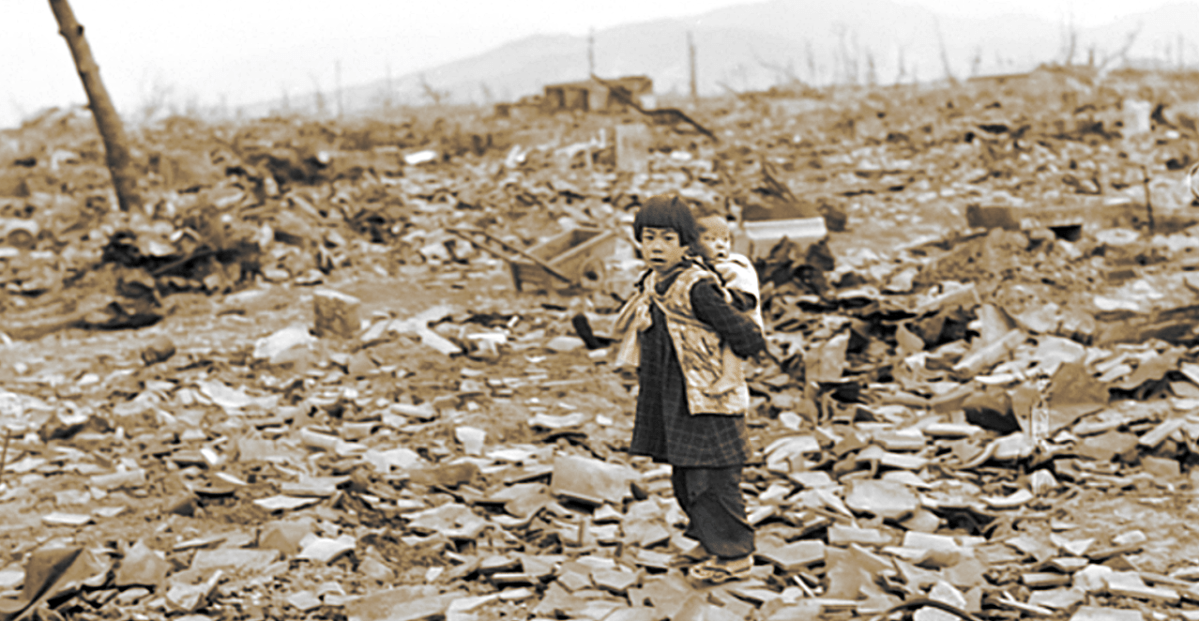
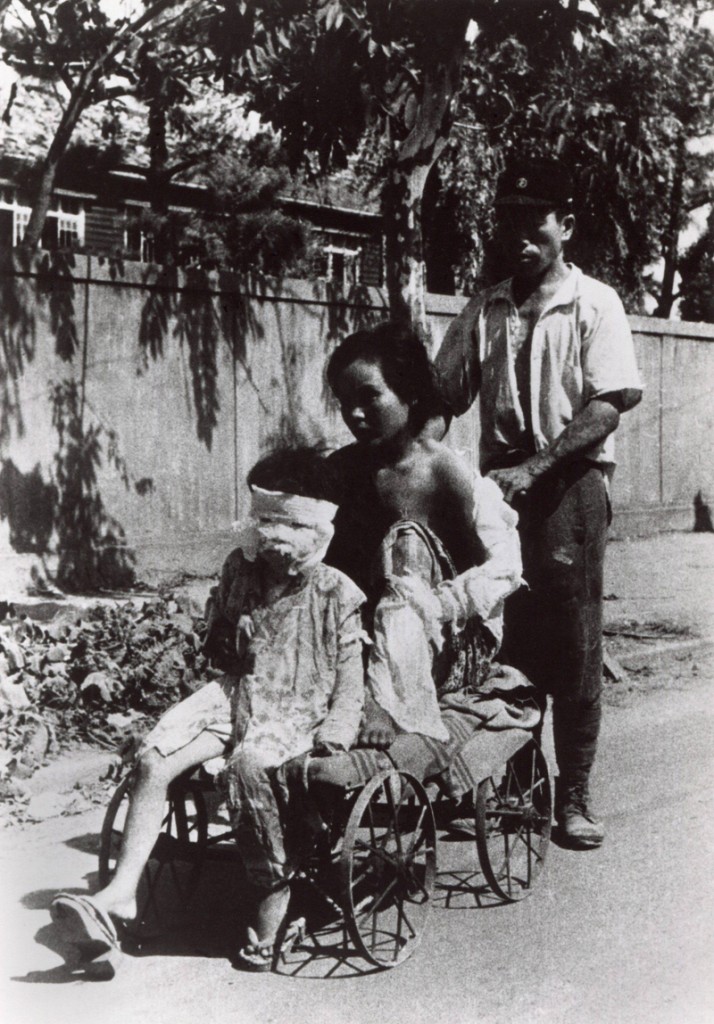
In a major essay to mark the 75th anniversary of the atomic bombing of Hiroshima, John Pilger describes reporting from five ‘ground zeros’ for nuclear weapons – from Hiroshima to Bikini, Nevada to Polynesia and Australia. He warns that unless we take action now, China is next.
When I first went to Hiroshima in 1967, the shadow on the steps was still there. It was an almost perfect impression of a human being at ease: legs splayed, back bent, one hand by her side as she sat waiting for a bank to open.
At a quarter past eight on the morning of August 6, 1945, she and her silhouette were burned into the granite.
I stared at the shadow for an hour or more, then I walked down to the river where the survivors still lived in shanties. I met a man called Yukio, whose chest was etched with the pattern of the shirt he was wearing when the atomic bomb was dropped.
He described a huge flash over the city, “a bluish light, something like an electrical short”, after which wind blew like a tornado and black rain fell. “I was thrown on the ground and noticed only the stalks of my flowers were left. Everything was still and quiet, and when I got up, there were people naked, not saying anything. Some of them had no skin or hair. I was certain I was dead.”??Nine years later, I returned to look for him and he was dead from leukaemia.
“No radioactivity in Hiroshima ruin” said The New York Times front page on 13 September, 1945, a classic of planted disinformation. “General Farrell,” reported William H. Lawrence, “denied categorically that [the atomic bomb] produced a dangerous, lingering radioactivity.”
Only one reporter, Wilfred Burchett, an Australian, had braved the perilous journey to Hiroshima in the immediate aftermath of the atomic bombing, in defiance of the Allied occupation authorities, which controlled the “press pack”.
“I write this as a warning to the world,” reported Burchett in the London Daily Express of September 5,1945. Sitting in the rubble with his Baby Hermes typewriter, he described hospital wards filled with people with no visible injuries who were dying from what he called “an atomic plague”.
For this, his press accreditation was withdrawn, he was pilloried and smeared. His witness to the truth was never forgiven.
The atomic bombing of Hiroshima and Nagasaki was an act of premeditated mass murder that unleashed a weapon of intrinsic criminality. It was justified by lies that form the bedrock of America’s war propaganda in the 21st century, casting a new enemy, and target – China.
During the 75 years since Hiroshima, the most enduring lie is that the atomic bomb was dropped to end the war in the Pacific and to save lives.
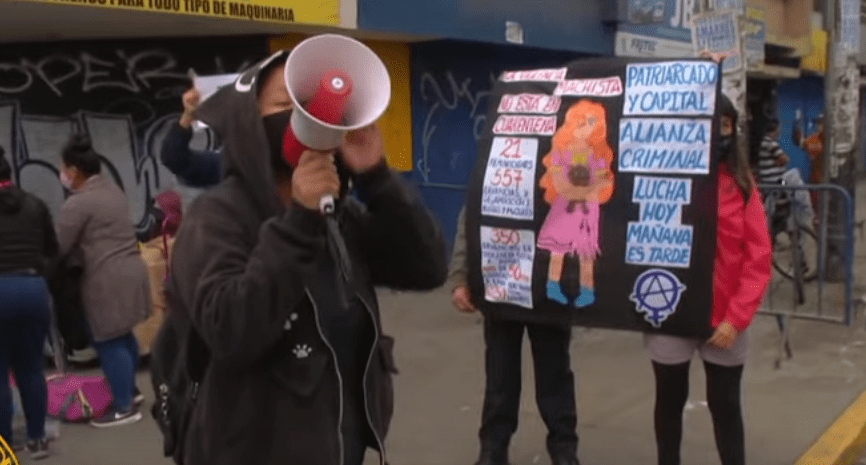
From March 16 through June 30, a total of 915 people – 606 girls and 309 women – were reported missing, according to authorities.
Last week, Peru’s women’s ministry said 1,200 women and girls had been reported missing during the pandemic – a higher figure that included the month of July.
“The figures are really quite alarming,” Isabel Ortiz, a top women’s rights official, told the Reuters news agency on Tuesday.
Rojava. Têkoşîna Anarşîst (Anarchist Struggle) was created at the end of 2017 after the liberation of Raqqa. An interview. Originally published by Anarchists Worldwide. Anarchists worldwide: From Latin America we have been following with attention and special interest what is happening in Rojava and Syria. First of all, could you explain the formation of the Battalion…







![Passengers practice social distancing as they stand in line before entering the airport in Lima, Peru [File: Sebastian Castaneda/Reuters]](https://www.aljazeera.com/mritems/imagecache/mbdxxlarge/mritems/Images/2020/8/5/49d152686e1f4c1082571bc4db85f808_18.jpg "Hundreds of Peru women, girls gone missing during virus lockdown")