


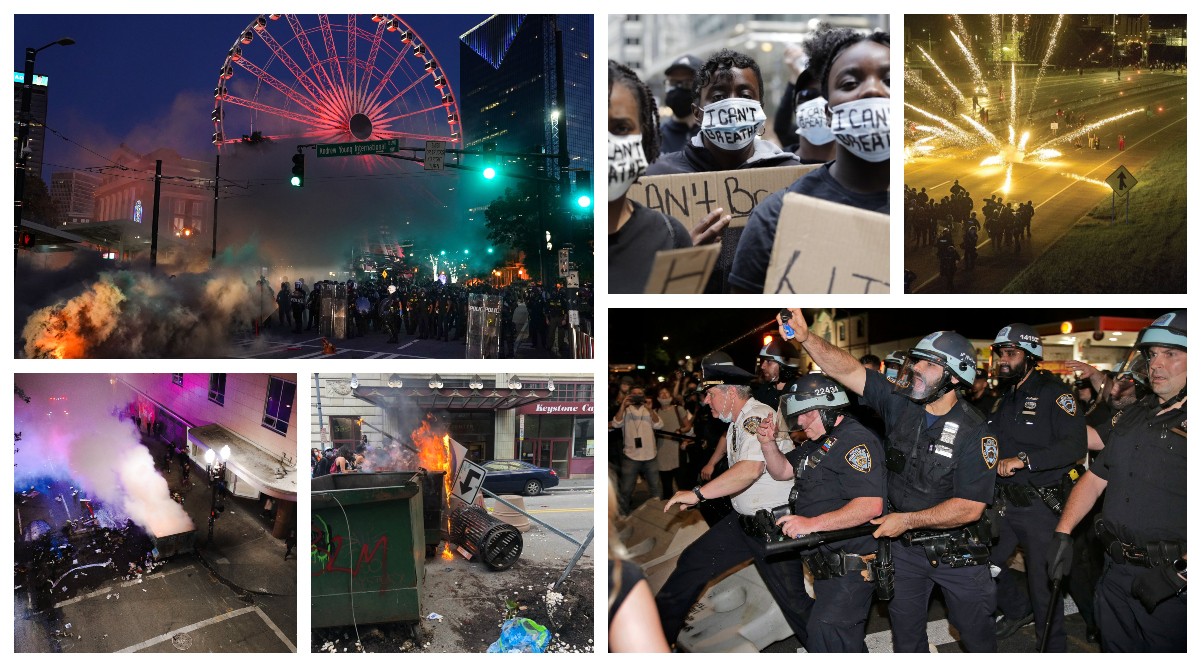
collage shared from Unicotn Riot
from —CrimethInc. Ex-Workers Collective, with thanls… pics added.
3,762 total views, 498 views today on Its Going Down
Police reforms post-Ferguson haven’t led to lower numbers of police killings. CrimethInc. asks – what would it take to stop them?
We’ve reached a breaking point. The murders of George Floyd—and Breonna Taylor, Tony McDade, and the other Black people whose lives were ended by police just this month—are only the latest in a centuries-long string of tragedies.
But in the context of the COVID-19 pandemic, when the state is openly treating Black communities as a surplus population to be culled by the virus, the arrogance and senselessness of the murder carried out by Officer Derek Chauvin crossed a line. Supported by hundreds of thousands across the US and beyond, the people of Minneapolis have made it clear that this intolerable situation must end, no matter what it takes.

Since the Ferguson uprising of 2014, considerable attention has focused on racist police killings in the United States. Reformers of many stripes have introduced new policies in hopes of reining in the violence. Yet according to the Police Shootings Database, the police killed more people in the US last year than in 2015. If police killings are continuing or even increasing despite widespread public attention and reform efforts, we need to revisit our strategy.
How can we bring an end to racist police murders once and for all?
Criminal Charges and Civil Lawsuits
It’s widely known that the chances of individual officers or departments suffering real consequences for killing people, especially Black people, are next to nothing. It makes sense that protestors and grieving families often demand criminal charges against murderous cops—the US criminal legal system offers no other model for “justice,” and by refusing to press charges, the authorities show how little they value Black lives.
But locking ordinary people in cages doesn’t prevent anti-social activity—and considering that police violence is legitimized by exceptional laws and powerful institutions, this deterrent seems to be even less effective for police. Johannes Mehserle, the officer who murdered Oscar Grant in Oakland in 2008, was one of very few police to serve prison time; yet the 2018 killing of Joshua Pawlik and many other police murders in the region suggest that this precedent has not deterred Bay Area police from fatally shooting people.
Nor do lawsuits seem to make a difference. The family of Justine Damond received a $20 million settlement after her murder by Minneapolis police—an extremely rare occurrence, likely related to the unusual circumstance of a Black male officer killing a white woman. But forcing the city’s taxpayers—some of whom suffer police violence daily—to shell out millions to pay for their murderous activity doesn’t work to stop police killings.
If it did, George Floyd would still be alive.
Civilian Review Boards and Police Accountability Measures
Minneapolis already has a civilian review board, but this didn’t prevent Chauvin from killing George Floyd. In fact, the review board had failed to impose consequences for any of the eighteen previous complaints made against Chauvin. It also didn’t prevent the murders of Justine Damond, Jamar Clark, or any of the other people killed by the city’s police.
Police commissioners themselves are now calling for oversight and accountability, likely in hopes of preventing further rioting. This shows how little threat such measures pose to their power.
Continue reading “What Will It Take to Stop the Police from Killing?”


