“I conclude that the 11 months under conditions of solitary confinement (regardless of the name given to his regime by the prison authorities) constitutes at a minimum cruel, inhuman and degrading treatment in violation of article 16 of the convention against torture,” Juan Mendez, UN special rapporteur on torture. Continue reading “Manning was tortured..Dismiss the charges NOW”
English: Demonstration in front of Sydney Town Hall in support of Julian Assange, 2010, December 10 (Photo credit: Wikipedia)
Ray McGovern, June 21, 2012 Barring a CIA drone strike on the Ecuadorian embassy in London, WikiLeaks founder Julian Assange’s sudden appeal for asylum there may spare him a prison stay in Sweden or possibly the United States. Assange’s freedom now depends largely on Ecuadorian President Rafael Vicente Correa Delgado, a new breed of independent-minded leader like Venezuelan President Hugo Chávez.
Correa has been a harsh critic of U.S. behavior toward Ecuador and its Latin American neighbors as well as an outspoken fan of WikiLeaks. Atypically for the region, Ecuador is not a major recipient of U.S. economic or military aid, so Washington’s leverage is limited. This suggests that the Ecuadorian government may decide to defy Washington, accept Assange’s request for asylum, and have him flown to Ecuador pronto.
In which case, most British “justice” officials will probably say good riddance and breathe a sigh of relief — literally. They have been holding their noses for weeks against the odor of their obeisance to U.S. diktat, after the British High Court rejected Assange’s argument that he should not be extradited to Sweden.
Although Swedish “justice” officials have not charged Assange with any crime, they insist that he be extradited to face questions resulting from allegations by two women of sexual assault. This is widely — and in my view correctly — perceived as a subterfuge to deliver Assange into Swedish hands to facilitate his eventual extradition to the U.S. to face even more serious charges for publishing classified information highly embarrassing to Washington.
There have been persistent reports that Assange has been the target of a secret grand jury investigating disclosures of classified U.S. documents allegedly slipped to WikiLeaks by Army Pvt. Bradley Manning. A leaked 2011 email from Fred Burton, a vice president of the private intelligence firm Stratfor, informed colleagues that “we have a sealed indictment on Assange,” but that claim has not been confirmed. Manning, however, is facing a court martial for allegedly leaking U.S. documents to WikiLeaks.
Giving the Brits the Slip
Interesting, is it not, that Assange — just days before he was to be extradited to Sweden — was able to (I guess) slip out of his ankle monitor, sneak through the cordon of bobbies on watch at the estate where he was under house arrest, dodge other bobbies and security chaps, and hit pay dirt inside the Ecuadorian embassy.
There is no denying that Assange is a clever chap. But unless you think him some kind of Houdini, there has to be some more likely explanation as to how he slipped through the various police checkpoints and walked into the embassy, which is located behind the popular Harrods department store in London.
Were the British security forces all out for tea? Or were they just as happy to have the Assange case — and all the pressure from Washington — focused elsewhere?
Certainly, the British had enough clues that, in extremis, Assange might attempt to make it to the Ecuadorian embassy. In late November 2010, Ecuadorian Deputy Foreign Minister Kintto Lucas publicly offered Julian Assange residency in Ecuador, saying that Ecuador was “very concerned” by information revealed by WikiLeaks linking U.S. diplomats with spying on friendly governments. Continue reading “Julian Assange’s Artful Dodge”

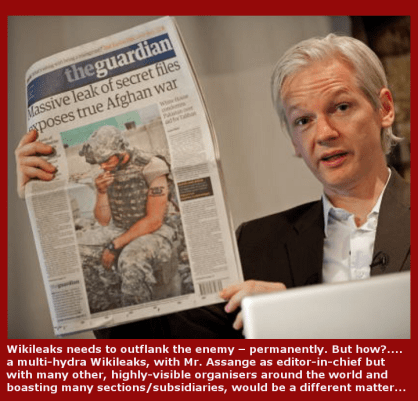 With Bradley Manning, the US soldier accused of leaking war crimes, admitting to certain charges, together with the news of CIA interference in Ecuador to get rid of President Rafael Correa, some may argue that the end game is in sight for Julian Assange, editor-in-chief of Wikileaks. Unless, that is, the US can be outflanked by opening up a new front… Continue reading “Is Wikileaks doomed?..How we could save it.. Plan B.”


 The Free