
 Rosemary Gonzalez was murdered in 2009, the victim of a war that ended in 1996. One day, 17-year-old Rosemary said good-bye to her mother Betty, walked out of their small house on the outskirts of Guatemala City and was never seen alive again.
Rosemary and Betty lived together in the poor neighborhood of Barcenas, under the constant shadow of violence. Across Guatemala, nearly 5,000 women have been killed in the past decade, attacked for the simple fact of being women. The women of Barcenas know well this fear—they live at the epicenter of this crisis.
In Guatemala, generations of women have faced murderous violence, but at its core is war. Now, the same dynamic is emerging in Iraq.
The Latin American women’s movement has given this crisis a name: femicide. It is defined by various forms of gender-based violence against women, including murder, and characterized by impunity for perpetrators and a lack of justice processes for victims. It occurs in conditions of social upheaval, armed conflict, violence between powerful rival gangs and militias, rapid economic transformation and the demise of traditional forms of state law enforcement.
For Guatemalan women, particularly those who are young, poor or Indigenous, the war against them continues — and Rosemary is one of its victims.
Young women in Rosemary’s community of Barcenas have few options other than backbreaking work in themaquilas (sweatshops) for meager pay. After long shifts, they walk home at night, looking over their shoulders for the attack they know could come at any moment…..
In Iraq, the U.S. invasion in 2003 also triggered a surge in violence against women. The overthrow of the Ba’ath regime ended decades of nominally secular rule, in which women consolidated certain human rights gains. The U.S. occupation brought to power Islamists whose vision of the world hinged on a fundamentalist policing of social roles for women.
Grassroots Responses
In Guatemala, a grassroots organization called the Women Workers’ Committee has created an oasis of safety for women and girls. They organize workshops and community watch groups to help
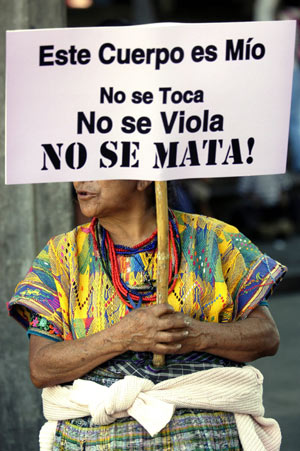
women know their rights to life, health and decent work and to enhance their safety. They provide crucial counseling for traumatized women and girls and legal services for families of murdered women. Guatemalan women have learned a bitter lesson. The crucible of war allowed violence against women to become entrenched in communities. Femicide has become the “new normal,” something women must think about every day.
read much more HERE http://www.peacewomen.org/news_article.php?id=3830&type=news
Guatemala’s long history of slaughter by US and local ‘white’ fascist rulers
“School of the Americas Watch is where I first came across the involvement of the Zetas with the cartels. Then I saw a website by Mothers of the murdered young women of Juarez accusing the Zetas of being involved in the torture killings of their daughters. The saddest part of all is that Guatemalan Kaibiles, notorious death squads trained by US Special Forces and known for disemboweling pregnant Mayan women in Guatemala and Chiapas at Acteal, also have been working for the cartels as many of them mutinied as well for more money. “Both Zetas and Kaibiles have been hired as mercenaries in Iraq. Kaibiles were even hired as UN Peacekeepers in the Congo! So called Peacekeepers have been killing and raping in Haiti, the Congo and Bosnia.” There is more information:
http://www.militaryphotos.net/forums/showthread.php?t=77215
 The Free