
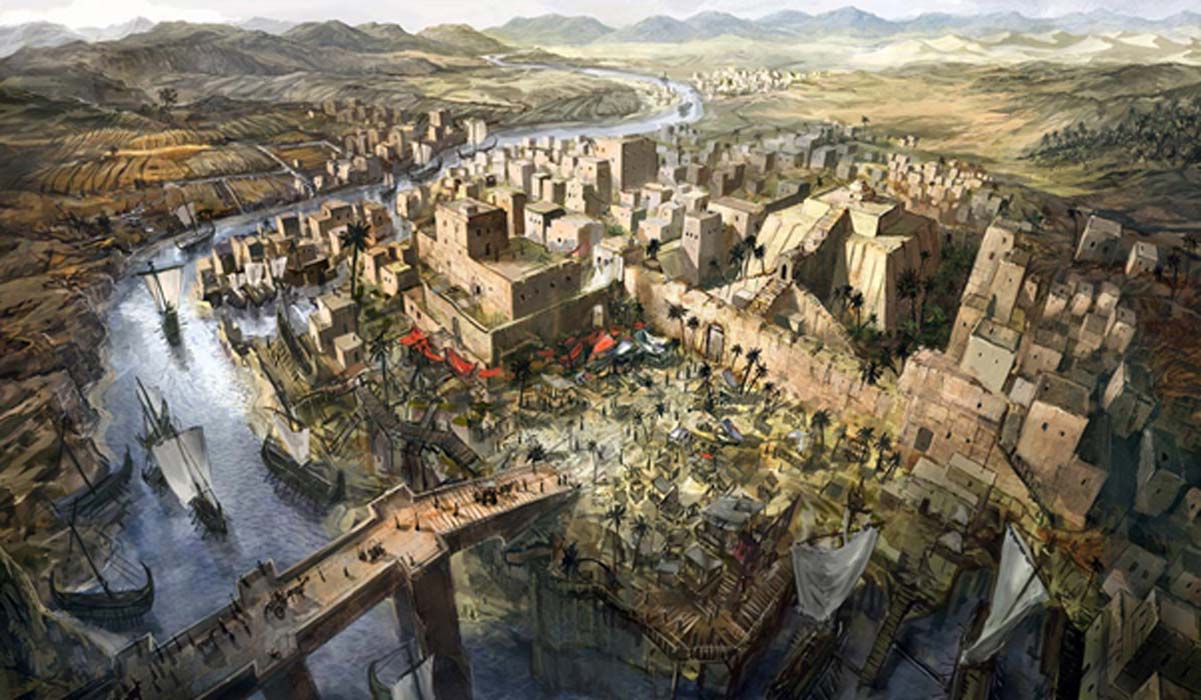
 Ancestral Tiwanaku Society celebrated
In the Mesopotamia rooms at the British Museum there are no depictions of warriors or warfare, chariots or combat, clubs or swords – for nearly four thousand years.
By Gregory Sams .. shared with thanks … There is a remarkable discovery that has not yet emerged from our renewed interest in ancient civilization. Yet few remark upon this glaring omission from the relics and records we dig up and discover.
I first recognized its absence at a visit to the British Museum, and made a point of going back a few years later for another check. Their Mesopotamian rooms begin at 6500 BC, and as you wander through the exhibits and look at the artifacts and
As for kings and rulers, there was a single image thought to be a king because it looks like he’s wearing a crown. And what is this king doing? He is feeding flowers to sheep.
Thriving Ancient Cities with No Ruling Elite?
Around 2700 BC the first inter-city state dispute turned into what could be termed a war. Little is known, other than that the Sumerians made off with the weapons of the losing Elamites.
Things went downhill from there and within a few centuries a psychopath named Sargon of Akkad murdered the existing king, seized power, and conquered 21 thriving and successful cities in Mesopotamia, cities that had operated without top down control by a ruling elite, but by bottom up organization – something at which people naturally excel.
He obliterated the city of Kazalla when it resisted, encouraging total compliance from the rest, and called the process “unification,” titling himself Sargon the Great. He started an unfortunate trend.
The Root of War
Some assume that humans had been slaughtering each other since the beginning of time rather than cooperating with each other, and that the first war in 2700 BC was simply the first one recorded, since writing had only recently appeared.
But the evidence discovered to date does not support the assumption, and writing was widely believed to have arrived with taxation. Taxation is what pays for standing armies and warfare, with our earliest written history telling us how many chickens farmer Fredi brought to market.
So, what does this mean? Why is this non-discovery so important? How did humans manage to live in cities and trade with each other, enjoying life much as we do today, without rulers? After all, aren’t death and taxes supposed to be immutable facts of life? Death may be, but taxes are no more than a recent invention in most of the world.
Palaces and Monuments Built with the Blood of Slaves
Since writing began, almost all the recorded history of the world tells us of top-down control by rulers demanding a proportion of everybody’s productivity in order to support their elevated work-free lifestyle.
We marvel at the great palaces and monuments that survived the collapse of empires and rulers throughout the world, rarely bewailing the fact that so many millions of ordinary human lives like yours and mine were sacrificed to create them, or destroyed at the time of their overthrow.
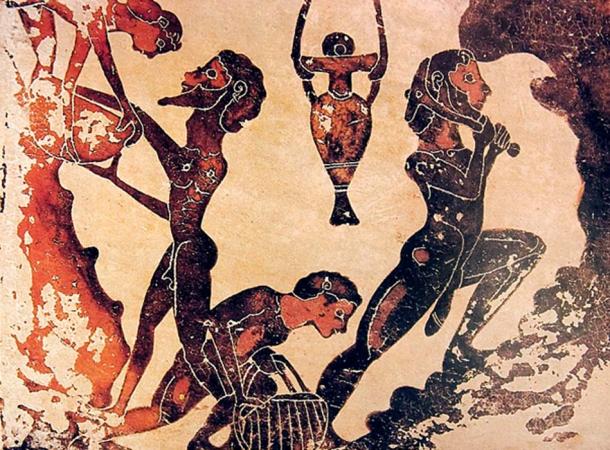
Palaces and monuments were built on the back of slaves and lower-class civilians (public domain)
Tiwanaku Flourished Without a Ruling Hierarchy
We think, based on our limited history (as written by the conquerors) that war, conflict, and top-down control are the natural order for humanity. It is important to recognize that it has not always been so. Aymaran New Year at Tiwanaku
The great Tiwanaku Empire of South America flourished for six centuries with no need for, or evidence of, a ruling hierarchy with weapons, soldiers, and armies of conquest.
Though they had no written language we know they flourished in what is now Bolivia, Peru, and Chile between 300 AD and 1000 AD, with some suggesting that their culture may have extended many thousands of years deeper into the past. Their power came not from swords or clubs but from a highly desirable civilization with a religion based upon Sun worship. 
Agricultural and social skills were key to Tiwanaku power, as well as their knowledge of how to brew alcohol from maize, and make psychedelic drugs from local plants. These were generously administered at the great festivals that were integral to Tiwanaku life. People did not need force to encourage them into such a union.
The Tiwanaku enjoyed trade and commerce, religion, art, sculpture, ceramics, textiles, irrigation, fashion and a highly integrated and cooperative social structure. In short, they maintained an equitable sustainable civilization for longer than did the Roman Empire, and organized it from the bottom up without the need of kings and military structures.
We are community animals by nature, blessed with high intelligence. Living together should not be a difficult task but a joy. When Tiwanaku civilization eventually collapsed it came about not by conquest but by climate change, after decades of prolonged drought.
The ancient site of Tiwanaku in Bolivia (public domain)
Cooperation and Peace Were a Way of Life
Without writing, there is scant evidence of how early civilization functioned, or proof it was ruled by coercive force. Without the evidence of conquest and weaponry, so apparent in subsequent ages, it seems probable that cooperation and peace were more commonplace than conflict and slaughter.
Perhaps excavations at Gopekli Tepe and other ancient sites will shed more light on the subject. Though we know that Egypt enjoyed civilization before it was unified around 3000 BC, we know little about life in that period – nobody thought it necessary to keep records.
The Peasant Communes
If we fast forward to more recent, and recorded, history we discover that hundreds of medieval cities managed to kick out the lords or dukes or kings who taxed them, taking management into their own hands. A classic example was 14th century Florence, a city of 90,000 that was run from the bottom by so-called “peasant communes” in which the bakers, architects, jewelers, bankers, doctors and builders were not titled nobles.
They all belonged to trade guilds ensuring quality and safety for their customers, and did all the things we think require top-down rulers to initiate (apart from waging war). In 1340, there were eight thousand children of both sexes in primary schools, with four universities servicing six hundred in higher education. 
There were thirty small hospitals with over one thousand beds in total. It worked, and perhaps it is no coincidence that Florence was the engine of the Renaissance. We are clever enough to get along together without a shepherd and sheepdogs directing.
In Ditmarschen, a free republic of farmers enjoyed significant autonomy for over four centuries until 1559, when it was finally invaded (it is now part of northern Germany). They had successfully repulsed an army of 12,000 sixty years earlier with a hastily-formed peasant’s army just 1000 strong. My maternal ancestors originated in that area.
No Coercive Rule
Might I suggest, in closing, that one of the greatest discoveries we could seek from the study of ancient civilization is the ongoing non-discovery of evidence for coercive rule by a select group possessing weapons and men trained to use them.
We have been on this planet, as “modern humans,” for at least 100,000 years and, depending upon location, rule by force has existed for anything from a few hundred to less than five thousand years. 
It is not a “natural” way to govern humanity and, despite all the hard evidence left by those who followed in Sargon’s chariot ruts, it is important to recognize that we are looking at a very small segment of ancient human history, which dominates because of its enduring giant construction projects. I close now with an extract from my current book, and readers may take comfort in the closing sentence.
Claims are often made for the civilizing effect of having rulers and empires, citing the patronage of the arts and the ability of an iron hand to keep things stable enough for culture to develop.
Yet the world is full of magnificent ruins from civilizations past—the temples, statues, and fortresses remaining as monuments to the pomp and paranoia of rulers past. Had the Iron Age known dynamite, it is unlikely that even these would be left behind.
![The State Is Out of Date: We Can Do It Better de [Sams, Gregory]](https://images-eu.ssl-images-amazon.com/images/I/513Ue1t7cGL.jpg) also by Gregory Sams.. ‘The State is Out of Date’… Kindle: 3.22 euro see details “Gregory Sams’
also by Gregory Sams.. ‘The State is Out of Date’… Kindle: 3.22 euro see details “Gregory Sams’
review.. I haven’t read this book beyond the free pages, but suspect that Sam may be more interested on Sun worship than Class War! – mike gilli, The Free
review..”The State is Out of Date” is a book of immense importance that also happens to be immensely readable. ……. The State IS out of date. We all know it. Now here’s the proof and the route map that gets us out of this mess.” -Graham Hancock, author of “Fingerprints of the Gods”

 The Free
Reblogged this on The Most Revolutionary Act and commented:
*
*
The great Tiwanaku Empire of South America flourished for six centuries with no need for, or evidence of, a ruling hierarchy with weapons, soldiers, and armies of conquest.
LikeLike