The video above features Collette Martin, a practicing nurse who testified before a Louisiana Health and Welfare Committee hearing December 6, 2021.1,2 Martin claims she and her colleagues have witnessed “terrifying” reactions to the COVID shots among children — including blood clots, heart attacks, encephalopathy and arrhythmias — yet their concerns are simply dismissed.
Among elderly patients, she’s noticed an uptick in falls and acute onset of confusion “without any known etiology.” Coworkers are also experiencing side effects, such as vision and cardiovascular problems.
Martin points out that few doctors or nurses are aware the U.S. Vaccine Adverse Events Reporting System (VAERS) even exists, so injury reports are not being filed. Hospitals also are not gathering data on COVID jab injuries in any other ways, so there’s no data to investigate even if you wanted to. According to Martin:
“We are not just seeing severe acute [short term] reactions with this vaccine, but we have zero idea what any long-term reactions are. Cancers, autoimmune [disorders], infertility. We just don’t know.
We are potentially sacrificing our children for fear of MAYBE dying, getting sick of a virus — a virus with a 99% survival rate. As of now, we have more children that died from the COVID vaccine than COVID itself.
And then, for the Health Department to come out and say the new variant [Omicron] has all the side effects of the vaccine reactions we’re currently seeing — it’s maddening, and I don’t understand why more people don’t see it. I think they do, but they fear speaking out and, even worse, being fired … Which side of history will you be on? I have to know that this madness will stop.”
Martin also states she believes the hospital treatment protocol is killing COVID patients. Doctors agree that it’s “not working,” but that “it’s all we have.” But “that’s simply not true,” she says. “It’s just what the CDC will allow us to give.”
What the VAERS Data Tell Us About COVID Jab Risks
I recently interviewed Jessica Rose, Ph.D., a research fellow at the Institute for Pure and Applied Knowledge in Israel, about what the VAERS data tell us about the COVID jabs’ risks. As noted by Rose, the average number of adverse event reports following vaccination for the past 10 years has been about 39,000 annually, with an average of 155 deaths. That’s for all available vaccines combined.
I don’t particularly have much to offer in the way of thoughtful analysis of last year, but there’s a few moments I think deserve to be remembered. There have been various end-of-year round-ups, I’ll try to collect a few decent ones at the end of this, but this one is mine.
“What happened on 21st March was an outpouring of rage against the violence of the police. The crowd fought back after police officers attacked the crowd with batons and riot shields. Pepper spray was used indiscriminately, people were charged with police horses. The protesters fought back, seizing police riot shields, helmets and batons to defend themselves. By the end of the evening several police vehicles had been set on fire.
We are writing this statement to make clear that we support those who have been sentenced today, and that we are proud of them for fighting back. We need to be ready to defend ourselves against the police, and stand with those facing repression and criminalisation.”
Rogan & Malone: The Most Important Interview of Our Time
In an interview with Joe Rogan, Dr. Robert Malone, mRNA vaccine expert and outspoken critic of our pandemic response, delivered a powerful message to the world. Yes, it’s three hours long, and yes, it’s worth every minute.
Joe Rogan, host of the widely viewed “Joe Rogan Experience” podcast, interviewed one of the world’s most qualified and unbiased individuals about the safety and efficacy of the COVID-19 vaccines now deployed upon nearly 4 billion human beings.
Something monumentally important happened in the closing days of 2021.…….
It was supposed to be the forum where the world finally committed to emissions reductions sufficient to meet the target of the Paris Agreement: […]
The majority of the capitalist class recognises in theory that climate change is a grave problem requiring drastic steps, but each government wants to protect their own capitalists.
The Australian Government is conspicuous by being on the list of bad guys at almost every point. Liberal Prime Minister Scott Morrison signed up to a commitment to net zero emissions by 2050, but only after almost every other advanced country (and many others) had done so.
However, its 2030 target is only a 26-28% reduction from 2010 levels. Even without lifting a finger it will definitely achieve 30% and possibly 35%, so the refusal to promise more is ferociously political.
In sectoral negotiations, 40 countries promised to phase out coal, but Australia was not one of them. More than 80 countries pledged to cut methane emissions by 30% by 2030, but Australia was not one of them. Neither were other big natural gas producers (and therefore producers of fugitive emissions) Russia and Iran.
And the Australian Government’s zeal in funding expansion of fossil fuel exports is joined with almost matching enthusiasm by the main opposition party, Labor. Similar stances have been taken by other large fossil fuel exporters, including Canada.
There is a reason for this. Capitalist governments exist, first and foremost, to protect the interests of their own capitalist class. There is enormous sunk capital invested in fossil fuels and the industries using them as inputs.
Governments want to protect these investments to the maximum extent possible. So when a problem is identified and specific action is required to address it, the governments that could make the biggest difference are ones least likely to sign up to it.
And on the rare occasion where a government that can make a big difference signs up (as Brazil has over attempts to stop deforestation), it is an attempt at fishing for international assistance that won’t have to be returned if targets aren’t met.
Professor Ian Jones, a virologist at the University of Reading, alluded to the fact that catching the new Omicron variant is better than getting a vaccine, as the strain functions like a “natural vaccine.” The new variant is reportedly too mild to cause any real harm other than a few sniffles and a snotty nose but generates enough antibodies needed for lasting immunity.
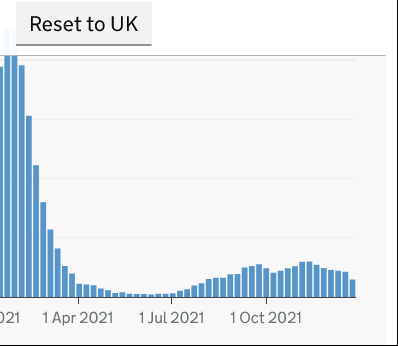
Covid figures available on 23rd Dec 21 had just 40 deaths on English Death Certs, ZERO in Wales and no info for Scotland. https://coronavirus.data.gov.uk/…
The more jabs that people receive, the more difficult it will be for people to develop this type of natural immunity, even if their immune system still works post-vaccine, that is.
An estimated 3,270,800 people in England, or about 6% of the population on average, had Covid in the week ending 31 December. The week before the figure was about one in 25.
But the last Covid figures available, on 23rd Dec, had just 40 deaths on English Death Certs, ZERO in Wales and no info for Scotland. https://coronavirus.data.gov.uk/…
40 deaths is too many (though more may have died with flu if it wasn’t largely displaced by Covid: see Disappearance of influenza). Also the 40 Covid deaths on 23rd Dec should be seen in context of 13.014 deaths from all causes in the same week https://www.ons.gov.uk/…
According to reports: “Some experts claim the benefits of extra jabs are minimal because their primary purpose – preventing deaths and hospitalizations – has barely waned after a year and several Covid variants, effectively meaning boosters are adding to an already high base level immunity.”
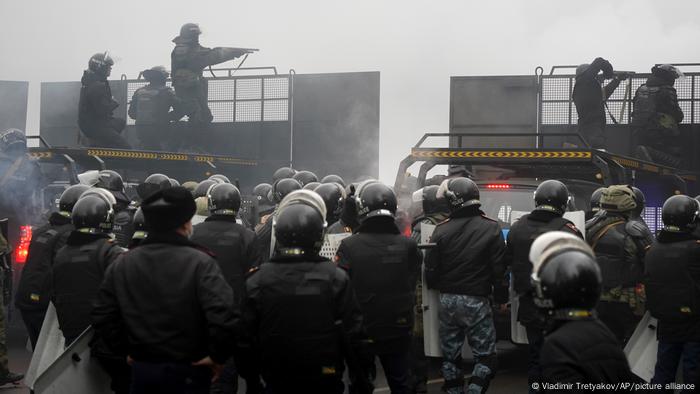
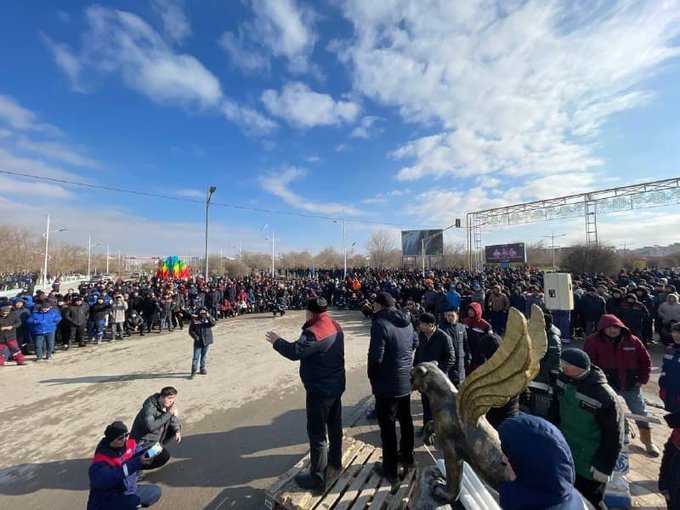
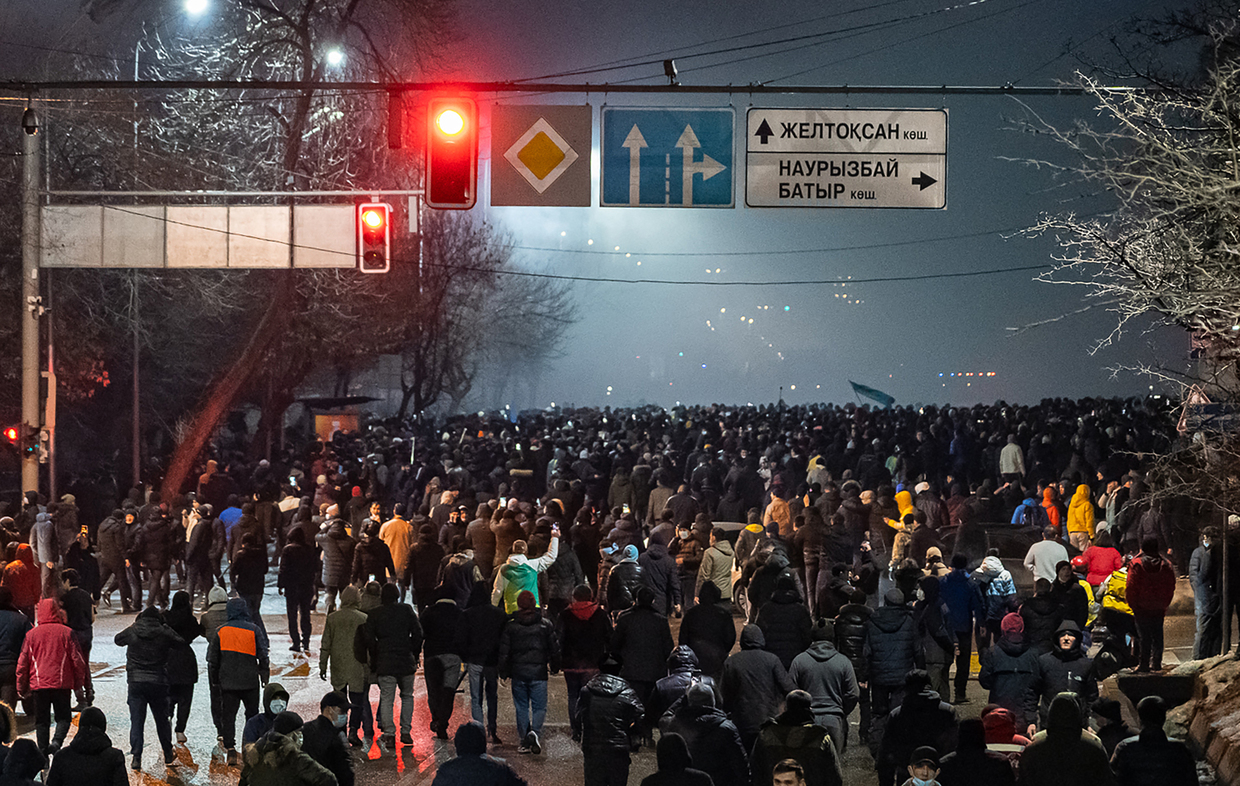
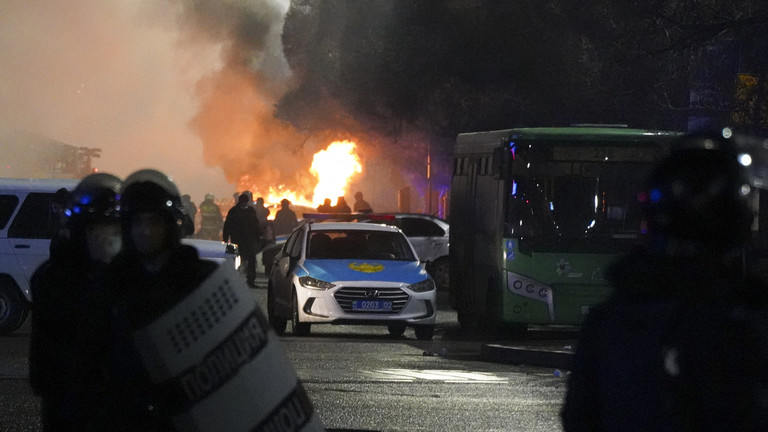
A full-scale uprising has broken out in Kazakhstan in response to the rising cost of living and the violence of the authoritarian government. Demonstrators have seized government buildings in many parts of the country, especially in Almaty, the most populous city, where they temporarily occupied the airport and set the capitol building on fire. As we publish this, police have recaptured downtown Almaty, killing at least dozens of people in the process, while troops from Russia and Belarus arrive to join them in suppressing the protests.
We owe it to the people on the receiving end of this repression to learn why they rose up. In the following report, we present an interview with a Kazakhstani expatriate who explores what drove people in Kazakhstan to revolt—and explore the implications of this uprising for the region as a whole.
“What is now happening in Kazakhstan has never happened here before.
“All night there were explosions, police violence against people, and some people burned police cars, including some random cars. Now people are marching around the main streets and something is happening near Akimat (the parliament building).”
-The last message we received from our comrade in Kazakhstan, an anarcha-feminist in Almaty, shortly before 4 pm (East Kazakhstan time), before we lost contact.
#Kazakhstan Armed security forces are in Almaty. There are also armoured personnel carriers, armoured vehicles, and military trucks. Local police reported that dozens of protesters had been killed. pic.twitter.com/h1vzkKdmjV
We should understand the uprising in Kazakhstan in a global context. It is not simply a reaction to an authoritarian regime. Protesters in Kazakhstan are responding to the same rising cost of living that people have been protesting all around the world for years. Kazakhstan is not the first place where an increase in the cost of gas has triggered a wave of protests—exactly the same thing has happened in France, Ecuador, and elsewhere around the world, under a wide range of administrations and forms of government.
What is significant about this particular uprising, then, is not that it is unprecedented, but that it involves people confronting the same challenges we confront, too, wherever we live.
The urgency with which Russia is moving to help to suppress the uprising is also significant. The Collective Security Treaty Organization [CSTO], a military alliance comprised of Russia, Armenia, Belarus, Kazakhstan, Kyrgyzstan, and Tajikistan—with Russia calling the shots—has committed to sending forces to Kazakstan. This is the first time that the CSTO has deployed troops to support a member nation; it refused to assist Armenia in 2021, during its conflict with Azerbaijan.
It is instructive that the war between Armenia and Azerbaijan did not warrant CSTO intervention, but a powerful protest movement does. As in other imperial projects, the chief threat to the Russian sphere of influence (the “Rusosphere”) is not war, but revolution.
Russia has profited considerably from the civil war in Syria and the Turkish invasion of Rojava, playing Syria and Turkey against each other to gain a foothold in the region. One of the ways that Vladimir Putin has held on to power in Russia has been by rallying Russian patriots to support him in wars in Chechnya and Ukraine. War—perpetual war—is part and parcel of the Russian imperial project, just as war has served the American imperial project in Iraq and Afghanistan. War is the health of the state, as Randolph Bourne put it.
Uprisings, on the other hand, must be suppressed by any means necessary. If the millions of people in the Rusosphere who languish under a combination of kleptocracy and neoliberalism saw an uprising succeed in any of those countries, they would hurry to follow suit. Looking at the waves of protest in Belarus in 2020 and in Russia a year ago, we can see that many people are inclined to do so even without hope of success.
In capitalist democracies like the United States, where elections can swap out one gang of self-seeking politicians for another, the illusion of choice itself serves to distract people from taking action to bring about real change.
In authoritarian regimes like Russia, Belarus, and Kazakhstan, there is no such illusion; the reigning order is imposed by despair and brute force alone. In these conditions, anyone can see that revolution offers the only way forward.
Indeed, the rulers of all three of those countries owe their power to the wave of revolutions that took place starting in 1989, bringing about the fall of the Eastern Bloc. We can hardly blame their subjects for suspecting that only a revolution could bring about a change in their circumstances.
Revolution—but for what purpose? We cannot share the optimism of liberals who imagine that social change in Kazakhstan will be as simple as chasing out the autocrats and holding elections. Without thoroughgoing economic and social changes, any merely political change would leave most people at the mercy of the same neoliberal capitalism that is immiserating them today.
And in any case, Putin will not give up so easily. Real social change—in the Rusosphere as in the West—will require a protracted struggle. Overthrowing the government is necessary, but not sufficient: in order to defend themselves against future political and economic impositions, ordinary people will have to develop collective power on a horizontal, decentralized basis. This is not the work of a day or a year, but of a generation.
updates.. Latest figures put police deaths at 13, with 2 claimed to be beheaded. No numbers available for demonstrators deaths, but videos show dozens of bodies.A bloody battle is now likely as troops face newly armed insurrectionists .. see also> The Uprising in Kazakhstan / news and interview.. from Crimethinc
Analyst Alya Kaminskaya does not rule out that the Pentagon seeks to use the Almaty hub [in Kazakhstan] as “an air base for reconnaissance and military cargo planes.”
She points out that Almaty International Airport no longer belongs to Kazakhstan since news emerged in May that 100% of its shares had been purchased by Turkey’s TAV Airports Holding.
“There are two alarming things. First, Turkey is an active NATO member and the Americans can benefit from Ankara’s geopolitical expansion into Central Asia and the South Caucasus,” military expert retired Colonel Shamil Gareev noted.
“Second, the Almaty airfield is the closest to China. For the US and Turkey, it is a perfect facility for reconnaissance activities related to China, including the Xinjiang Autonomous Region,” he added.
According to military expert, retired Lieutenant General Yuri Netkachev, “another reason why the US and Turkey are interested in Kazakhstan is because the country produces about 40% of the world’s raw uranium.
“If the Americans and Turks manage to put Russia and Kazakhstan at odds with each other, they might try to choke off our Strategic Nuclear Forces. So, Russia should better maintain friendly relations with Kazakhstan in order to be able to protect its strategic interests,” the expert noted.
Updates: CSTO invokes Article 4, sends troops to Kazakhstan
The world news is uniformly vague about what constitutes the opposition and who the insurgents are.
Much is made of the word nationalist but no information is available about the role of pro-Western, pan-Turkic and Islamist factions, for example. The government Kazinform news site has been offline all day.
Whatever the nature of the steadily mounting conflict in Kazakhstan, whether it was initially and remains motivated by rising gasoline prices as in France with the emergence of the Yellow Vest movement three years ago, or whether it has been or is developing into something more political – and geopolitical – will become more clear in the ensuing days.
Irrespective of the nature and course of the situation, this background information is worth recalling.
Kazakhstan is one of three nations bordering both Russia and China, far the most strategically vital one at that. (The others are Mongolia and North Korea.)
It is a member of the Commonwealth of Independent States, Collective Security Treaty Organization, Eurasian Economic Union, Shanghai Cooperation Organization and the recently-renamed Organization of Turkic States as well as the Organization for Security and Co-operation in Europe.
It also was among the first former Soviet states to join a NATO partnership program, the North Atlantic Cooperation Council, in 1992, which was replaced by the Euro-Atlantic Partnership Council/Partnership for Peace in 1997, Kazakhstan remaining a member in the new structure. In 2006 it became the first non-European nation to sign an Individual Partnership Action Plan with NATO.
It borders three of the other four former Soviet Central Asian republics: Kyrgyzstan, Turkmenistan and Uzbekistan. There were uprisings and so-called color revolutions in Kyrgyzstan in 2005 and 2010 and in Uzbekistan in 2005. Kazakhstan accounts for some 60% of Central Asia’s gross domestic product, mainly through natural gas and oil production and distribution.
DW is an anti/Russian German state media
Kazakhstan is one of five Caspian Sea littoral states, along with Azerbaijan, Iran, Russia and Turkmenistan.
It hosts the Baikonur Cosmodrome, leased to Russia, the world’s largest space launch facility.
Kazakhstan’s border with Russia, at 7,000 kilometers, is the longest continuous land border in the world.
In several significant ways it is a geostrategically vital country. It could be argued that there is none more so.








 The Free