Resistance takes root: Preparing for Capitalist Collapse

Resistance takes root in Barcelona

Hilary Wainwright explores the deepening organization of the Indignados movement

The Catalans have a phrase: ’em planto’. It has a double meaning: ‘I plant’, or ‘I’ve had enough’. At end of the huge 15 October demonstration of Indignados (‘outraged’) in Barcelona – the papers put it at around 250,000 – we were  greeted with an impromptu garden under the Arc de Triomf, the end point of the march. Campaigners for food sovereignty had planted vegetables in well-spaced rows, ready for long term cultivation.

The point was partly an ecological one. But the surrounding placards indicated that the gardeners also intended it to make a symbolic point about the broader significance of the march. ‘Plantemos’ declared a large cardboard placard, meaning: ‘we plant ourselves’ – ‘we stand firm’. Mariel, who was dressed as a bee – essential to flourishing horticulture and now facing pesticidal destruction – explained that the activists who organised the garden were part of the agro-ecology bloc on the march. The march as a whole had several layers of self-organisation that became apparent at certain moments. There were three main focal themes – all issues on which active alliances had come together over recent months: education (yellow flags), health (green flags) and housing (red flags).
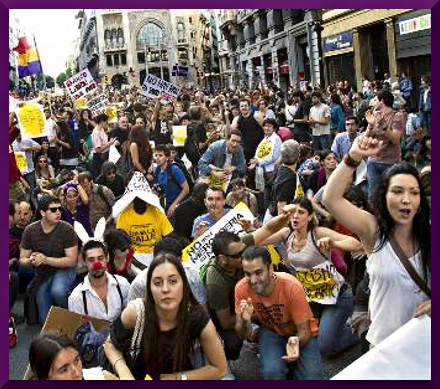
As we approached the Arc de Triomf, someone on a loud hailer announced that the different directions in which those following each of the themes should go, guided by an open lorry carrying the appropriate flag. The idea was that the demonstration would end not with speeches to the assembled masses, on the traditional model. Instead, the plan was to hold assemblies to discuss action and alternatives to cuts and privatisation.

News came through later in the evening that two of these assemblies had taken action, leading an occupation of a third hospital – two that were making redundancies had already been occupied the day before the demonstration. They had also squatted a large unoccupied building to turn it into housing for ten families. Evictions have become a focus of intense conflict in Barcelona as the numbers grow every day.

As well as clusters around themes, it was the regular neighbourhood assemblies, feeding into an occasional assembly of assemblies, that were the organism that gave the demonstration its impressive life.

The neighbourhood assemblies emerged in early summer this year, following the birth of the Indignados movement in the occupations of the squares of Spain and Greece. As the occupation of Barcelona’s Plaça de Catalunya reached its peak towards the end of May and the general assembly in the square began to plan its future, the locus of organised indignation spread to the neighbourhoods – sometimes reviving or connecting with pre-existing neighbourhood associations, sometimes building on quite dense social bonds. For example, the assembly from Sant Andreu, a predominantly working-class neighbourhood in the north of the city, marched for over an hour to reach the demonstration, proudly announcing their assembly on their yellow T-shirts.

Like many on the demonstration, they brought handmade placards. Some of their slogans were specific: ‘education is not for sale’, ‘for high quality education; against the cuts’. Others were more general: ‘nothing to lose; all to gain’, ‘the system is dead, the people are alive’. A lot of these homemade banners highlighted the exhaustion and corruption of the political system, one offering a reward: ‘2,000 euro for an honest politician’. Abstentions could be high in November’s elections.

There is disillusionment too with trade unions. In the occupation of the square earlier this year, it was not only parties that were not wanted, but also the unions. They had been part of a social contract with the government that had let workers down, leading to a fall in wages and weak protection. Most significantly, they showed no concern – and often hostility – to the growing numbers of people, especially among the young, who had no chance of a long term job. Yesterday only the CNT (Confederación Nacional del Trabajo), the union founded by the anarchists and still less bureaucratised than other trade unions, dared show its face.

Interestingly, though, there are signs of workers recovering the confidence to organise in their workplaces as a direct result of the collective action taking place on the streets, and waking up the unions in the process.

Bea recently worked in a call centre. She remembers the fear that made her fellow workers timid and passive. She was impressed that after the occupations of the squares, the call centre workers went on strike over injustices they had previously suffered in silence. ‘It was as if the strength of the example of collective action on the square gave them the confidence, broke through the fear,’ she said.

Where this kind of awakening will lead is unclear. General goals are clearly expressed: real democracy based on popular assemblies in the neighbourhoods, reform of the electoral system for different levels of government, the right of referendums including on the European level, an end to cuts and privatisation of public services, banks and finance under public control, economic development based on co-operation, self-management and a social economy – the list is long and elaborate (see here, for example).

The important, distinguishing feature of this vision of change is that it is not centred on what governments should do. Rather it is a guide to action at many levels, starting with what the people can do collaboratively, through spaces they occupy, resources they reclaim, new sources of power they create. There is a self-consciousness that the creation of far-reaching alternatives will take time. In conversation, the slogans are put in context: ‘we’re going slowly, because we are going far’ is a common saying.

One thing is certain: the energy, creativity and will comes from outside the existing institutions. Bargaining, pressure, people and organisations that bridge the outside and the inside will no doubt be part of the process of change, but the established institutions have lost the initiative. There is no bravado about this. Among those I talked to on our way home from the Arc de Triomf and the improvised garden, there was anxiety as well as elation at the size and success of the demonstration. ‘I feel some people are looking for leaders,’ said Nuria, a translator and free culture activist. But in the many levels of organisation producing this impressive show not only of anger but of serious engagement in creating alternatives, it becomes clear that this is not a ‘leaderless’ movement. It is emerging, experimentally perhaps, as movement where leadership is shared and is learnt – a movement that can grow and flourish as well as stand firm.

Oscar Reyes says

Hilary’s really captured the spirit of yesterday’s march well, but I think her post also goes some way to correcting a lot of the US/anglocentric/major financial centres bias written in round-ups of the global protests. Inspiring as the Wall Street protests are, it is not really accurate to claim (as the Guardian, New York Times and even activist sites like ZNet have it) that these were the spur to rallies that swept the globe.

An initial call was made several months ago: http://15o.democraciarealya.es/ and the most successful of these have been based on concerted organising, not simply the fact that (as Jon Stewart of the Daily Show recently put it, the media dial has turned from blackout to circus).

It’s easy to over-state the “new model of protest” line too (eg. http://www.redpepper.org.uk/birth-of-a-new-movement/ ). There are many novel elements in this, enabled by the internet as well as the re-organisation of global labour– as Paul Mason has pointed out a while ago
http://www.bbc.co.uk/blogs/newsnight/paulmason/2011/02/twenty_reasons_why_its_kicking.html
But in other ways it is all decidedly old-school: unemployment, job insecurity and the defence of a welfare state under threat from a massive austerity programme are spurring protests, coupled with a revolt against a banking system that’s totally out of control.

The Barcelona protest was one of the numerous protests in cities across the state of Spain, from 60,000 in Sevilla in the south to over 10,000 reported in Vigo in the north-west, and 500,000 in the capital Madrid. There are reports and videos (in Spanish) at
http://www.kaosenlared.net/noticia/estado-espanol-recopilacion-cronicas-videos-manifestaciones-15-o
and
http://madrid.tomalaplaza.net/2011/10/15/la-indignacion-sale-a-las-calles-de-todo-el-mundo-el-15-de-octubre/

The story of the three strands of the march that Hilary describes is also worth following. In Nou Barris, a working class suburb in the north of Barcelona, the march was followed by the occupation of an empty block of flats, with the aim of housing families that had faced home repossessions:
http://acampada9barris.wordpress.com/2011/10/16/okupat-un-bloc-de-pisos-buits-a-nou-barris/

A 6,000-strong march continued to the Hospital del Mar, in support of a revolt against health cuts that had already seen the occupation of two hospitals on the night before the main demonstration. The symbolic end point saw a huge die-in, with activists playing dead to symbolise “the deaths of many citizens” as a result of savage health sector cuts.
http://www.setmanaridirecta.info/noticia/la-columna-de-sanitat-la-mes-concorreguda-de-totes

Thousands more formed an education block that met up with an occupation at the Geography and History Faculties of the University of Barcelona, located close to the centre of the city. Once there, convened an assembly to discussed the demands of the recently formed Platform for a Public University (Plataforma Unitària per la Universitat Pública), which has called for a strike on 17 November.
http://www.setmanaridirecta.info/noticia/2000-persones-una-assemblea-la-facultat-del-raval-reocupada-la-columna-vermella

Lesley Wood says:

Terrific article! Thanks for filling in the gaps. I was there, but the crowd was way too big to get a sense of what was going on!

Oscar says:

really insightful article….makes great sense to those who weren’t there…this huge demo…and all the rivers of resistances it symbolises…is trully inspiring …it looks like the ‘indignados’ movement is here to stay and hopefully irreversible.

NOTE . This blogger is preparing a series of cool posts,  on Squat Centers,  Free Universities,  Circus Squats, Anarchist roots, Food and consumption  CoOps,  Mutual Aid Networks, Alternative Banking, etc.  in the Catalunya area.. watch this space for updates….

27 Oct.. Dia d’acció..Day of Action vs.Banks

Our Lives or Their Profits.... Day of Action against the Banks

27 Octubre: Dia d’acció contra els bancs i caixes

 Hola companyes i companys indignats, des de el 15M del Vallès occidental proposem que el dia 27 d’octubre sigui un dia ple d’accions a tot el territori català contra bancs i caixes. /

The Sabadell Assembly have cxalled  Day of Action in all Catalunya against the Banks this Thursday 

/ La idea és que cada localitat o cada territori s’organitzi per fer l’acció, aquesta proposta ja va ser aprovada a l’ assemblea general que es va realitzar a Plaça Catalunya.
The idea es that each area organizes to do an action. This proposal was already approved in the General Assembly held in Plaza catalunya.
Salut i revolució

INDIGNADES SABADELL


Stalinists and 15K police defend Greek ‘Parliament’..why bother?

Protecting the parliamentarians from the people they pretend to represent were fifteen thousand riot cops. But remarkably, supporters of the misnamed Communist Party of Greece formed their own battalion, protecting the police and the parliament from those they called “provocateurs” and even, bizarrely, “anarcho-fascists”. They might as well have accused demonstrators of being meat-eating vegetarians!

5000.000 demonstrators. The communist/stalinist union, anxious as ever to control, joined the police to save the Parliament. This allowed sold out politicians to rubber stamp still more cuts to try and save the European Capitalist System. There followed another Battle of Syntagma Square., with one unlucky stalinist dying of a heart attack.

Let Capitalism FALL. Lets make something Better!

This was the biggest general strike and demonstrations yet against the Greek austerity measures, which continue to drive many into desperate poverty, destitution and even death.

An estimated 500,000 took to the streets of Athens  – which is the equivalent of 2.5 million in London. It was the largest show of Greek working class power since the fall of the military junta in 1974.

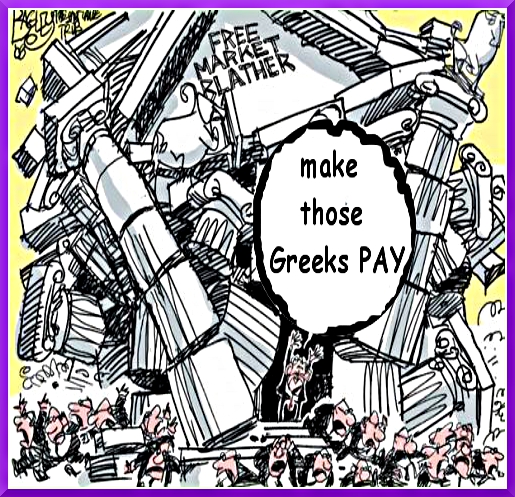
But so long as the profit system remains in place, true power remains in the hands of the ultra-wealthy international financiers. As the debt bubble reaches the point of bursting, there are divisions within this group. Despite the divisions, the combined will of the international financiers in represented by the so-called ‘troika’ – unelected European Commission bureaucrats, the European Central Bank, and the International Monetary Fund. The politicians who meet in the Greek parliament are therefore the puppets of the troika, though they still try to maintain a facade of democracy by arguing a bit before they pass each round of austerity cuts.

Protecting the parliamentarians from the people they pretend to represent were fifteen thousand riot cops. But remarkably, supporters of the misnamed Communist Party of Greece formed their own battalion, protecting the police and the parliament from those they called “provocateurs” and even, bizarrely, “anarcho-fascists”. They might as well have accused

demonstrators of being meat-eating vegetarians!….

”When there’s a Revolution..The PARTY puts it down”
And yet – from the perspective of the trade union bureaucrats who form the base of that party – it makes a lot of sense. Though their website talks of

''if THEY don't pay then WE won't pay at all, then Humpty Dumpty will fall off the Wall!''

the PASOK government enforcing the will of the “plutocracy” by “fire and sword”, their worst fear is a working class movement that they cannot control, which organises on a rank and file basis, and will not accept sell-out after sell-out…..

The whole of Greek society is now in turmoil. Aside from the events of the last two days, almost every day sees fresh strikes and occupations. In response, the PASOK government is mobilising the military to crush resistance by refuse workers. But perhaps in doing so, it is preparing its own demise, one way or another.

Most economists now talk of a Greek default – or at least a huge debt ‘haircut’ – being inevitable. When this happens, the shockwaves will be felt around the world. Sooner or later, the Greek situation is coming to a town near you, and when it does, the international working class will need to organise itself at a grassroots level, and face down the threat of brutal dictatorship….

Read more HERE…(with thanks)

http://infantile-disorder.blogspot.com/2011/10/decoding-battle-of-syntagma-square-as.html

Eat the Rich: One week of Occupy London

On Saturday 22 October at 1pm in London, the general assembly is geared up to receive a swell of visitors, as many who work are inspired by the camp and plan to come and visit and see what it’s all about. It will be an important test for the assembly facilitators, to hold the camp together as more voices enter the equation…Posted by Jamie Kelsey-Fry

Saturday will mark a week since OccupyLondon claimed its space at the feet of St Paul’s Cathedral. It has been a difficult but utterly uplifting experience for all.

IMF predicts collapse of Capitalism!

People are gravitating to the camp constantly, drawn by what is really still an idea taking shape, but an idea that is already inspiring.

The camp is determined and committed to channelling peoples voices through general assembly and consensus. The aims of the London assembly and others around the world are cut from the same cloth.  We all want to challenge the fundamental assumptions that underlie the world’s political and financial systems, which are failing us at all levels.

It’s an easy criticism to make that the assembly ‘offers no solutions’. Of course not, not yet. But the process of building a movement that asks the right questions, and considers that another world is possible, has begun. The systems of general assembly and consensus can be painstaking but they do mean that all those people involved have their voices heard.

The camp came up with their first statement in 48 hours. It’s now only six days in. I would suggest that if this process of forming a concrete vision of a fairer, safer more just world is anything as erudite as the way the London camp has organised itself, then we are in for something of great value. Perhaps an idea whose time has come.

If you plan to visit, I have no doubt that you will find the camp to be, at the very least, a source of hope. At best, you may find yourself deciding that you belong here, and the next thing you know, you’ll be collecting a sleeping bag and joining a working group. See you soon.

Permaculture at Occupy Wall Street


permaculture design at occupy wall streetLike many of you, I’ve been watching the Occupy Wall Street (and local OccupySTL) protests with fascination. While I know the mainstream media hasn’t gotten too creative in its reporting (once it started reporting), the little bit of digging I’ve done on “on-the-ground” reporting has turned up more than just angry kids, but an ongoing experiment with political participation and governance itself.

Sure, unemployment, income disparity, and the American dream have been at the forefront of the movement… but I wondered early on if environmental sustainability was getting a “place at the table” as this movement forms and grows.

The answer: yes (as I suspected). This morning, I received email from the OWS Sustainability Working Group and Seismologik Media about a short film the latter had produced in partnership with One Pack Productions (unfortunately, embedding Vimeo wasn’t working for me today, so you’ll have to click through). Of course, I’m happy to see permaculture on display at Occupy Wall Street; I’m even happier to see that there’s more than protest going on there, but also experimentation with alternative, sustainable ways to meeting needs (which, of course, is its own form of protest).

Take a look at the film (it’s just under five minutes long), and let us know what you think. What other kids of sustainability experimentation could be going on in the midst of this activism?


World demo news: 350,000+ Occupy Barcelona..

15 O..one of many actions in Barcelona

There was no trouble because the police kept away, though I saw dozens of banks and the stock exchange being

heavily ‘redecorated’. The mainstream paper ‘El Periodico’ estimated 350,ooo participants, an enormous turnout

of every imaginable sector in festival mood and yelling anti Capitalist slogans.

Dozens of other Iberian cities were equally swamped with demonstrators. In Madrid a large empty hotel was occupied to accomodate families evicted for failing to pay impossible mortgages .

El grupo de indignados que ha ocupado esta madrugada el hotel Madrid, en la calle Carretas, tiene intención de “resistir pacíficamente” en el edificio y “cederlo” a la Plataforma de Afectados por la Hipoteca.

Participant numbers. Cifras de asistencia en diferentes ciudades, según van contando las agencias: en Vigo, 10.000 manifestantes; Barcelona: 400.000 según la organización (la Guardia Urbana los cifra en 60.000); Alicante: 10.000; Elche: 2.000; Baleares, 5.000; Vitoria, 3.000.

11.56
En directo: Un grupo de indignados ha ocupado esta madrugada el hotel Madrid, en la calle Carretas

Las protestas han comenzado ya en Asia y Oceanía. Seúl, Tokyo, Hong Kong, Manila, Melbourne, Sydney y Auckland ya han tenido sus concentraciones de protesta. El simpatizante de Annonymous de la foto es uno de los manifestantes que han salido a la calle en Sydney

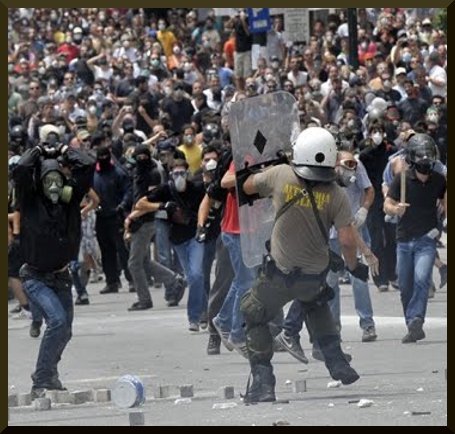
ROME 17.02… 70 injured, 3 seriously as the street battle between Occupiers and fascist police develops in Rome
En directo: Un grupo de indignados ha ocupado esta madrugada el hotel Madrid, en la calle Carretas

La Policía italiana emplea cañones de agua contra los agitadores de Roma. Lanzaron piedras y petardos a los agentes, convirtiendo en batalla campal lo que era una marcha pacífica y multititudinaria.

En Bruselas, 6.000 manifestantes han arrojado zapatos contra la fachada del edificio de la Bolsa. Los activistas han gritado en castellano «¡culpable!»

En directo: Un grupo de indignados ha ocupado esta madrugada el hotel Madrid, en la calle Carretas

Berlin En Alemania ha habido manifestaciones en diferentes ciudades. Las más concurridas han tenido lugar en Berlín y Francfort. En la capital, un grupo de activistas ha intentado sin éxito adentrarse en el Bundestag, el Parlamento alemán. La foto es de AP.

New YorkUnas 2.000 personas del movimiento Ocupa Wall Street han marchado este sábado por el distrito financiero de Neuva York secundando la convocatoria global de protesta de este 15 de

15 Oct Rome. A more typical image than the burning cars.

octubre. Esta es la primera gran marcha del día, que culminará con una concentración en Times Square.

….Al menos 71 arrestados y cerca de 5.000 personas han secundado este sábado en Nueva York la manifestación celebrada en el marco de las marchas a nivel global con motivo del día 15-O que se han extendido a más de 80 países, según ha confirmado el Departamento de la Policía neoyorquina.

London La Policía Metropolitana que hay un solo detenido en las protestas de Londres, informa The Guardian. AHy discrepancias sobre las cifras de participación, la Policía habla de unos mil asistentes y la BBC estima que hay entre 3.000 y 4.ooo manifestantes. La protesta está dividida entre la «zona cero» de la jornada, en torno al edificio de la Bolsa, con quienes logran pasar el cordón policial, y varios cientos que se han quedado fuera, más diluidos, y no siempre bien recibidos por los residentes del barrio


15 Oct. How to Occupy. Download your Guide here..

Occupy! Your guide to the international Occupation Movement

October 13, 2011  (Peoples’ Assemblies) (, , )

An occupation guide out of Santa Cruz and Baltimore that provides an introduction to consensus decision-making, know your rights info, and contextualizes US occupation in the context of recent international uprisings.

The ultra-rich have us by the throats and they’ve had us by the throats for a long, long time.

While the rest of us suffer through a worldwide economic crisis, the people at the top are just getting richer. In a 2011 study, the richest 20% of the country had 85% of the privately held wealth. For the rest of us, nothing’s getting better: the state is closing schools and libraries, rolling back social services, shutting down bus lines and state parks.

But an international movement has sprung up to challenge the foundations of our global system of corporatism and greed. It’s a protest movement qualitatively different from any that has come before, a uniquely 21st century form. It’s a movement without party politics. It’s a movement inspired by the advances of communication that have allowed us to function without authority, allowing every voice to at last be weighed truly as equal. It’s a movement that doesn’t bring a list of demands to the powers that be but instead suggests that we can build a different society.

The wealth that it takes to get us out of this mess is right in front of us—we know because we are the ones who created it. We designed and built the cities. We # y the planes, crunch the numbers, grow the food, write the software, and do everything it takes to keep this society running. All the wealthiest do is sit there and watch their money make more money.

The wealth is right in front of us and yet they tell us there isn’t enough to feed us, to educate us. They’re lying. Maybe they’re lying to themselves, maybe they’re lying to us—it doesn’t matter. They don’t matter. We don’t need them.

We are the 99% and we are more powerful than they’ll ever be.

http://www.indybay.org/uploads/2011/10/12/occupy-imposed.pdf