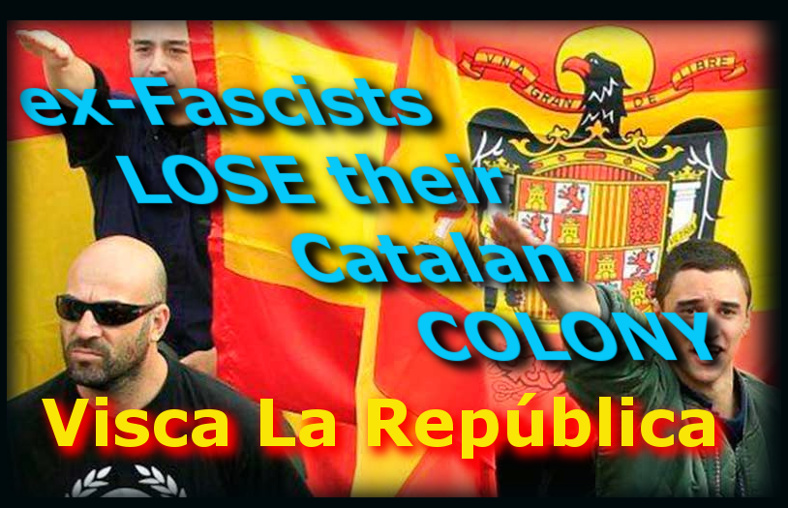
Seems like every State and Authoritarian on the planet is virulently against Catalans complaining about 500 years of macho Spanish colonialism. Of course, because their very own ‘cash cow’ populations could go copy-cat. Rebellion is brewing everywhere as wealth is funneled ever more to the tiny hierarchical elite.
The Spanish Right, unreformed, rabid and clerical have wallowed in repressive robbery and mass murder for centuries. But recently some of the tens of thousands of politicians have been caught with their greedy fat fingers in the public cash box.
No prison, no punishment, of course, but the far right PP almost got voted out. And one way they could keep power was by BLAMING THE CATALANS. For 5 years we have suffered an incessant racist campaign against these hospitable and long suffering people. And now provoking a tidal wave of racist and sexist male violence against them.
Until finally… We want back the democratic Republic your military took from us by murder and massacre. We don’t want your King, appointed by a fascist dictator, or your Constitution, agreed only under the threat of 40 more years of total repression.
Hopefully the blind authoritarianism of the stomping PP nationalists will be the death throes of the imperial mentality,. If not the Catalans will resist, the debts won’t be paid, and the entire economic House of Cards could tumble down.
Then maybe we can build something better in Iberia.
New Joint Declaration from Anarchist Trade Unions
viaJulius Gavroche, with thanks…….. The government of Catalonia declares its independence from Spain; the Spanish government in response dismisses the Catalan government, assumes direct control of the region and declares regional elections for the 21st of December. What happens from hereon in is unknown. Below is a statement from the country’s principal anarchist labour unions before the unfolding of events …
The undersigned organisations, national labour unions, share our preoccupation with the situation in Catalonia, because of the State repression unleashed, because of the decrease in rights and freedoms that this presupposes and will presuppose, and because of the growth of a rancid nationalism that again shows its face in a great part of the country. Continue reading “All Authoritarians Condemn Catalonia : Anarchists call for Revolution”
Franklin Lopez sub.media has gone to Puerto Rico where he is from to help his family and the community clean up after Hurricane Maria
In Puerto Rico, a humanitarian catastrophe continues to unfold 12 day after Hurricane Maria struck the island. Over the weekend, the Pentagon said the percentage of Puerto Rico’s 3.5 million residents without access to clean drinking water rose to 55 percent. Only 5 percent of the island has electricity, while food and fuel remain scarce and about half of the island’s roads are impassable. Continue reading “Autonomous Action Radio Program.. ‘THIS IS NOT FAKE’..”
The CGT anarchist union called the General Strike against repression and for Civil Rights, which has now been endorsed by the ‘Table for Democracy’ including all the major Trade Unions and civil Organisations.The ongoing traffic situation in Tarragona province was described as ‘chaotic’ at 10.00am#3Oct
The Independence Referendum has morphed into a mass rebellion against the neo-fascist central government of thugs and thieves, and is rapidly spreading out of Catalonia around the Spanish State.
Here we try to inform you of minute by minute events with some rough quick translations from the alternative media
General Strike against Repression and for Human Rights. Tuesday 3rd Oct 2017
to be updated ..translator went to the demo
21.00
The King’s Speech.. by his Magnificent Majesty Felipe
The new King came on the telly but instead of acting royal he praised the neo-fascist repression of the PP regime and accused the Catalans of all kinds of shit. Foolish Felipe missed his one opportunity to reunite Spain by ordering the occupying Spanish police thugs home, as his father might have done.
Instead he insulted and branded all Catalans as living in illegality by going against the Constitution. But of course the Spanish monarchy itself is totally illegal, having been APPOINTED BY A FASCIST DICTATOR who illegally destroyed the 2nd Spanish Republic and murdered hundreds of thousands.
From here the Royal Speech looks like another spectacular own goal.
Spanish police move towards the #3O demonstration without their official uniforms. Be aware! @EU_Commission#Catalunya
SUMMARY OF THE SITUATION AT THIS TIME
– Massive protests against the police action of 1-O.
– The PSOE (‘ex socialists’ asks to reproach Sáenz de Santamaría for the police violence.
-Though some big firms are trying o stay open there has been massive an unprecedented support for the strike in all sectors.#3O
-Solidarity demonstrations have been held across the Spanish State and some in Europe. But the EU and various States and Establishment media, including the BBC have come out against Catalonia.
-The main theme of people’s anger seems to have extended from demanding Independence to expelling imported brutal Spanish police and demanding civil and work rights.
– The demonstration is concentrated all the way from the Plaza Universitat and down Via Laietana, moving in the direction Parlament de Catalunya.Although there are also many huge concentrations at different points in Catalonia.
– Barcelona is also without public transport until 17:00 hours. The only 25% and onl till 20.00 Mobility is not guaranteed in the Catalan capital. Public transport in Tarragona and Girona has also been nearly paralysed by the numerous traffic blockades and mass picketing of motorways.Spanish National Police & Guardia Civil are now forces of occupation in Catalunya. #3Oct
– The PP says it will not now apply article 155, Direct Rule over Catlunya because of the lack of political support, but it already has done on a de facto basis..
14:49
The adhesion to the general stoppage by the Barcelona City Council has resulted in the suspension of all institutional acts and the convocation of political bodies, as well as the closure of equipment and services not essential to the functioning of the city. Thus, they have not opened the public civic centers, libraries, play centers, centers of old people, family spaces, equipment of the Institute Sports Barcelona (IBE), museums, theaters and centers of art of public ownership. demonstrators advised any strike breakers to close
80% of the more than 10,000 workers of the Barcelona City Council and their entities and companies are not working on Tuesday, after the council of the Catalan capital has joined the “national strike,” according to the institution. The same sources have indicated that at the moment they do not know how many of these workers have supported the general strike called by the General Confederation of Labor (CGT), the mayor Ada Colau decreed minimum services in the essential services that the City council of Barcelona.
14:34
At 13.10 consumption in the whole peninsular electrical system has been about 1,000 MW lower than last Tuesday, where economic activity was the usual, and not like today that is marked by the general strike called in Catalonia. This difference would be equivalent to stopping a nuclear power plant.
13:47
Click here to see the traffic in the Catalan capital. Not much traffic but heavy delays…Clica aquí 2:00 pm
Thousands of people have entered the Parc de la Ciutadella in Barcelona and are concentrated in front of the Parliament of Catalonia. The firefighters are in the front row and the Mossos d’Esquadra protect the building. Finally, Universities for the Republic and the Committees in Defense of the Referendum have summoned. Parliament of Catalonia / Víctor Yustres
13.25 h.
In Sabadell there is one of the most massive mobilizations that are remembered in the city, according to the local police, there are 25,000 people. The demonstration came out of the Macià Axis about an hour ago and will end before the City Hall. Posters of “I was in our home”, referring to the polling station where the concentrated people managed to push the National Police back. Mass mobilization in Sabadell / Emma Giné #3O
13.05 h.
The pickets manage to close several establishments of Mercadona: in Tarragona, Terrassa, Salt, Vic, some neighborhoods of Barcelona and Balaguer, with tractors, among others. The tractors have managed to close the Mercadona de Balaguer
12.52 h.
In Valls the accesses to the Industrial Estate have been cut at dawn. About 100 tractors from all of the Alt Camp have concentrated on the Cooperativa Agrícola de Valls to organize more actions during the rest of the day. In the morning, news pickets have closed the supermarkets Aldi, Lidl, Mercadona and Carrefour, while the small business have joined massively the Strike call. At 12 noon there was a crowded concentration on the square with the support of a tractor . /Elisenda Trilla
12:45
The multitudinous demonstration in the square of Universitat of Barcelona makes the zone impassable. Torrents of students come on foot from Diagonal and other city campuses. A few hundred adults have joined them along the way. They sing slogans against violence and police repression. In fact, the concentration overflows the square, fills the Gran Via beyond Roger de Llúria (towards Besòs)
12.40 h.
Dozens of tractors start to leave the Sucre de Vic car park towards the confluence between the C-17 with the C-25, the transverse area, at the height of Gurb. / Dolors Pena
Parlament de Catalunya / Víctor Yustres
13.25 h.
The Tractor Army ready to intervene/ Dolors Pena
12.30 Girona, a city of only 98,000
Mass picket Oct 3rd already at 11.00 am at Police HQ in Via Laietana, Barcelona
12.15
In the city of Tarragona, the first pickets began early in the morning, with cuts on the highway and main accesses to the city. The call for concentration has brought together thousands of people who have protested before the Subdelegation of the Spanish government. Finally, the march has followed and passed El Crte Ingles and a Mercadona, which had blinds down. Backing the strike is practically total except for some chains such as Mercadona.#3O
La rambla de Lluís Companys de Tarragona plena a vessar / Comitè en Defensa del Referèndum i l’Autodeterminació a Tarragona
Hundreds have occupied The High Speed Train Station in Girona and stopped the trains.. Centenars de persones ocupen l’estació de l’AVE a Girona i aconsegueixen aturar la circulació de trens
/ Carles Palacio
11.53
Festive atmosphere in Puigcerdà at the border with France, at the Guingueta d’Ix. Roads have been cut by the neighbors. @ 324cat
The biggest demonstration in 35 years , already in the streets of #SantCeloni #Vagageneral # 3OCT pic.twitter.com/8QzhodG1mu – Helena López Vallejo (@ Hlopezvallejo) October 3, 2017
11:49
The ports of Barcelona and Tarragona have paralyzed their activity, both maritime and land, as a consequence of the general strike. From the Port of Barcelona they have pointed out that only minimal services are provided for passage, since the installations have docked two cruisers, and also to handle specific goods, like perishable products.The same happens in the Port of Tarragona, where they are also providing minimum services only for passage, security controls and dangerous goods.The activity is expected to be paralyzed in both ports as a result of the strike, with the exception of the minimum services mentioned.
Some big industries like the SEAT plant in Martorell claim to be functioning with ‘complete normality’.
11:46
The CAPs Public Health Centers are closed by the general strike, except if it is a CUAP of Emergencies.Hospitals are opening just a few emergency rooms.It is not easy to reach either.
11.38
”Different mass pickets are beginning to complicate mobility in Barcelona. Numerous people invade the road in streets that are not yet closed to traffic. The main difficulties: Diagonal, between Gregorio Marañón and Pius XII cut in both directions. Comte d’Urgell, cut between Francesc Macià and London. Restrictions in Aragon and cuts in much of the center of the city (Plaza de la Universidad, Pelai, Plaza de Catalunya, Via Laietana). In the rest, for now, relative normality”. from El Periódico with thanks
11.30
The demo at Police HQ is hotting up. ..Concentracion delante Jefatura Policia Nacional en Via Laietana FOTO FERRAN SENDRA
11. 20 h.
Most shops in Lleida have joined the general strike. The ‘information’ pickets have gone to the Renfe rail station, the Mercadona supermarket and have now they cross the main street asking to close the few shops that are still open. At the same time, a silent concentration is taking place at Mariola’s adult school, one of the polling stations where a person was seriously injured during the police charges during the referendum day. Relatives of the injured person confirm that they “hit him in the back, testicles and arms.” They also claim, however, that “he would return without hesitation.” They thank the people who helped him, “because he would have died here.”#3Oct Concentration in front of Mariola / Joana Soto’s adult school
11:00 p.m. Half a thousand people are concentrated at the gates of the Ramon Llull school in Barcelona, the city’s electoral college that received one of the toughest police interventions during the referendum celebration. The neighbours cut off the Consell de Cent street in the shout of “we are people of peace”, “the streets will always be ours” and “Spanish, manipulative press”. The children of the educational center have wet their hands with colored paint to leave their prints on the road asphalt along with the motto “we are a worthy people.”
11:05
Practically all Catalan schools have closed their doors today after the students did not attend, following the call for a general strike supported by the Government, which yesterday authorized the schools to close if students did not show up for class.
10:37 Tues.3 oct
The main cultural institutions in Catalonia, from the National Theater of Catalonia (TNC), the Museu Nacional d’Art de Catalunya (MNAC), the business committee of the Liceu or the Ateneu Barcelonès have joined the general strike convened in rejection the violent acts of 1-O. The Sagrada Família temple and main tourist attraction of Barcelona, has closed its doors for the same reason, as has La Pedrera de Gaudí and the Barça Museum. It has also joined the Gremi de Llibreters de Catalunya, which “strongly condemns the unjustifiable repression of the police forces of the State and solidarity with the victims.”
people gather outside police station in Barcelona Verneda
10.18 h. Right now there are 57 main roads blocked including the main motorways of Catalunya. L’AP7, l’A2, la C17, la C32 and the NII
Un piquet tallant els dos sentits de la marxa de l’AP7 Sud
10:28
Most of the shops in the city center of Barcelona have dawned closed on Tuesday, following the call for a general strike .La Rambla kiosks, historic bakeries and shops that open every day of the year, have decided to lower their blinds, while some large chains have opened theircafes.Other chains like Desigual, Mango, El Corte Inglés (famous for its far right ownership and defiance of strikes) and Mercadona have decided to open.The chains Bon Preu and Grup Ametller Origin, Bon Área, Keisy and Sorli announced Monday that they would cease their activity.
09.50 h.
Demo called by the CNT outside HQ of the PP ruling party protected by Catalan cops with a cordon set up by the firemen. ”Some 2,000 people have concentrated this morning in front of the PP headquarters in Catalunya, whom they see as the “culprits” of the police action of 1-O.The mobilization has been called by the CNT in the framework of the ‘Stop the country’ on Tuesday under the motto ‘Guilty of labor reform, the militarization of the city and the misery of women workers.The spokesmen of the CNT have read a statement in which they have defended the strike as a rejection of “labor reforms and the continuing loss of rights for the working class added to the concern about the actions of the different repressive bodies of the State.” #3OA Tractor demo closed access to Girona Airport. Passengers continued on foot.
08:40
We update road traffic data: A total of 24 demonstrations cut off the circulation of several roads and highways in Catalonia early this morning, such as several sections of the AP-7 or C-32, and in some cases caused queues of 10 kilometers.
The main AP-7 north/south motorway is completely cut at Girona and 2 more points along with tha main AP2 at Molins de Rei, in both directions of circulation, as a group of neighbors have invaded it with their cars. The B-30 lateral motorway is also cut in Sant Cugat del Vallès, as are some stretches of the Eix Transversal, the C-32 motorway and the main N-340.
The traffic jams are occurring due to the protests of citizens who with their cars and tractors cut the tracks or make slow marches.
This is the case of the A-2, the motorway that goes to Lleida, the neighbors have made a stop with their cars at the height of El Bruc and they are in slow march towards Igualada with the purpose of collapsing the freeway.
Is it reasonable to hope for a better world? Study the cruelty and indifference of governments, the disarray of opposition parties, the apparently inexorable slide towards climate breakdown, the renewed threat of nuclear war, and the answer appears to be no. Our problems look intractable, our leaders dangerous, while voters are cowed and baffled. Despair looks like the only rational response.
But over the past two years, I have been struck by four observations. What they reveal is that political failure is, in essence, a failure of imagination. They suggest to me that it is despair, not hope, that is irrational. I believe they light a path towards a better world.
The first observation is the least original. It is the realisation that it is not strong leaders or parties that dominate politics as much as powerful political narratives. The political history of the second half of the 20th Century could be summarised as the conflict between its two great narratives: the stories told by Keynesian social democracy and neoliberalism.
First one and then the other captured the minds of people across the political spectrum. When the social democracy story dominated, even the Conservatives and Republicans adopted key elements of the programme. When neoliberalism took its place, political parties everywhere, regardless of their colour, fell under its spell. These stories overrode everything: personality, identity and party history.
This should not surprise us. Stories are the means by which we navigate the world. They allow us to interpret its complex and contradictory signals. We all possess a narrative instinct: an innate disposition to listen for an account of who we are and where we stand.
When we encounter a complex issue and try to understand it, what we look for is not consistent and reliable facts but a consistent and comprehensible story. When we ask ourselves whether something “makes sense”, the “sense” we seek is not rationality, as scientists and philosophers perceive it, but narrative fidelity. Does what we are hearing reflect the way we expect humans and the world to behave? Does it hang together? Does it progress as stories should progress?
A string of facts, however well-attested, will not correct or dislodge a powerful story. The only response it is likely to provoke is indignation: people often angrily deny facts that clash with the narrative “truth” established in their minds. The only thing that can displace a story is a story. Those who tell the stories run the world.
I came to the second, more interesting, observation with the help of the writer and organiser George Marshall. It is this. Although the stories told by social democracy and neoliberalism are starkly opposed to each other, they have the same narrative structure. We could call it the Restoration Story. It goes like this:
Disorder afflicts the land, caused by powerful and nefarious forces working against the interests of humanity. The hero – who might be one person or a group of people – revolts against this disorder, fights the nefarious forces, overcomes them despite great odds and restores order.
Stories that follow this pattern can be so powerful that they sweep all before them: even our fundamental values. For example, two of the world’s best-loved and most abiding narratives – Lord of the Rings and the Narnia series – invoke values that were familiar in the Middle Ages but are generally considered repulsive today. Disorder in these stories is characterised by the usurpation of rightful kings or their rightful heirs; justice and order rely on their restoration. We find ourselves cheering the resumption of autocracy, the destruction of industry and even, in the case of Narnia, the triumph of divine right over secular power.
If these stories reflected the values most people profess – democracy, independence, industrial “progress” – the rebels would be the heroes and the hereditary rulers the villains. We overlook the conflict with our own priorities because the stories resonate so powerfully with the narrative structure for which our minds are prepared. Facts, evidence, values, beliefs: stories conquer all.
The social democratic story explains that the world fell into disorder – characterised by the Great Depression – because of the self-seeking behaviour of an unrestrained elite. The elite’s capture of both the world’s wealth and the political system resulted in the impoverishment and insecurity of working people. By uniting to defend their common interests, the world’s people could throw down the power of this elite, strip it of its ill-gotten gains and pool the resulting wealth for the good of all.
Order and security would be restored in the form of a protective, paternalistic state, investing in public projects for the public good, generating the wealth that would guarantee a prosperous future for everyone. The ordinary people of the land – the heroes of the story – would triumph over those who had oppressed them.
The neoliberal story explains that the world fell into disorder as a result of the collectivising tendencies of the over-mighty state, exemplified by the monstrosities of Stalinism and Nazism, but evident in all forms of state planning and all attempts to engineer social outcomes. Collectivism crushes freedom, individualism and opportunity. Heroic entrepreneurs, mobilising the redeeming power of the market, would fight this enforced conformity, freeing society from the enslavement of the state.
Order would be restored in the form of free markets, delivering wealth and opportunity, guaranteeing a prosperous future for everyone. The ordinary people of the land, released by the heroes of the story (the freedom-seeking entrepreneurs) would triumph over those who had oppressed them.
Then – again with Marshall’s help – I stumbled into the third observation: the narrative structure of the Restoration Story is a common element in most successful political transformations, including many religious revolutions. This led inexorably to the fourth insight: the reason why, despite its multiple and manifest failures, we appear to be stuck with neoliberalism is that we have failed to produce a new narrative with which to replace it.
You cannot take away someone’s story without giving them a new one. It is not enough to challenge an old narrative, however outdated and discredited it may be. Change happens only when you replace it with another. When we develop the right story, and learn how to tell it, it will infect the minds of people across the political spectrum.
***
But the best on offer from major political parties is a microwaved version of the remnants of Keynesian social democracy. There are several problems with this approach. The first is that this old story has lost most of its content and narrative force. What we now call Keynesianism has been reduced to two thin chapters: lowering interest rates when economies are sluggish and using counter-cyclical public spending (injecting public money into the economy when unemployment is high or recession threatens).
Other measures, such as raising taxes when an economy grows quickly, to dampen the boom-bust cycle; the fixed exchange rate system; capital controls and a self-balancing global banking system (an International Clearing Union) – all of which John Maynard Keynes saw as essential complements to these policies – have been discarded and forgotten.
This is partly because the troubles that beset the Keynesian model in the 1970s have not disappeared. While the oil embargo in 1973 was the immediate trigger for the lethal combination of high inflation and high unemployment (‘stagflation’) that Keynesian policies were almost powerless to counteract, problems with the system had been mounting for years. Falling productivity and rising cost-push inflation (wages and prices pursuing each other upwards) were already beginning to erode support for Keynesian economics. Most importantly, perhaps, the programme had buckled in response to the political demands of capital.
Strong financial regulations and controls on the movement of money began to weaken in the 1950s, as governments started to liberalise financial markets. Richard Nixon’s decision in 1971 to suspend the convertibility of dollars into gold destroyed the system of fixed exchange rates on which much of the success of Keynes’s policies depended. The capital controls used to prevent financiers and speculators from sucking money out of balanced, Keynesian economies collapsed. We cannot hope that the strategies deployed by global finance in the 20th Century will be unlearnt.
But perhaps the biggest problem residual Keynesianism confronts is that, when it does work, it collides headfirst with the environmental crisis. A programme that seeks to sustain employment through constant economic growth, driven by consumer demand, seems destined to exacerbate our greatest predicament.
Without a new, guiding story of their own, allowing them to look towards a better future rather than a better past, it was inevitable that parties which once sought to resist the power of the wealthy elite would lose their sense of direction. Political renewal depends on a new political story. Without a new story, that is positive and propositional, rather than reactive and oppositional, nothing changes. With such a story, everything changes.
The narrative we build has to be simple and intelligible. If it is to transform our politics, it should appeal to as many people as possible, crossing traditional political lines. It should resonate with deep needs and desires. It should explain the mess we are in and means by which we might escape it. And, because there is nothing to be gained from spreading falsehoods, it must be firmly grounded in reality.
This might sound like a tall order. But there is, I believe, a clear and compelling Restoration Story to be told that fits this description.
***
Over the past few years, there has been a convergence of findings in different sciences: psychology, anthropology, neuroscience and evolutionary biology. Research in all these fields points to the same conclusion: that human beings are, in the words of an article in the journal Frontiers in Psychology, “spectacularly unusual when compared to other animals”. This refers to our astonishing degree of altruism. We possess an unparalleled sensitivity to the needs of others, a unique level of concern about their welfare, and a peerless ability to create moral norms that generalise and enforce these tendencies.
We are also, among mammals, the supreme cooperators. We survived the rigours of the African savannahs, despite being weaker and slower than our predators and most of our prey, through developing a remarkable capacity for mutual aid. This urge to cooperate has been hard-wired into our brains through natural selection. Our tendencies towards altruism and cooperation are the central, crucial facts about humankind. But something has gone horribly wrong.
Our good nature has been thwarted by several forces, but perhaps the most powerful is the dominant political narrative of our times. We have been induced by politicians, economists and journalists to accept a vicious ideology of extreme competition and individualism, that pits us against each other, encourages us to fear and mistrust each other, and weakens the social bonds that make our lives worth living.
The story of our competitive, self-maximising nature has been told so often and with such persuasive power that we have accepted it as an account of who we really are. It has changed our perception of ourselves. Our perceptions, in turn, change the way we behave.
With the help of this ideology, and the neoliberal narrative used to project it, we have lost our common purpose. This leads in turn to a loss of belief in ourselves as a force for change, frustrating our potential to do what humans do best: to find common ground in confronting our predicaments, and to unite to overcome them. Our atomisation has allowed intolerant and violent forces to fill the political vacuum. We are trapped in a vicious circle of alienation and reaction. The hypersocial mammal is falling apart.
But by coming together to revive community life we, the heroes of this story, can break the vicious circle. Through invoking our capacity for togetherness and belonging, we can rediscover the central facts of our humanity: our altruism and mutual aid. By reviving community, built around the places in which we live, and by anchoring ourselves, our politics and parts of our economy in the life of this community, we can restore the best aspects of our nature.
Where there is atomisation, we will create a thriving civic life. Where there is alienation, we will forge a new sense of belonging: to neighbours, neighbourhood and society. Community projects will proliferate into a vibrant participatory culture. New social enterprises will strengthen our sense of attachment and ownership.
Where we find ourselves crushed between market and state, we will develop a new economics, that treats both people and planet with respect. We will build it around a great, neglected economic sphere: the commons. Local resources will be owned and managed by communities, ensuring that wealth is widely shared. Using common riches to fund universal benefits will supplement state provision, granting everyone security and resilience.
Where we are ignored and exploited, we will revive democracy and retrieve politics from those who have captured it. New methods and rules for elections will ensure that every vote counts and financial power can never vanquish political power. Representative democracy will be reinforced by participatory democracy, that allows us to refine our political choices. Decision-making will be returned to the smallest political units that can discharge it.
The strong, embedded cultures we develop will be robust enough to accommodate social diversity of all kinds: a diversity of people, of origins, of life experiences, of ideas and ways of living. We will no longer need to fear people who differ from ourselves; we will have the strength and confidence to reject attempts to channel hatred towards them.
Through restoring community, renewing civic life and claiming our place in the world, we build a society in which our extraordinary nature – our altruism, empathy and deep connection – is released. A kinder world stimulates and normalises our kinder values. I propose a name for this story: the Politics of Belonging.
***
Some of this can begin without waiting for a change of government: one of the virtues of a politics rooted in community is that you do not need a national movement in order to begin. But other aspects of this programme depend on wider political change. This too might sound like an improbable hope – until you begin to explore some of the remarkable things that have been happening in the United States.
The Big Organising model developed by the campaign to elect Bernie Sanders as the Democratic nominee is potentially transformative. Rather than relying on big spending, big data and a big staff, it uses proliferating networks of volunteers, who train and supervise more volunteers, to carry out the tasks usually reserved for staff. While Hillary Clinton’s campaign was organising money, the Sanders campaign was organising people. By the end of the nomination process, more than 100,000 people had been recruited. Between them, they ran 100,000 events and spoke to 75 million voters.
His bid for the nomination was a giant live experiment, most of whose methods were developed on the job. Those who ran it report that by the time they stumbled across the strategy that almost won, it was too late. Had it been activated a few months earlier, the volunteer network could have abandoned all forms of targeting and contacted almost every adult in the USA. If the techniques they developed were used from the outset, they could radically alter the prospects of any campaign for a better world.
When, after reading a book by two of Sanders’s organisers, I argued in a video for the Guardian that this method could be used to transform the prospects of Jeremy Corbyn’s Labour party, I was widely mocked. But it turned out to be true. By adopting elements of the Sanders strategy, Labour, supported by Momentum, almost won an election that was widely predicted to be a Conservative landslide. And the method that propelled this shift is still in its infancy.
I believe it could become still more powerful when combined with some of the techniques identified by former Congressional staffers in the Indivisible guide to influencing Members of Congress. These people studied the methods developed by the Tea Party movement and extracted the crucial lessons. They discovered that the key is to use local meetings with representatives to press home a single demand, film and share their responses on social media, then steadily escalate the pressure.
The Tea Party honed this technique until its requests became almost impossible to resist. The same thing can be done, though without the harassment to which that movement sometimes resorted. Supported by the Big Organising model, using its proliferating phone-bank teams and doorstep canvassing, the Indivisible methods could, I believe, be used to flip political outcomes in any nation that claims to be a democracy.
But none of this will generate meaningful and lasting change unless it is used to support a new, coherent political narrative.
Those who want a kinder politics know we have, in theory at least, the numbers on our side. Most people are socially-minded, empathetic and altruistic. Most people would prefer to live in a world in which everyone is treated with respect and decency, and in which we do not squander either our own lives or the natural gifts on which we and the rest of the living world depend. But a small handful, using lies and distractions and confusion, stifle this latent desire for change.
We know that, if we can mobilise such silent majorities, there is nothing this small minority can do to stop us. But because we have failed to understand what is possible, and above all failed to replace our tired political stories with a new, compelling narrative of transformation and restoration, we have failed to realise this potential. As we rekindle our imagination, we discover our power to act. And that is the point at which we become unstoppable.
In total, the public prosecutor launched 109 investigative procedures against “known” persons and 64 others against “persons unknown”.
From August 28, almost two months since the end of the G20, the trials began against the accused persons, all of whom are being held on remand in Hamburg.
Two trials are already over and further court appearances are expected in the coming days.
1st trial (28/08/2017): 2 years and 7 months’ imprisonment for one alleged rioter.
Dutch, 21 years old, he is accused of throwing two bottles at a cop during the “Welcome to Hell” demo of July 6. The charges are “serious assault and battery of a policeman”, “violent disorder” and “rebellion”. The judge hit hard and inflicted a prison sentence of 2 years and 7 months. This sentence goes way beyond the request of the prosecutor, who had asked for one year and nine months.
The judge justified their decision with the new law aimed at strengthening the protection of agents of the State on duty *, which came into force on 30 May 2017.
Many people (families, people close to him and those in solidarity) were present in the courtroom in support of the accused. On another note, the accused chose to remain silent right through the trial, and to cover his face completely in order to avoid the scavengers of the press present in number in the court.
During the deliberations, some reaction from the supporters broke the silence of the courtroom. The father of the accused let go: « they want our son to pay for what happened these four days in Hamburg ».
The height of ridicule was reached when the “wounded” riot policeman, 30-years-old from Berlin, came to testify stating that, despite the fact that the bottles had touched his leg and head, having felt a shock at the level of his helmet, he had managed to catch up with the alleged launcher and arrested him. He went on to say that, at the time of the arrest, the accused adopted a fetal position, which constitutes an act of resistance.Continue reading “Hamburg (Germany): The state takes revenge on the G20 Resistance”
Spinhuis might get evicted but these streets are still ours! Thank you so much for your support .Here are some shots from our manifestations .
Amsterdam: Spinhuis to be evicted. We are militant and determined to resist
– August 30th, 2017
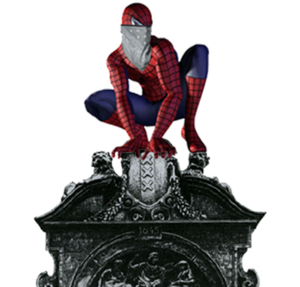
On the 28th of August, almost two years after the abandoned dungeon under the bridge was squatted, the Spinhuis will be evicted. The autonomous social centre will be swept away. What will come in its place will be a closed, ostensibly ‘neigbourhood initiative’ for canal homeowners, but which is widely known to be a vessel for the ambitions of Peter Hagendoorn (son of the well-known real estate speculant).
Whoever thought that we would just let this happen is wrong. Long have we fought for a social and independent Spinhuis to remain, using all the tools we had: from crowbars on doors, to negotiations with the municipality, and all the rhetorical skills and political wrangling that come with dealing with bureaucrats.
However the fate of the squat had already been decided upon. Nevertheless, we remain ready to fight. From under the bridge we will take to the streets to resist the evictions of the Spinhuis and ADM, and the overwhelming commercialisation and gentrification of our city. Here follows a reflection on the past two years and the battle that is yet to come.
During our time in the Spinhuis, so much was learned and accomplished, but we also made our mistakes. Too long have we negotiated politely: with a municipality that is selling off our city; with rich neighbours, who bluntly declare that homeless people should be excluded from our space and city centre; with slimy real estate speculants, who called the police when we opened the Spinhuis to shelter refugees from the We Are Here group. Continue reading “Spinhuis ..Occupied Free Life University RESISTS in Amsterdam”






 C-32 motorway and the main N-340.






 Spinhuis might get evicted but these streets are still ours! Thank you so much for your support
 On the 28th of August, almost two years after the abandoned dungeon under the bridge was squatted, the
 The Free