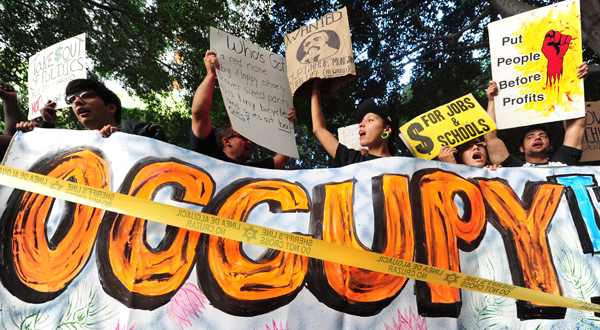
Ocupat un Banc/ Occupan otro Banco / Banks occupied in Barcelona

Ya son dos o tres los bancos ocupados por Barcelona en pocos dias.

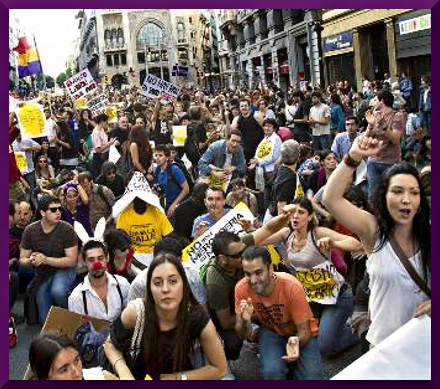
Los indignad*s de La Floresta hacían una Cercavila por los Bancos de Sant Cugat, luego la Paella Popular

en la Plaza, y actuaron una pequeña drama que terminó..SORPRESA con la entrada en un banco anterior en La Plaza.

Participaron hasta 200 personas incluyendo l*s niñ*s.  El Banc Indignat está cerca al Castillo CSO, ocupado hace 10 dias,

así que hay movimiento, también una cooperativa de consumo y varias cosas más


in EEenglish

Now there are I think 3 ex banks OCCUPIED around Barcelona. And on Friday a big crowd played cat and mouse with the baffled police, before successfully occupying another huge building as a ‘home for evicted mortgage defaulters’.

The latest Bank was taken in the La Floresta suburb. After a leafleting and graffiti march around local banks the local  ‘Indignats’ cooked an enormous veggie Paella for up to 200 people. Finally they enacted a drama in the street which ended..SURPRISE in the occupation of an adjoining abandoned bank.(Still going strong). La Floresta is close to the new Occupied Castle Social Center (see post), begun just last week, so there’s plenty of local action, including a small consumers CoOp, an occupied  community garden.. and more stuff.


Visit the Occupied Bank..Ocupat un Banc!

Why have we OCCUPIED a bank?
These are the ultimate expression of capitalism, one of the clearest signals that may be taking profits from the suffering of the majority of the population
Every day, in Spain there are approximately 300 evictions, where banks tend to be those responsible for the evictions of families for non-payment of mortgages. In Barcelona there are thousands of people homeless or living in extreme poverty. On the other hand, just in our neighborhood there are 800 empty flats, and as many other sites continues beyond the residents in the neighborhood.

Per què hem ocupat un banc?
Aquests són la màxima expressió del capitalisme, sent una de les senyals més evidents el fet que puguin estar traient beneficis del patiment de la majoria de la població. Cada dia a l’Estat espanyol hi ha aproximadament uns 300 desnonaments, on els bancs acostumen a ser els responsables dels desnonaments de les famílies per impagament de les hipoteques. A Barcelona hi ha milers de persones sense casa o vivint en extrema pobresa. Com a contrapartida, només en el nostre barri hi ha uns 800 pisos buits, i com a tants altres llocs es segueix fent fora els veïns i veïnes del barri.

What are we doing?
Gradually the activities and workshops are being made (kind of guitar, vegan eatery, etc.). Or are being started (salsa classes, Jiu-Jitsu, etc..), Many people have passed to fix the space or bring things that could be  used (tables, food, books, etc.).. Come and find out what equipment is needed, what activities are being organised or simply to collaborate with the project in the bank and drop a question.

Què estem fent?
Poc a poc són més les activitats i tallers que s’estan realitzant (classe de guitarra, sopadors, etc.) o que estan en procés de començar (classes de salsa, jiu-jitsu, etc.), com molta és la gent que s’ha passat a arreglar l’espai o a portar coses que poguessin servir (taules, menjar, llibres, etc.). Si vols saber què material fa falta, quines activitats s’estan fent o simplement per col·laborar amb el projecte passa’t pel banc i pregunta.

If there is the eviction of the bank:
Concentration-time in front of the space.
-Demonstration at 20pm the same day in Revolution Square.
We can be found every day from 17h to 22h or 19h every Thursday at the assembly space.

Si es produís el desallotjament del banc:
-Concentració en el moment davant de l’espai.
-Manifestació a les 20h del mateix dia a plaça Revolució.


Ens pots trobar cada dia de 17h a 22h o cada dijous a les 19h a l’assemblea de l’espai.
VINE I PARTICIPA!ALLIBERANT ESPAIS, CONSTRUÏNT ALTERNATIVES!

oThursday 10: 19pm meeting space. If you have any activity or part of the project, this is your time.ogle Translation

Wednesday 9: Sopador vegan (20h) + Season Video (21h): “End VIC: resist or die”

“Franklin Lopez Movie which examines addiction to violence and the systematic exploitation of the environment that dominates the culture” civilized “West. Based on the books “Endgame” by Derrick Jensen in which the author asks: If your land is invaded by aliens who are destroying forests, poisoning the air and water, and contaminate crops, resist the occupation? “

MORE INFO…AGENDA CLICK here

http://barcelona.indymedia.org/newswire/display/433822/index.php

Resistance takes root: Preparing for Capitalist Collapse

Resistance takes root in Barcelona

Hilary Wainwright explores the deepening organization of the Indignados movement

The Catalans have a phrase: ’em planto’. It has a double meaning: ‘I plant’, or ‘I’ve had enough’. At end of the huge 15 October demonstration of Indignados (‘outraged’) in Barcelona – the papers put it at around 250,000 – we were  greeted with an impromptu garden under the Arc de Triomf, the end point of the march. Campaigners for food sovereignty had planted vegetables in well-spaced rows, ready for long term cultivation.

The point was partly an ecological one. But the surrounding placards indicated that the gardeners also intended it to make a symbolic point about the broader significance of the march. ‘Plantemos’ declared a large cardboard placard, meaning: ‘we plant ourselves’ – ‘we stand firm’. Mariel, who was dressed as a bee – essential to flourishing horticulture and now facing pesticidal destruction – explained that the activists who organised the garden were part of the agro-ecology bloc on the march. The march as a whole had several layers of self-organisation that became apparent at certain moments. There were three main focal themes – all issues on which active alliances had come together over recent months: education (yellow flags), health (green flags) and housing (red flags).
As we approached the Arc de Triomf, someone on a loud hailer announced that the different directions in which those following each of the themes should go, guided by an open lorry carrying the appropriate flag. The idea was that the demonstration would end not with speeches to the assembled masses, on the traditional model. Instead, the plan was to hold assemblies to discuss action and alternatives to cuts and privatisation.

News came through later in the evening that two of these assemblies had taken action, leading an occupation of a third hospital – two that were making redundancies had already been occupied the day before the demonstration. They had also squatted a large unoccupied building to turn it into housing for ten families. Evictions have become a focus of intense conflict in Barcelona as the numbers grow every day.

As well as clusters around themes, it was the regular neighbourhood assemblies, feeding into an occasional assembly of assemblies, that were the organism that gave the demonstration its impressive life.

The neighbourhood assemblies emerged in early summer this year, following the birth of the Indignados movement in the occupations of the squares of Spain and Greece. As the occupation of Barcelona’s Plaça de Catalunya reached its peak towards the end of May and the general assembly in the square began to plan its future, the locus of organised indignation spread to the neighbourhoods – sometimes reviving or connecting with pre-existing neighbourhood associations, sometimes building on quite dense social bonds. For example, the assembly from Sant Andreu, a predominantly working-class neighbourhood in the north of the city, marched for over an hour to reach the demonstration, proudly announcing their assembly on their yellow T-shirts.

Like many on the demonstration, they brought handmade placards. Some of their slogans were specific: ‘education is not for sale’, ‘for high quality education; against the cuts’. Others were more general: ‘nothing to lose; all to gain’, ‘the system is dead, the people are alive’. A lot of these homemade banners highlighted the exhaustion and corruption of the political system, one offering a reward: ‘2,000 euro for an honest politician’. Abstentions could be high in November’s elections.

There is disillusionment too with trade unions. In the occupation of the square earlier this year, it was not only parties that were not wanted, but also the unions. They had been part of a social contract with the government that had let workers down, leading to a fall in wages and weak protection. Most significantly, they showed no concern – and often hostility – to the growing numbers of people, especially among the young, who had no chance of a long term job. Yesterday only the CNT (Confederación Nacional del Trabajo), the union founded by the anarchists and still less bureaucratised than other trade unions, dared show its face.

Interestingly, though, there are signs of workers recovering the confidence to organise in their workplaces as a direct result of the collective action taking place on the streets, and waking up the unions in the process.

Bea recently worked in a call centre. She remembers the fear that made her fellow workers timid and passive. She was impressed that after the occupations of the squares, the call centre workers went on strike over injustices they had previously suffered in silence. ‘It was as if the strength of the example of collective action on the square gave them the confidence, broke through the fear,’ she said.

Where this kind of awakening will lead is unclear. General goals are clearly expressed: real democracy based on popular assemblies in the neighbourhoods, reform of the electoral system for different levels of government, the right of referendums including on the European level, an end to cuts and privatisation of public services, banks and finance under public control, economic development based on co-operation, self-management and a social economy – the list is long and elaborate (see here, for example).

The important, distinguishing feature of this vision of change is that it is not centred on what governments should do. Rather it is a guide to action at many levels, starting with what the people can do collaboratively, through spaces they occupy, resources they reclaim, new sources of power they create. There is a self-consciousness that the creation of far-reaching alternatives will take time. In conversation, the slogans are put in context: ‘we’re going slowly, because we are going far’ is a common saying.

One thing is certain: the energy, creativity and will comes from outside the existing institutions. Bargaining, pressure, people and organisations that bridge the outside and the inside will no doubt be part of the process of change, but the established institutions have lost the initiative. There is no bravado about this. Among those I talked to on our way home from the Arc de Triomf and the improvised garden, there was anxiety as well as elation at the size and success of the demonstration. ‘I feel some people are looking for leaders,’ said Nuria, a translator and free culture activist. But in the many levels of organisation producing this impressive show not only of anger but of serious engagement in creating alternatives, it becomes clear that this is not a ‘leaderless’ movement. It is emerging, experimentally perhaps, as movement where leadership is shared and is learnt – a movement that can grow and flourish as well as stand firm.

Oscar Reyes says

Hilary’s really captured the spirit of yesterday’s march well, but I think her post also goes some way to correcting a lot of the US/anglocentric/major financial centres bias written in round-ups of the global protests. Inspiring as the Wall Street protests are, it is not really accurate to claim (as the Guardian, New York Times and even activist sites like ZNet have it) that these were the spur to rallies that swept the globe.

An initial call was made several months ago: http://15o.democraciarealya.es/ and the most successful of these have been based on concerted organising, not simply the fact that (as Jon Stewart of the Daily Show recently put it, the media dial has turned from blackout to circus).

It’s easy to over-state the “new model of protest” line too (eg. http://www.redpepper.org.uk/birth-of-a-new-movement/ ). There are many novel elements in this, enabled by the internet as well as the re-organisation of global labour– as Paul Mason has pointed out a while ago
http://www.bbc.co.uk/blogs/newsnight/paulmason/2011/02/twenty_reasons_why_its_kicking.html
But in other ways it is all decidedly old-school: unemployment, job insecurity and the defence of a welfare state under threat from a massive austerity programme are spurring protests, coupled with a revolt against a banking system that’s totally out of control.

The Barcelona protest was one of the numerous protests in cities across the state of Spain, from 60,000 in Sevilla in the south to over 10,000 reported in Vigo in the north-west, and 500,000 in the capital Madrid. There are reports and videos (in Spanish) at
http://www.kaosenlared.net/noticia/estado-espanol-recopilacion-cronicas-videos-manifestaciones-15-o
and
http://madrid.tomalaplaza.net/2011/10/15/la-indignacion-sale-a-las-calles-de-todo-el-mundo-el-15-de-octubre/

The story of the three strands of the march that Hilary describes is also worth following. In Nou Barris, a working class suburb in the north of Barcelona, the march was followed by the occupation of an empty block of flats, with the aim of housing families that had faced home repossessions:
http://acampada9barris.wordpress.com/2011/10/16/okupat-un-bloc-de-pisos-buits-a-nou-barris/

A 6,000-strong march continued to the Hospital del Mar, in support of a revolt against health cuts that had already seen the occupation of two hospitals on the night before the main demonstration. The symbolic end point saw a huge die-in, with activists playing dead to symbolise “the deaths of many citizens” as a result of savage health sector cuts.
http://www.setmanaridirecta.info/noticia/la-columna-de-sanitat-la-mes-concorreguda-de-totes

Thousands more formed an education block that met up with an occupation at the Geography and History Faculties of the University of Barcelona, located close to the centre of the city. Once there, convened an assembly to discussed the demands of the recently formed Platform for a Public University (Plataforma Unitària per la Universitat Pública), which has called for a strike on 17 November.
http://www.setmanaridirecta.info/noticia/2000-persones-una-assemblea-la-facultat-del-raval-reocupada-la-columna-vermella

Lesley Wood says:

Terrific article! Thanks for filling in the gaps. I was there, but the crowd was way too big to get a sense of what was going on!

Oscar says:

really insightful article….makes great sense to those who weren’t there…this huge demo…and all the rivers of resistances it symbolises…is trully inspiring …it looks like the ‘indignados’ movement is here to stay and hopefully irreversible.

NOTE . This blogger is preparing a series of cool posts,  on Squat Centers,  Free Universities,  Circus Squats, Anarchist roots, Food and consumption  CoOps,  Mutual Aid Networks, Alternative Banking, etc.  in the Catalunya area.. watch this space for updates….

Eat the Rich: One week of Occupy London

On Saturday 22 October at 1pm in London, the general assembly is geared up to receive a swell of visitors, as many who work are inspired by the camp and plan to come and visit and see what it’s all about. It will be an important test for the assembly facilitators, to hold the camp together as more voices enter the equation…Posted by Jamie Kelsey-Fry

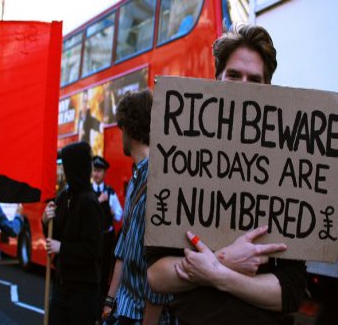
Saturday will mark a week since OccupyLondon claimed its space at the feet of St Paul’s Cathedral. It has been a difficult but utterly uplifting experience for all.

IMF predicts collapse of Capitalism!

People are gravitating to the camp constantly, drawn by what is really still an idea taking shape, but an idea that is already inspiring.

The camp is determined and committed to channelling peoples voices through general assembly and consensus. The aims of the London assembly and others around the world are cut from the same cloth.  We all want to challenge the fundamental assumptions that underlie the world’s political and financial systems, which are failing us at all levels.

It’s an easy criticism to make that the assembly ‘offers no solutions’. Of course not, not yet. But the process of building a movement that asks the right questions, and considers that another world is possible, has begun. The systems of general assembly and consensus can be painstaking but they do mean that all those people involved have their voices heard.

The camp came up with their first statement in 48 hours. It’s now only six days in. I would suggest that if this process of forming a concrete vision of a fairer, safer more just world is anything as erudite as the way the London camp has organised itself, then we are in for something of great value. Perhaps an idea whose time has come.

If you plan to visit, I have no doubt that you will find the camp to be, at the very least, a source of hope. At best, you may find yourself deciding that you belong here, and the next thing you know, you’ll be collecting a sleeping bag and joining a working group. See you soon.

Permaculture at Occupy Wall Street


permaculture design at occupy wall streetLike many of you, I’ve been watching the Occupy Wall Street (and local OccupySTL) protests with fascination. While I know the mainstream media hasn’t gotten too creative in its reporting (once it started reporting), the little bit of digging I’ve done on “on-the-ground” reporting has turned up more than just angry kids, but an ongoing experiment with political participation and governance itself.

Sure, unemployment, income disparity, and the American dream have been at the forefront of the movement… but I wondered early on if environmental sustainability was getting a “place at the table” as this movement forms and grows.

The answer: yes (as I suspected). This morning, I received email from the OWS Sustainability Working Group and Seismologik Media about a short film the latter had produced in partnership with One Pack Productions (unfortunately, embedding Vimeo wasn’t working for me today, so you’ll have to click through). Of course, I’m happy to see permaculture on display at Occupy Wall Street; I’m even happier to see that there’s more than protest going on there, but also experimentation with alternative, sustainable ways to meeting needs (which, of course, is its own form of protest).

Take a look at the film (it’s just under five minutes long), and let us know what you think. What other kids of sustainability experimentation could be going on in the midst of this activism?


Permaculture Co-ops: “I Do My Labor with My Neighbor!”.

I do my Labor with my Neighbor

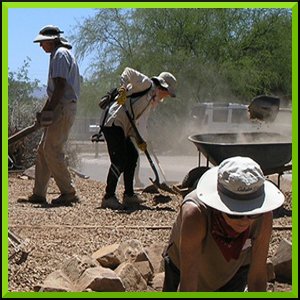
The front of his white and blueT-shirt had the Watershed Management Group (WMG) logo on it and in a font that looked like it had been stamped diagonally across read the words “CO-OP”. When he turned around to grab a pick axe, other wise known as an Arizona Shovel, the back of the shirt said “I Do My Labor with My Neighbor!”.

-This catchy little phrase does more than just rhyme. It tells of an opportunity for community, a way to reach an otherwise high costing goal. A chance to not only change your own personal landscape, but eventually heal a neighborhood and enjoy a little bit more of a responsible feeling as you look out at your land.

-The WMG has created, and successfully run, this CO-OP program down in Tucson and I have been lucky enough to not only participate in some of the workshops, but I have also been able to meet some amazing and interesting people who share like views on how we should be friendly to the desert……….

………..   -While the clock neared the end of the workshop…who am I kidding, it was actually an hour past end time, the clouds could no longer hold back their hydro-soaked insides and it began to RAIN!! Like I said, the workshop was officially over, but there was still almost every single volunteer still there. This was a passion and a need to see this through. A belief that this was important and an opportunity to grow a property AND grow the knowledge inside. So we hit another gear, put the final pieces into place, and actually started catching that SkyGold into one of the pur-tiest metal tanks in the neighborhood.

-My brain, my clothes and my passion left soaked that early evening as I drove off…back to the Valley of the Sun.   -Hopefully in the very near future, I too can wear a white shirt with a blue logo that PROUDLY states:

“I Do My Labor, With My Neighbor!”

Read Full story HERE  http://rainwaterjunkie.com/2010/08/03/labor-with-your-neighbor.aspx.


Watershedding

Here’s what I’m excited about these days: we just held a volunteer workshop to totally makeover a Tucson family’s front yard.  15 volunteers transformed it from a sterile, black-plastic and rock-laden heat island into a runoff-capturing garden of native plants, organic mulch, and (soon) living soil.  This workshop, which was followed by blessed afternoon monsoon rain showers, was just the second in some 24 public workshops that WMG is co-hosting with six different Tucson neighborhoods over the next year.   Through these projects we will de-pave a closed alley to turn it into a pocket park, install rainwater-fed trees along the entrance of a school, and create rain gardens in the middle of a parking lot, among other things.  We will do all of this alongside volunteers from each neighborhood. 20 of these volunteers recently completed a 5-month training with WMG to assess, design, build, and advocate for these kinds of green infrastructure in their communities. 

Check it out HERE http://www.watershedmg.org/node/271

Permaculture: Magic Food Forest Trip

PLOWBOY: And did all your contact with the wilds have any effect on your perceptions of our modern agricultural system?

MOLLISON: Oh yes! Everything I did, either in research or in fieldwork, indicated that there was something fundamentally wrong with modern farming methods. For instance, every problem I found in commercial agribusiness was actually caused by the industry itself. Usually — when a farmer called in the CSIRO for a consultation — the results of our investigation pointed the finger straight at the grower him- or herself!

As I saw the same situation occur time and time again, I gradually came to the conclusion that most contemporary crop-raisers must be doing things the wrong way. So my last few years with the CSIRO were spent in the forest,

permaculture is mutual aid

observing the plant and animal species on location . . . and there I learned that everything in nature is self -controlled and self -balancing.

You know, a lot of modern thought suggests that the planet — as a living organismic — seeks to protect itself by rejecting any species that causes it harm. For instance, if cattle damage part of the earth, the harmed region will respond by growing thorn bushes and poisonous plants, thus rejecting the animals. Well, I think we — the members of the human race — are perilously close to being rejected by the earth in that same way . . . and quite rightly so, since we’ve created some terrible damage.