Ukrainian world chess champion not playing in dictatorial Saudi Arabia
”The Saudi State only exists so the US can rule the Oil Market. Terrorism, extreme misogyny, slavery and mass murder are therefore acceptable with impunity”.
This video is called The Famous Chess Trap In Action By Anna Muzychuk.
Una explosión sacudió un oleoducto de crudo que alimenta la terminal marítima de Es Sider en Libia, dijo una fuente petrolera en el país.
IN ENGLISH HERE El puerto mediterráneo de Es Sider es el mayor depósito de petróleo de Libia. La explosión ocurrió cerca de Marada, en el oleoducto perteneciente a la compañía petrolera Waha, dijo la fuente a Reuters.
El puerto está controlado ahora por las fuerzas del General Hafter. los ‘últimos noticias son que el petróleo había sido redirigido a otro oleoducto y que se perderán menos de 100.000 barriles por día en exportaciones durante aproximadamente una semana. Sin embargo, los precios del petróleo en los Estados Unidos alcanzaron un nuevo récord después de la noticia. una foto en Twitter del oleoducto.. 26 de diciembre 17

“Una fuente militar dijo a RIA Novosti que la” gran “explosión en el oleoducto fue el resultado de un ataque terrorista” Los combatientes pertenecían a las Brigadas de Defensa de Benghazi (afiliadas a Al Qaeda) o al Estado Islámico (IS, anteriormente ISIS / ISIL) ya que son terroristas que llevan a cabo desvíos para paralizar las instalaciones de producción petrolera “. Russia Today Reportuna foto en Twitter del oleoducto.. 26 de diciembre 17
“En marzo del 2017 las fuerzas leales al comandante militar de Libia, Khalifa Haftar, recapturaron Es Sidar y reanudaron las operaciones”.
Repsol sigue saqueando Libia … Las ganancias se disparan mientras que los vecinos Tuareg y Tebu pasan hambre
El sabotaje de Es Sider, sin embargo, no interrumpirá las exportaciones del yacimiento petrolífero de Sharara, donde la empresa española Repsol tiene la mayor participación del 60%. Sharara ahora exporta casi 300.000 barriles de petróleo por día, lo que le da enormes ganancias a Repsol.El inmenso campo petrolero de Sharara. El gas metano se quema, desperdiciando un recurso no renovable para obtener ganancias más rápidas. No les importa la creciente emergencia climática del planeta, al contrario el Repsol se jacta del incremento de la extracción y la gente local se queján del racismo y que no han recibido nada.Continue reading “Repsol Sigue Saqueando Libia: el último Sabotaje de un Oleoducto no le Afecta.”
by UndercoverInfo On the day Brexit beleaguered Britain gets a new passport there will be the inevitable street parties by flag-waving, jingoistic and nationalistic loons. And accompanying those sickening celebrations there is likely to be a surge in hate crimes against anyone looking ‘foreign’, including tourists.
An explosion has rocked a crude oil pipeline that feeds the Es Sider sea terminal in Libya, an oil source in the country said.
The Mediterranean port of Es Sider, the largest oil depot in Libya. The blast occurred near Marada, on the pipeline belonging to the Waha oil company, the source told Reuters.
The port is now controlled by the powerbroker General Hafter’s forces. Later reports said that oil had been re-routed and less than 100,000 barrels a day in exports will be lost for about a week. Nevertheless oil prices in the US hit a new high on the news. a twitter photo of the export pipeline 26 Dec 17
”A military source told RIA Novosti that the “large” explosion at the pipeline was the result of a terrorist attack“The fighters belonged to either (al-Qaeda-affiliated) Benghazi Defense Brigades or Islamic State (IS, formerly ISIS/ISIL) as they are terrorists who carry out diversions to cripple oil production facilities.” Russia Today Report
The news of the Libyan blast saw oil prices spike to above $65 a barrel on Tuesday, Reuters reported.”In March ’17 … Es Sidar was recaptured by forces loyal to Libya’s eastern-based military commander, Khalifa Haftar, and resumed operations”.
Repsol still looting Libya… Profits Soar while local Tuareg and Tebu go Hungry
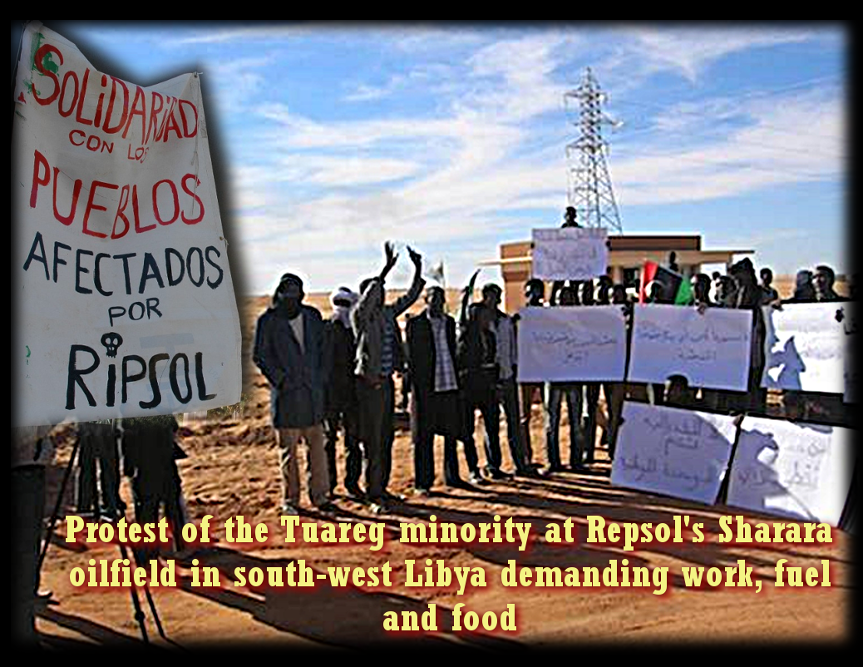
The explosion will not however disrupt exports from the Sharara oilfield where Spanish company Repsol has the biggest 60% stake. Sharara now exports nearly 300.000 barrels of oil a day, making enormous profits for Repsol.
Protest of the Tuareg minority at the Sharara oilfield in south-west Libya demanding work, fuel and food
Chief Executive Officer – Josu Jon Imaz boasted that its ‘upstream’ profits soared by $69 million when the pipeline from Sharara to the port came back online after protest Blockades in the second quarter of 2016. (source Repsol).
Google map image of part of Repsol’s Sharara oil extraction
Repsol’s local company has contributed nothing that we know of to alleviate the extreme suffering of the impoverished local people suffering racist discrimination in the Ubari area next to the oilfield. Instead it is concentrating on trying to boost its profits by pumping out Libyan oil even faster, aiming for 330,000 barrels a day in the near future .
Repsol is joint operator with both the National Oil Corporation (NOC), France’s ‘imperialist’ Total, and Austria’s OMV which also have stakes in what is currently Libya’s biggest oilfield.The Sharara oilfield is situated in the middle of what was once Lake Megafezzan, once bigger than the UK, which is now dried up, it may not rain for 5 years in the area. . All that is left are a dozen small salt lakes near Ubari fed from the extensive Sahara aquifer beneath, which may be already damaged or in imminent danger from Repsol’s oil extraction. The Tuareg eat the red shrimps which thrive in the ultra salty water.Continue reading “Repsol Looting Libya: profits unaffected by Pipeline Sabotage:”
On the night before Christmas, we’ll all be about. While the people are sleeping, we’ll realise our clout. We’ll expropriate goods from the stores, ‘cos that’s fair. And distribute them widely, to those who need care.Ruth Kinna 20 December 2018
Can we reclaim Christmas for the masses? Credit: Grace Wilson/STRIKE! magazine.
An anarchist guide to Christmas
It’s no surprise to discover that anarchist theorist Pyotr Kropotkin was interested in Christmas. In Russian culture, St. Nicholas (Николай Чудотворец) was revered as a defender of the oppressed, the weak and the disadvantaged. Kropotkin shared the sentiments.
A principle or theory of life and conduct under which society is conceived without government — harmony in such a society being obtained, not by submission to law, or by obedience to any authority, but by free agreements concluded between the various groups…
But there was also a family link. As everyone knows, Kropotkin could trace his ancestry to the ancient Rurik dynasty that ruled Russia before the upstart Romanovs and which, from the first century CE, controlled the trade routes between Moscow and the Byzantine Empire. Nicholas’s branch of the family had been sent out to patrol the Black Sea.
But Nicholas was a spiritual man and sought an escape from the piracy and brigandage for which his Russian Viking family was famed. So he settled under a new name in the southern lands of the Empire, now Greece, and decided to use the wealth that he had amassed from his life of crime to alleviate the sufferings of the poor.
Unpublished archival sources recently discovered in Moscow reveal that Kropotkin was fascinated by this family tie and the striking physical similarity between himself and the figure of Father Christmas, popularised by the publication of ‘A Visit from St. Nicholas’ (better known as ‘The Night Before Christmas’) in 1823.
Kropotkin was not quite so portly as Klaus, but with a cushion stuffed up his tunic, he felt he could pass. His friend Elisée Reclus advised him to drop the fur trim on the outfit. That was a good idea as it would also allow him to wear a bit more black with the red.
The need for a new life becomes apparent. The code of established morality, that which governs the greater number of people in their daily life, no longer seems sufficient.
He’d decided to follow Elisée’s advice on the reindeer, too, and to use a hand driven sleigh. Kropotkin wasn’t normally given to dressing up. But exploiting the resemblance to spread the anarchist message was excellent propaganda by the deed.
Anticipating ‘V’, Kropotkin thought that we could all pose as Santa Claus. On the edge of one page Kropotkin writes: “Infiltrate the stores, give away the toys!”
Faint remnants on the back of a postcard read:
On the night before Christmas, we’ll all be about While the people are sleeping, we’ll realise our clout We’ll expropriate goods from the stores, ‘cos that’s fair And distribute them widely, to those who need care.
His project notes also reveal some valuable insights into his ideas about the anarchistic features of Christmas and his thinking about the ways in which Victorian Christmas rituals might be adapted.
“We all know”, he wrote, “that the big stores – John Lewis, Harrods and Selfridges – are beginning to exploit the sales potential of Christmas, establishing magic caves, grottos and fantastic fairylands to lure our children and pressurise us to buy gifts that we do not want and cannot afford”.
“If you are one of us”, he continued, “you will realise that the magic of
Men lived thousands of years before the first States were constituted…
Christmas depends on Father Christmas’s system of production, not the stores’ attempts to seduce you to consume useless luxuries”. Kropotkin described the sprawling workshops at the North Pole, where elves worked all year, happily because they knew that they were producing for other peoples’ pleasure. Noting that these workshops were strictly not-for profit, craft-based and run on communal lines, Kropotkin treated them as prototypes for the factories of the future (outlined in Fields, Factories and Workshops).
Some people, he felt, thought that Father Christmas’s dream to see that everyone received gifts on Christmas day, was quixotic. But it could be realised. Indeed, the extension of the workshops – which were quite expensive to run in the Arctic – would facilitate generalised production for need and the transformation of occasional gift-giving into regular sharing. “We need to tell the people”, Kropotkin wrote, “that community workshops can be set up anywhere and that we can pool our resources to make sure that everybody has their needs met”!
One of the issues that most bothered Kropotkin about Christmas was the way in which the inspirational role that Nicholas’s had played in conjuring Christmas myths had confused the ethics of Christmas. Nicholas was wrongly represented as a charitable, benevolent man: saintly because he was beneficent. Absorbed in the figure of Father Christmas, Nicholas’s motivations for giving had become further skewed by the Victorian’s fixation with children.
Kropotkin didn’t really understand the links, but felt that it reflected an attempt to moralise childhood through a concept of purity that was symbolised in the birth of Jesus. Naturally he couldn’t imagine the creation of the Big Brother Santa Claus who knows when children are asleep and awake and comes to town apparently knowing which have dared to cry or pout.
But sooner or later, he warned, this idea of purity would be used to distinguish naughty from nice children and only those in the latter group would be rewarded with presents.
Whatever the case, it was important both to recover the principle of Nicholas’ compassion from this confusing mumbo-jumbo and the folkloric origins of Santa Claus. Nicholas gave because he was pained by his awareness of other peoples’ hardship. Though he wasn’t an assassin (as far as Kropotkin knew), he shared the same ethics as Sofia Petrovskaya. And while it was obviously important to worry about the well-being of children, the anarchist principle was to take account of everyone’s suffering.
Similarly, the practice of giving was mistakenly thought to require the implementation of a centrally-directed plan, overseen by an omniscient administrator. This was quite wrong: Father Christmas came from the imagination of the people (just consider the range of local names that Nicholas had accrued – Sinterklaas, Tomte, de Kerstman). And the spreading of good cheer – through festivity – was organised from the bottom up.
Buried in Christmas, Kropotkin argued, was the solidaristic principle of mutual aid.
Kropotkin appreciated the significance of the ritual and the real value that
The education we all receive from the State, at school and after, has so warped our minds that the very notion of freedom ends up by being lost, and disguised in servitude.
individuals and communities attached to carnivals, acts of remembrance and commemoration. He no more wanted to abolish Christmas than he wished to see it republicanised through some wrong-headed bureaucratic re-ordering of the calendar.
It was important, nonetheless, to detach the ethic that Christmas supported from the singularity of its celebration. Having a party was just that: extending the principle of mutual aid and compassion into everyday life was something else. In capitalist society, Christmas provided a space for special good behaviours. While it might be possible to be a Christian once a year, anarchism was for life.
When we see how voluntary societies invade everything and are only impeded in their development by the State, we are forced to recognize a powerful tendency, a latent force in modern society.
Kropotkin realised his propaganda would have the best chance of success if he could show how the anarchist message was also embedded in mainstream culture. His notes reveal that he looked particularly to Dickens’ A Christmas Carol to find a vehicle for his ideas. The book was widely credited with cementing ideas of love, merriment and goodwill in Christmas. Kropotkin found the genius of the book in its structure. What else was the story of Scrooge’s encounter with the ghosts of Christmas past, present and future than a prefigurative account of change?
By seeing his present through his past, Scrooge was given the chance to alter his miserly ways and re-shape both his future and the future of the Cratchit family. Even if it was only remembered once a year, Kropotkin thought, Dickens’s book lent anarchists a perfect vehicle to teach this lesson: by altering what we do today, by modelling our behaviours on Nicholas, we can help construct a future which is Christmas!
This article was originally published by STRIKE! magazine in 2014.
Kropotkin was Right: Cooperation beats Competition
New studies are proving false whole libraries that claim humans are innately selfish and cruel. Starting with a false view of Darwin’s theory of Evolution right wing leaders of opinion have built a tower of lies to justify their crimes against humanity, as argued from the beginning by the anarchist Peter Kropotkin. Humans are innately cooperative and empathetic, and this gives us the basis for a new kind of non-capitalist system. We reprint below a new article by the influential science journalist George Monbiot on these themes.
Human Kind
new evidence shows human cooperation and empathy predominate
Fascinating new lines of research suggest that we are good people, tolerating bad things.
Do you find yourself thrashing against the tide of human indifference and selfishness? Are you oppressed by the sense that while you care, others don’t? That because of humankind’s callousness, civilisation and the rest of life on earth are basically stuffed? If so, you are not alone. But neither are you right.
A study by the Common Cause Foundation, due to be published next month, reveals two transformative findings. The first is that a large majority of the 1000 people they surveyed – 74% – identify more strongly with unselfish values than with selfish values. This means that they are more interested in helpfulness, honesty, forgiveness and justice than in money, fame, status and power. The second is that a similar majority – 78% – believes others to be more selfish than they really are. In other words, we have made a terrible mistake about other people’s minds.
The revelation that humanity’s dominant characteristic is, er, humanity will come as no surprise to those who have followed recent developments in behavioural and social sciences. People, these findings suggest, are basically and inherently nice.
A review article in the journal Frontiers in Psychology points out that our behaviour towards unrelated members of our species is “spectacularly unusual when compared to other animals”. While chimpanzees might share food with members of their own group, though usually only after being plagued by aggressive begging, they tend to react violently towards strangers. Chimpanzees, the authors note, behave more like the Homo economicus of neoliberal mythology than people do.
Humans, by contrast, are ultra-social: possessed of an enhanced capacity for empathy, an unparalleled sensitivity to the needs of others, a unique level of concern about their welfare and an ability to create moral norms that generalise and enforce these tendencies.
Such traits emerge so early in our lives that they appear to be innate. In other words, it seems that we have evolved to be this way. By the age of 14 months, children begin to help each other, for example by handing over objects another child can’t reach. By the time they are two, they start sharing things they value. By the age of three, they start to protest against other people’s violation of moral norms.
A fascinating paper in the journal Infancy reveals that reward has nothing to do with it. Three to five-year-olds are less likely to help someone a second time if they have been rewarded for doing it the first time. In other words, extrinsic rewards appear to undermine the intrinsic desire to help. (Parents, economists and government ministers, please note). The study also discovered that children of this age are more inclined to help people if they perceive them to be suffering, and that they want to see someone helped whether or not they do it themselves. This suggests that they are motivated by a genuine concern for other people’s welfare, rather than by a desire to look good. And it seems to be baked in.
Children sharing ice-cream on stick near Sapa.
Why? How would the hard logic of evolution produce such outcomes? This is the subject of heated debate. One school of thought contends that altruism is a logical response to living in small groups of closely related people, and evolution has failed to catch up with the fact that we now live in large groups, mostly composed of strangers. Another argues that large groups containing high numbers of altruists will outcompete large groups which contain high numbers of selfish people. A third hypothesis insists that a tendency towards collaboration enhances your own survival, regardless of the group in which you might find yourself. Whatever the mechanism might be, the outcome should be a cause of celebration.
So why do we retain such a dim view of human nature? Partly, perhaps, for historical reasons. Philosophers from Hobbes to Rousseau, Malthus to Schopenhauer, whose understanding of human evolution was limited to the Book of Genesis, produced persuasive, influential and catastrophically mistaken accounts of “the state of nature” (our innate, ancestral characteristics). Their speculations on this subject should long ago have been parked on a high shelf marked “historical curiosities”. But somehow they still seem to exert a grip on our minds.
Another problem is that – almost by definition – many of those who dominate public life have a peculiar fixation on fame, money and power. Their extreme self-centredness places them in a small minority, but, because we see them everywhere, we assume that they are representative of humanity.
The media worships wealth and power, and sometimes launches furious attacks on people who behave altruistically. In the Daily Mail last month, Richard Littlejohn described Yvette Cooper’s decision to open her home to refugees as proof that “noisy emoting has replaced quiet intelligence” (quiet intelligence being one of his defining qualities). “It’s all about political opportunism and humanitarian posturing,” he theorised, before boasting that he doesn’t “give a damn” about the suffering of people fleeing Syria. I note with interest the platform given to people who speak and write as if they are psychopaths.
The consequences of an undue pessimism about human nature are momentous. As the Common Cause Foundation’s survey and interviews reveal, those who have the bleakest view of humanity are the least likely to vote. What’s the point, they reason, if everyone else votes only in their own selfish interests? Interestingly, and alarmingly for people of my political persuasion, it also discovered that that liberals tend to possess a dimmer view of other people than conservatives do. Do you want to grow the electorate? Do you want progressive politics to flourish? Then spread the word that other people are broadly well-intentioned.
Misanthropy grants a free pass to the grasping, power-mad minority who tend to dominate our political systems. If only we knew how unusual they are, we might be more inclined to shun them and seek better leaders. It contributes to the real danger we confront: not a general selfishness, but a general passivity. Billions of decent people tut and shake their heads as the world burns, immobilised by the conviction that no one else cares.
You are not alone. The world is with you, even if it has not found its voice.
An Israeli military court has extended the detention of Ahed Tamimi, a 16-year-old girl who has become the face of Palestinian resistance to Israel’s military occupation of the West Bank for many who follow the weekly protests in her village through social media.Ahed was arrested in an overnight raid of her family’s home in the village of Nabi Saleh last Monday.
Barcelona 01 10 2017 Politica Referendum 1-O elecciones la policia nacional ha intentado desalojar a las personas concentradas en las puertas del colegio electoral Ramon Llull Foto Ferran Nadeu
by Àngel Garcia and Anna Celma That the state has repressive mechanisms to curb dissent and control the population is something widely known among social movements and activists. Cases like Pandora or Piñata, the 4-F (see Ciutat Morta docu), the imprisonment of Alfon, among many others, have led to the activation of a police, political and judicial apparatus and the creation of a speech that builds an “internal enemy” like the anti-systemites or the perroflautas. What is not yet so visible is how patriarchy and state social control tools are bundled together. To look into this, from Novact and with the support of entities and groups members of the platform ‘Defender of those who Defend‘ ( like Center Irídia, Calala and Stop Represión Granada, among others ) have prepared a report on the relationship between repression and gender, which was presented at the University of Barcelona. As the professor of law philosophy Encarna Bodelón says, “the fight against patriarchy has also been the story of multiple repressions,” individual or collective. The authors of the report gave an overview of the social and feminist mobilizations to study how repression is legitimated through the idea of ”citizen security”.For them, “the gender system and the dominant neoliberal ideology in the State are two structures of a mutually constitutive nature” and as such, they must be considered together.
Citizen security and family protection are two areas where the patriarchal state works to “repress and discipline” the bodies that are seen as non-normative
TOPSHOT – People clash with Spanish Guardia Civil guards outside a polling station in Sant Julia de Ramis, where Catalan president was supposed to vote, on October 1, 2017, on the day of a referendum on independence for Catalonia banned by Madrid.
The report is low in the feminist perspective to understand the phenomenon of repression exerted by the State. With this starting point, it addresses the psychosocial impacts and underlines the importance of putting care in the center as a mechanism of repair and support driven from the gender perspective.
At the same time, the impact of state repression on women and feminist movements is analyzed, and it analyzes whether the punitive system acts differently depending on gender or sexual orientation in protest contexts and in the face of social movements.Citizen security (public domain) and the protection of the family (private area) are two areas where the patriarchal state works to “repress and discipline” the bodies that are read as non-normative.
Women have experienced various offenses against their bodies, either from the attempts to impose legislation that violates their sexual and reproductive rights – such as the “Counter-Counter Gallardon” of abortion – or directly, suffering from violence when they occupy and politicize public spaces.
The report also highlights how the expansion of the criminal system in Spanish territory has been parallel to the restriction of welfare policies. These cuts suffer more, again, women. In view of all this, the authors argue that a logic of feminist analysis opens the door to rethink how to deal with the actions of the criminal system. “While for men there are socially accepted models of transgression, which can even be seen as an emblem of masculinity, for women the transgression is transformed into stigma and rejection.
This causes dissent to be more easily assumed by men, as they are more compatible with social and family roles that require less obligations, “concludes the document. Before that, however, they now identify a flight of the “figure of the hero” and the images of heroicity and victimism.
Since the Referendum on Oct 1st 120 attacks by Spanish nationalist fascists have been documented in Catalonia.
When repression arrives, there is also a phenomenon of feminization of the response. When time goes by and the repressive process continues, with people pending trial or imprisonment, for example, those who remain within the anti-prescription and support groups are women. This, for the authors of the report, implies that in the end it ends up giving more importance to the care in these environments.
A space is allowed to express everything that the “message of heroicity” does not allow: fears, pains, shortcomings or insecurities. Also, the effects of repressive violence that do not always arise at the first moments, such as depression, anxiety, less frequent psychotic disorders … All in all, consequencesof post-traumatic stress disorder. This means that, from experience, a logic of prevention, care and co-responsibility has begun: preparation before the repression arrives to have more room for action and the ability to receive the violence. Sexual repression On October 1, between various songs, there was “without the girls, there is no revolution.”
These screams resounded while the police forces of the National Police Force (CNP) and the Civil Guard entered their constituencies to prevent voting during the Catalan referendum. During the day, repression became universalized and jumped from the creation of the “internal enemy” on a small scale to extrapolate it to the entire Catalan population mobilized in defense of the referendum. In this context, the report indicates that it is he produced “again the body of the woman to mean the masculine dominion”.
Martra Torrecilla had her fingers snapped by National Spanish Police
On October 1 there were cases of “sexuada repression”, in which the woman’s body is a receptacle of punitive mechanisms that want to redirect and highlight what must correspond to femininity, one band, and that at the same time uses violence that expresses the message of the domination of men. This is the case, for example, of the aggressions by which Marta Torrecillas filed a complaint.
The report indicates that “once again the body of women” became “to mean male dominance.” On October 1 there were cases of “sexuada repression” On October 25, Torrecillas denounced the sexual violence that was submitted by the CNP to the IES Pau Claris – recorded on video and that ran for the Nets. Torrecillas accuses them of twisting their fingers, touching the breasts and throwing her dow the stairs.
Many women, to a lesser or greater extent, suffered this police violence at first hand, also elderly women. The authors of the report, at the same time, study how sexual repression is exercised from patriarchy against men to impose their patriarchal domain.
For example, they analyze the sexual violence used by the police forces in the French State against a young person in Paris: on February 1, 2017, in a “routine” drug control in the neighborhood Aulnay-sous-Bois, four agents of the French police arrested some guys to ask for their documentation.
Théo, aged 22, suffered aggression when the agents were searching his anus, aggressions from which he had to be operated on in the hospital’s emergency department. In response to this police violence, there were disturbances in this peripheral zone of the French capital for several nights.
A similar strategy, although with much lower intensity, is anmalysed in the conversation between police, fortuitously recorded during the transfer of Oriol Junqueras to the prison center of Estremera. The agents mocked the possibility that the vice president of the Generalitat could suffer rape in prison.All the repressive logic of sexual violence was reproduced, in this case, as a tool by men in a situation of domination against a man in a situation of vulnerability.
The report, by Novact and Defend Who Defends, allows us a first approach to analysing the relationship between state, patriarchy and repression.
Novact i la plataforma Defender a Quien Defiende publiquen un informe que analitza des de la perspectiva de gènere el fenomen de les repressions. El document evidencia com poder punitiu i patriarcal es cohesionen per preservar l’ordre social
Imatge de la repressió davant d’una seu electoral a Sabadell el dia 1 d’octubre
Novact i la plataforma Defender a Quien Defiende publiquen un informe que analitza des de la perspectiva de gènere el fenomen de les repressions. El document evidencia com poder punitiu i patriarcal es cohesionen per preservar l’ordre social
Que l’Estat té mecanismes repressius per frenar la dissidència i controlar la població és quelcom àmpliament conegut entre els moviments socials i l’activisme. Casos com Pandora o Piñata, el cas 4-F, l’empresonament d’Alfon, entre molts altres, han comportat l’activació dels aparells policials, polítics i judicials en la creació d’un discurs que construeix un “enemic intern”, com l’antisistema o el perroflauta.
El que encara no és tan visible és com el patriarcat i les eines estatals de control social estan entortolligades. Per evidenciar-ho, des de Novact i amb el suport d’entitats i col·lectiu membres de la plataforma Defender a Quien Defiende– com Centre Irídia, Calala i Stop Represión Granada, entre altres- han elaborat un informe sobre la relació entre repressió i gènere, que aquest dijous 16 de novembre s’ha presentat a la Universitat de Barcelona.
“des de Novact i amb el recolzament d’entitats i col·lectius membres de la plataforma Defender a Quien Defiende, com Centre Irídia, Clala i Stop Represión Granada, entre altres.”
Com diu en el pròleg la professora de filosofia del dret Encarna Bodelón, “la lluita contra els patriarcats ha estat també la història de múltiples repressions”, individuals o col·lectives. Les dones autores de l’informe han fet una panoràmica de les mobilitzacions socials i feministes per estudiar com es legitima la repressió a través de la idea de “seguretat ciutadana”. Per a elles, “el sistema de gènere i la ideologia neoliberal dominant a l’Estat són dues estructures de caràcter mútuament constitutiu” i com a tal, han d’examinar-se juntes.
La seguretat ciutadana i la protecció de la família són dos àmbits en què l’estat patriarcal treballa per “reprimir i disciplinar” els cossos que són llegits com a no normatius
L’informe es bassa en l’òptica feminista per a comprendre el fenomen de la repressió exercida per l’Estat. Amb aquest punt de partida, atén els impactes psicosocials i subratlla la importància de posar en el centre les cures com a mecanisme de reparació i acompanyament impulsat des de la visió de gènere.
Alhora, radiografia l’impacte de la repressió estatal envers les dones i els moviments feministes, i analitza si el sistema punitiu actua de manera diferent en funció del gènere o les orientacions sexuals en els contextos de protesta i enfront dels moviments socials./ Pau Fabregat
Davant de tot això, les autores defensen que una lògica d’anàlisi feminista obre les portes a repensar com fer front a les actuacions del sistema penal. “Mentre que per als homes hi ha models socialment acceptats de transgressió, que fins es poden lluir com a emblema de masculinitat, per a les dones la transgressió es transforma en estigma i rebuig.
Això fa que les dissidències puguin ser més fàcilment assumides pels homes, ja que a més resulten més compatibles amb uns rols socials i familiars que requereixen menys obligacions”, conclou el document. Davant d’això, però, identifiquen avui dia una fugida de la “figura de l’heroi” i de les imatges d’heroïcitat i victimisme.
Quan arriba la repressió, també es produeix un fenomen de feminització de la resposta. Quan el temps passa i el procés repressiu continua, amb persones pendents de judici o empresonades, per exemple, qui es manté a dins dels grups antirepressius i de suport són les dones. Això, per a les autores de l’informe, implica que al final s’acabi donant més importància a les cures en aquests entorns.S’habilita un espai per expressar tot allò que el “missatge de l’heroïcitat” no permet: pors, dolors, mancances o inseguretats. També els efectes de la violència repressiva que no sempre afloren als primers moments, com ara depressió, ansietat, trastorns psicòtics amb menys freqüència… Tot plegat, conseqüències del trastorn d’estrès post- traumàtic. Això fa que, des de l’experiència, es comenci a instaurar una lògica de la prevenció, de la cura i de corresponsabilitzar: preparar-se abans que arribi la repressió per tenir més marge d’actuació i capacitat per rebre el cop.
La repressió sexuada
L’1 d’octubre, entre diversos càntics, hi havia el de “sense les iaies, no hi ha revolució”. Aquests crits ressonaven mentre les forces policials del Cos Nacional de Policia (CNP) i de la Guàrdia Civil entraven a les seus electorals per impedir les votacions durant el referèndum català. Durant la jornada, la repressió es va universalitzar i va saltar de la creació de “l’enemic intern” a petita escala a extrapolar-lo a tota la població catalana mobilitzada en defensa del referèndum.En aquest context, l’informe assenyala que es va produir “altra vegada el cos de la dona per significar el domini masculí”. L’1 d’octubre es va haver-hi casos de “repressió sexuada”, aquella en què el cos de la dona és receptacle d’uns mecanismes punitius que volen reconduir i remarcar el que ha de correspondre a la feminitat, d’una banda, i que alhora empra unes violències que cosifiquen i expressen el missatge de la dominació dels homes. És el cas, per exemple, de les agressions per les quals Marta Torrecillas va presentar una querella.
El 25 d’octubre, Torrecillas va denunciar la violència sexual a què va ser sotmesa pel CNP a l’IES Pau Claris – gravada en vídeo i que va córrer per les xarxes. Torrecillas els acusa de torçar-li els dits, tocar- li els pits i llançar-la per les escales. Moltes dones, a menor o major mesura, van patir aquesta violència policial de primera mà, també dones grans.Les autores de l’informe, alhora, estudien com la repressió sexuada s’exerceix des del patriarcat contra els homes per arrabassar-los el domini patriarcal. Per exemple, analitzen la violència sexual emprada pels cossos policials a l’Estat francès contra un jove a París: l’1 de febrer del 2017, en un “rutinari” control de drogues al veïnat Aulnay-sous- Bois, quatre agents de la policia francesa van aturar uns nois per demanar-los la documentació.
Théo, de 22 anys, va ser agredit quan els agents van “introduir una porra per l’anus, agressions fruit de les quals va haver de ser operat a l’hospital d’urgència”. Com a resposta davant d’aquesta violència policial, hi va haver disturbis en aquesta zona perifèrica de la capital francesa durant diverses nits.
Una estratègia similar, tot i que de molt més baixa intensitat, es troba en la conversa entre policies, gravada fortuïtament durant el trasllat d’Oriol Junqueras al centre penitenciari d’Estremera. Els agents feien mofa de la possibilitat de què el vicepresident de la Generalitat patís una violació a presó.
Es reproduïa tota la lògica repressiva de la violència sexuada, en aquest cas, com una eina d’homes en situació de dominació contra homes en situació de vulnerabilitat. Per tant, l’informe, impulsat per Novact i Defender a Quien Defiende, permet fer una primera aproximació a l’abast de la relació entre estat, patriarcat i repressió.