The military, the media and politicians are gearing up for a Third World War with warmongering talk. We had British Defence Secretary Grant Shapps telling us that Britain was “moving from a post-war to pre-war world.” Two top Estonian defence officials took advantage of a meeting with counterparts from Latvia and Lithuania and a visit […]
By Finian Cunningham | Strategic Culture Foundation | January 28, 2024 The Red Sea conflict is intensifying as is the impact on commercial shipping and the global economy, according to shipping news reports. One might think that common sense would prevail here to solve the conflict diplomatically and quickly. If a ceasefire was called in Gaza to […]
Awareness about the climate crisis has never been greater, and with that an accompanied sense of dread surrounding its implications for people and the planet.
Despite this, we are making progress: We have a clear path forward to get out of this mess.
For the first time ever, at COP28, “transition away from fossil fuels” was included in the final outcome of the 2023 UN Climate Talks, and more than 100 countries supported tripling renewable energy and doubling energy efficiency by 2030.
But we know that the fossil fuel industry and those with vested political and economic interests are trying really hard to oppose this path forward and find a way to continue with business as usual.
As a matter of fact, money and influence is being used to slow down progress by introducing dangerous distractions – technologies still unproven, expensive and complex to construct for most, especially in countries in parts of Africa, South America and Asia.
Here are a few terms we heard during COP28 that it is crucial we debunk in order to have a real shot at keeping temperatures at 1.5C, in line with the Paris Agreement.
Carbon Capture and Storage (CCS)
Carbon Capture and Storage (CCS) is the fossil fuel industry’s plan B to keep profiting at the expense of the health of the planet.
It is claimed to be a technology that reduces the climate impact of burning fossil fuels by capturing the carbon dioxide pollution before it reaches the atmosphere and then burying it underground.
Exxon, for instance, features their carbon capture efforts on their website and calls themselves “the global leader in carbon capture and storage”.
But they’re also one of the top 10 companies in the world responsible for global emissions, which far surpass the total amount of carbon captured and what they invest in “low carbon” projects – less than 5% of their multi billion dollar profits.
And the problems don’t end there. 81% of carbon captured to date has been used to extract more oil from existing wells by pumping the captured carbon into the ground to force out more oil. Currently, some CCS is also done through tree plantations – the burden of which typically falls on the Global South, putting pressure on food systems and land conflicts even though these countries have done little to cause the climate crisis.
Anything that allows burning to continue is fundamentally not on the scale of change we need and replicates a broken and extractive system. Dangerous distractions like CCS risk extending the life of the failing fossil fuel industry, and present no realistic solution for a full, quick, fair and just energy transition for all.
Emissions abatement, Carbon Neutrality and Carbon Credits
These terms allude not to cutting, but reducing emissions. They also allude to still unproven, costly and sometimes even harmful methods like reforestation.
Instead of actually lowering emissions, companies are able to hit their “net-zero targets” by claiming that the carbon they have emitted has been “offset” by something else, like planting trees.
Not only does this method fail to tackle the negative social and environmental impacts of fossil fuel extraction and burning, these projects can also notoriously displace communities, aggravate land conflicts, disrupt food systems and harm biodiversity.
Open toxic pool in the the Ecuadorean Amazon rainforest near Lago Agrio. Photo: Caroline Bennett, RAN
The science is clear: reducing emissions is not enough. Even if these methods and technologies were cheap and scalable, and didn’t risk predatory and colonialist practices, fossil fuel emissions have no place in urgently scaling up the renewable energy transition. Unless we completely phase out of fossil fuels, we will not reach the target we need to keep the planet safe.
Nuclear energy
Large-scale energy technologies like nuclear power plants require billions of dollars upfront, take an average of 8 years to build, and waste management is extremely tricky.
In Japan, we are still experiencing the impacts of the Fukushima Daiichi nuclear disaster that happened in 2011. It led to the evacuation and displacement of over 150,000 people, exposure of many to radioactivity, contamination of land and water, astronomical clean-up and radioactive waste costs, impacts on agricultural and fishery livelihoods – the list goes on.
With nuclear, when things go wrong, they go very, very wrong.
Also, nuclear uses centralized technology, governance, and decision-making processes, concentrating the distribution of power in the hands of the few.
As we build the world we want, transferring ownership and control of renewable energy infrastructure from private monopolies increasingly to communities and the public sector or small and medium enterprises, will allow for electricity to be produced close to where it would be consumed, and communities and workers would directly benefit from improved energy access and governance.
What can get us where we need to be in time?
We know exactly what we can and need to do.
Even the fossil fuel industry knows that we need to fully transition from fossil fuels and into decentralized renewable energy solutions like wind and solar, which have proven to be safe, already cheaper than any fossil fuel plant and scalable.
For those that are often at the forefront of the climate crisis, in order to power up renewables, rich countries need to invest in countries in Africa, Latin America and parts of Asia seven times the current levels and their debt needs to be canceled.
When we scale up renewable energy solutions, the demand for raw materials and minerals will inevitably rise.
Not only do we need democratic and transparent regulation for them but as we move forward, we must also explore ways to reduce the need for these materials and scale down less-necessary forms of production.
In sum; We need to advocate for policies that incentivize and support the widespread adoption of decentralized and community-led wind and solar technologies. Also, we need massive investment in research and development of renewable energy, energy storage and energy efficiency measures. These solutions can contribute to a diversified and resilient energy landscape and are crucial steps toward achieving a clean and just energy future.
Bella Baxter could be read as an incarnation of Gray’s vision for a defiant and free Scotland.
Director Yorgos Lanthimos’s Poor Things tells the story of Bella Baxter (Emma Stone), an irrepressibly free woman who seems to have the mind of an innocent child. She embarks on an exuberant voyage of discovery, travelling around 19th-century Europe and reaching Egypt, experiencing many new things as her intellect rapidly develops, before returning home to face her secret past.
Gray was a writer, artist, polemicist, and civic nationalist – who had an immense influence on contemporary Scottish literature and beyond.
Like watching Lanthimos’s gorgeous spectacle, reading Gray is a wild and unsettling ride. His work is full of progressive imagination, wry impropriety and intricate literary form.
Gray was a bold creative thinker, one who dared to make a slightly disreputable character out of God, for instance. He was a radical who disturbed established order, including through the blending of visual and literary art.
For him, naming and contesting arbitrary power and providing both visceral witness to, and alternative visions of, contemporary society are defining qualities of his work – particularly Poor Thing
A Scottish Frankenstein
Rather than a single perspective, Poor Things is made up of different documents stitched together – prefaces, journal entries, letters, explanatory footnotes – that produce multiple, competing stories. The story is self-reflexive, where the narrative voice or action dwell on the act of writing or making fiction.
Poor Things is full of allusions to, and borrowings from, the rich resources of Victorian fiction – most obviously Frankenstein – and reference works. Typographical experimentation and word play abound.
For instance, the name of the novel’s great medical scientist Godwin Baxter is sometimes abbreviated to “God” to emphasise paternalism, powers of creation, withdrawal from the world and many other interpretations.
by Paul Cudenec Imagine, for a moment, that you are part of the criminocracy. Yes, I know that’s not easy for anyone with a modicum of self-respect, ethics or humanity, but try to put yourself there, nonetheless. OK. Now imagine that, for whatever self-destructive reason, you want to bring down that criminocracy from within, by […]
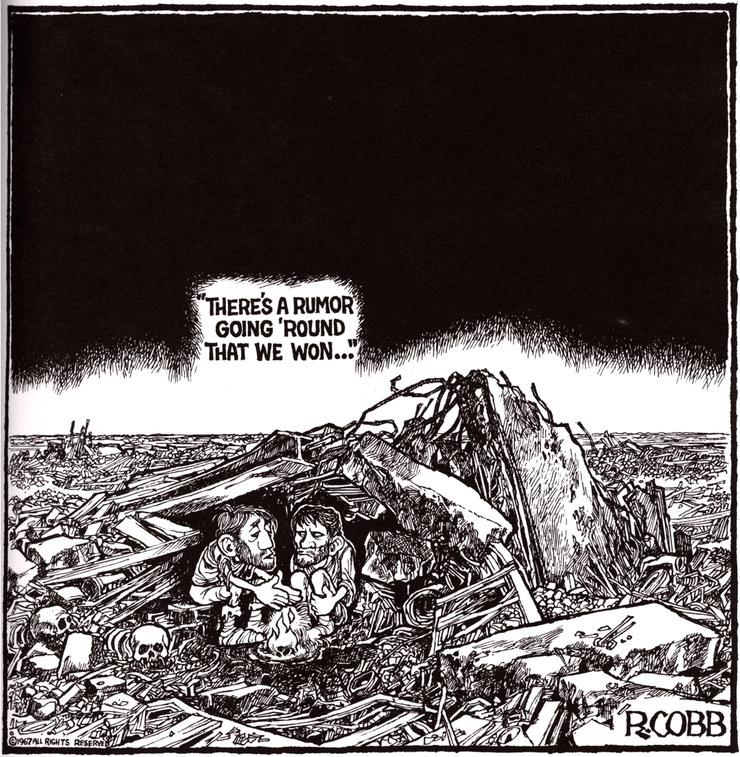
The United States is planning to deploy nuclear weapons to the UK for the first time in 15 years, The Telegraph reported Friday, citing Pentagon documents.
The report also comes amid heightened tensions between NATO and Russia over the Ukraine conflict, and calls from some Western politicians to prepare for a potential armed clash with Moscow.
The British newspaper cited procurement contracts for a new facility at the Royal Air Force station at Lakenheath in Suffolk, which point to Washington’s intention to bring nuclear weapons to the base.
RAF Lakenheath is expected to house B61-12 bombs that are three times more powerful than those dropped on Hiroshima in 1945, the Telegraph said.
The US sent F-35 nuclear-capable fighters to the base last year.
Significant modernization is underway at RAF Lakenheath for F-35A aircraft, a planned “surety dormitory,” and other infrastructure indicating that the nuclear weapons mission may be returning after a hiatus of 15 years.
The nuclear-related upgrades to RAF Lakenheath are taking place as the new 495th Fighter Squadron (hosted at RAF Lakenheath) prepares to become the first U.S. Air Force squadron in Europe to be equipped with the nuclear-capable F-35A Lightning II.
Britain has bombed Yemen and flown dozens of military supply flights from it Cyprus colony to the Israeli military to keep up the bombing of Gaza, now equivalent to over 2 Hiroshimas- UK/US policy is drawing the ire of missile equipped solidarity militias in Iraq, Yemen, Syria and Lebanon.
The upgrades coincide with the long-planned delivery of the new B61-12 gravity bombs to Europe, which will replace the approximately 100 legacy B61-3s and -4s currently estimated to be deployed in Europe.
Russian Foreign Ministry spokeswoman Maria Zakharova said last year that Moscow would be compelled to enact “compensatory countermeasures” if American nuclear warheads were to return to Britain.
Russia has accused the West of stoking tensions in Europe and maintains that the eastward expansion of NATO is one of the root causes of the Ukraine conflict.
High-ranking European officials, including German Defense Minister Boris Pistorius, have spoken of the need to brace for a potential war with Russia. Last week the chair of the NATO Military Committee, Admiral Rob Bauer, urged the bloc to be “readier across the whole spectrum” for direct confrontation.
The head of Russia’s Foreign Intelligence Service, Sergey Naryshkin, dismissed the claims that Moscow was planning an offensive against NATO as “information warfare” aimed at justifying “hybrid aggression.”
Fuggedaboutit! BY PHILIP GIRALDI • UNZ REVIEW • JANUARY 25, 2024 I sometimes wonder what the Founders, if they could return to life and see their creation, would think of today’s American Republic. President George W. Bush described the Constitution of the United States as “just a goddamned piece of paper” before he went on a rampage […]






 The Free