Communiqué by the Autonome Antifa Freiburg from 10.11.2017 about the censoring of Indymedia linksunten by the Federal Ministry of the Interior
On 25 August 2017 Federal Minister of the Interior Thomas de Maizière, a member of the CDU, announced the ban of the open-posting platform Indymedia linksunten. Early in the morning, at 5:30, some 250 police raided four private houses and the Autonomous Center KTS in Freiburg. The raids were against five named persons.
Three of these people were handed the ban order from the Federal Ministry of the Interior by the police of the LKA Baden-Württemberg (State Criminal Police Office) who conducted the raid. The Federal Ministry had instructed the State Ministry of the Interior of Baden-Württemberg to enforce the ban. It in turn instructed the Government presidium Freiburg to do so. The Government presidium Freiburg then asked the LKA Baden-Württemberg for official assistance.
On 1 September the LKA confiscated additional IT infrastructure in Freiburg, giving the reason that the computers confiscated in the first raid were described as “strongly encrypted”. In the week following the raids the people concerned were followed round the clock by observation teams. Additionally the confiscation of post and email was ordered.
A week after the raids, the car of one of the concerned people was broken open and the interior panelling of the driver’s door was opened. Inside the KTS, safes were pulled out of walls during the raids and nearly all locks were broken. The autonomous center was devastated. The damage, including the confiscation of money and of technical equipment, amounts to around 80.000 Euro. Continue reading “Germany in Winter “our Ideas are still Alive, our Resistance not Broken.””
Ukrainian world chess champion not playing in dictatorial Saudi Arabia
”The Saudi State only exists so the US can rule the Oil Market. Terrorism, extreme misogyny, slavery and mass murder are therefore acceptable with impunity”.
This video is called The Famous Chess Trap In Action By Anna Muzychuk.
Una explosión sacudió un oleoducto de crudo que alimenta la terminal marítima de Es Sider en Libia, dijo una fuente petrolera en el país.
IN ENGLISH HERE El puerto mediterráneo de Es Sider es el mayor depósito de petróleo de Libia. La explosión ocurrió cerca de Marada, en el oleoducto perteneciente a la compañía petrolera Waha, dijo la fuente a Reuters.
El puerto está controlado ahora por las fuerzas del General Hafter. los ‘últimos noticias son que el petróleo había sido redirigido a otro oleoducto y que se perderán menos de 100.000 barriles por día en exportaciones durante aproximadamente una semana. Sin embargo, los precios del petróleo en los Estados Unidos alcanzaron un nuevo récord después de la noticia. una foto en Twitter del oleoducto.. 26 de diciembre 17
“Una fuente militar dijo a RIA Novosti que la” gran “explosión en el oleoducto fue el resultado de un ataque terrorista” Los combatientes pertenecían a las Brigadas de Defensa de Benghazi (afiliadas a Al Qaeda) o al Estado Islámico (IS, anteriormente ISIS / ISIL) ya que son terroristas que llevan a cabo desvíos para paralizar las instalaciones de producción petrolera “. Russia Today Reportuna foto en Twitter del oleoducto.. 26 de diciembre 17
“En marzo del 2017 las fuerzas leales al comandante militar de Libia, Khalifa Haftar, recapturaron Es Sidar y reanudaron las operaciones”.
Repsol sigue saqueando Libia … Las ganancias se disparan mientras que los vecinos Tuareg y Tebu pasan hambre
El sabotaje de Es Sider, sin embargo, no interrumpirá las exportaciones del yacimiento petrolífero de Sharara, donde la empresa española Repsol tiene la mayor participación del 60%. Sharara ahora exporta casi 300.000 barriles de petróleo por día, lo que le da enormes ganancias a Repsol.El inmenso campo petrolero de Sharara. El gas metano se quema, desperdiciando un recurso no renovable para obtener ganancias más rápidas. No les importa la creciente emergencia climática del planeta, al contrario el Repsol se jacta del incremento de la extracción y la gente local se queján del racismo y que no han recibido nada.Continue reading “Repsol Sigue Saqueando Libia: el último Sabotaje de un Oleoducto no le Afecta.”
by UndercoverInfo On the day Brexit beleaguered Britain gets a new passport there will be the inevitable street parties by flag-waving, jingoistic and nationalistic loons. And accompanying those sickening celebrations there is likely to be a surge in hate crimes against anyone looking ‘foreign’, including tourists.
An explosion has rocked a crude oil pipeline that feeds the Es Sider sea terminal in Libya, an oil source in the country said.
The Mediterranean port of Es Sider, the largest oil depot in Libya. The blast occurred near Marada, on the pipeline belonging to the Waha oil company, the source told Reuters.
The port is now controlled by the powerbroker General Hafter’s forces. Later reports said that oil had been re-routed and less than 100,000 barrels a day in exports will be lost for about a week. Nevertheless oil prices in the US hit a new high on the news. a twitter photo of the export pipeline 26 Dec 17
”A military source told RIA Novosti that the “large” explosion at the pipeline was the result of a terrorist attack“The fighters belonged to either (al-Qaeda-affiliated) Benghazi Defense Brigades or Islamic State (IS, formerly ISIS/ISIL) as they are terrorists who carry out diversions to cripple oil production facilities.” Russia Today Report
The news of the Libyan blast saw oil prices spike to above $65 a barrel on Tuesday, Reuters reported.”In March ’17 … Es Sidar was recaptured by forces loyal to Libya’s eastern-based military commander, Khalifa Haftar, and resumed operations”.
Repsol still looting Libya… Profits Soar while local Tuareg and Tebu go Hungry
The explosion will not however disrupt exports from the Sharara oilfield where Spanish company Repsol has the biggest 60% stake. Sharara now exports nearly 300.000 barrels of oil a day, making enormous profits for Repsol.
Protest of the Tuareg minority at the Sharara oilfield in south-west Libya demanding work, fuel and food
Chief Executive Officer – Josu Jon Imaz boasted that its ‘upstream’ profits soared by $69 million when the pipeline from Sharara to the port came back online after protest Blockades in the second quarter of 2016. (source Repsol).
Google map image of part of Repsol’s Sharara oil extraction
Repsol’s local company has contributed nothing that we know of to alleviate the extreme suffering of the impoverished local people suffering racist discrimination in the Ubari area next to the oilfield. Instead it is concentrating on trying to boost its profits by pumping out Libyan oil even faster, aiming for 330,000 barrels a day in the near future .
Repsol is joint operator with both the National Oil Corporation (NOC), France’s ‘imperialist’ Total, and Austria’s OMV which also have stakes in what is currently Libya’s biggest oilfield.The Sharara oilfield is situated in the middle of what was once Lake Megafezzan, once bigger than the UK, which is now dried up, it may not rain for 5 years in the area. . All that is left are a dozen small salt lakes near Ubari fed from the extensive Sahara aquifer beneath, which may be already damaged or in imminent danger from Repsol’s oil extraction. The Tuareg eat the red shrimps which thrive in the ultra salty water.Continue reading “Repsol Looting Libya: profits unaffected by Pipeline Sabotage:”
On the night before Christmas, we’ll all be about. While the people are sleeping, we’ll realise our clout. We’ll expropriate goods from the stores, ‘cos that’s fair. And distribute them widely, to those who need care.Ruth Kinna 20 December 2018
Can we reclaim Christmas for the masses? Credit: Grace Wilson/STRIKE! magazine.
An anarchist guide to Christmas
It’s no surprise to discover that anarchist theorist Pyotr Kropotkin was interested in Christmas. In Russian culture, St. Nicholas (Николай Чудотворец) was revered as a defender of the oppressed, the weak and the disadvantaged. Kropotkin shared the sentiments.
A principle or theory of life and conduct under which society is conceived without government — harmony in such a society being obtained, not by submission to law, or by obedience to any authority, but by free agreements concluded between the various groups…
But there was also a family link. As everyone knows, Kropotkin could trace his ancestry to the ancient Rurik dynasty that ruled Russia before the upstart Romanovs and which, from the first century CE, controlled the trade routes between Moscow and the Byzantine Empire. Nicholas’s branch of the family had been sent out to patrol the Black Sea.
But Nicholas was a spiritual man and sought an escape from the piracy and brigandage for which his Russian Viking family was famed. So he settled under a new name in the southern lands of the Empire, now Greece, and decided to use the wealth that he had amassed from his life of crime to alleviate the sufferings of the poor.
Unpublished archival sources recently discovered in Moscow reveal that Kropotkin was fascinated by this family tie and the striking physical similarity between himself and the figure of Father Christmas, popularised by the publication of ‘A Visit from St. Nicholas’ (better known as ‘The Night Before Christmas’) in 1823.
Kropotkin was not quite so portly as Klaus, but with a cushion stuffed up his tunic, he felt he could pass. His friend Elisée Reclus advised him to drop the fur trim on the outfit. That was a good idea as it would also allow him to wear a bit more black with the red.
The need for a new life becomes apparent. The code of established morality, that which governs the greater number of people in their daily life, no longer seems sufficient.
He’d decided to follow Elisée’s advice on the reindeer, too, and to use a hand driven sleigh. Kropotkin wasn’t normally given to dressing up. But exploiting the resemblance to spread the anarchist message was excellent propaganda by the deed.
Anticipating ‘V’, Kropotkin thought that we could all pose as Santa Claus. On the edge of one page Kropotkin writes: “Infiltrate the stores, give away the toys!”
Faint remnants on the back of a postcard read:
On the night before Christmas, we’ll all be about While the people are sleeping, we’ll realise our clout We’ll expropriate goods from the stores, ‘cos that’s fair And distribute them widely, to those who need care.
His project notes also reveal some valuable insights into his ideas about the anarchistic features of Christmas and his thinking about the ways in which Victorian Christmas rituals might be adapted.
“We all know”, he wrote, “that the big stores – John Lewis, Harrods and Selfridges – are beginning to exploit the sales potential of Christmas, establishing magic caves, grottos and fantastic fairylands to lure our children and pressurise us to buy gifts that we do not want and cannot afford”.
“If you are one of us”, he continued, “you will realise that the magic of
Men lived thousands of years before the first States were constituted…
Christmas depends on Father Christmas’s system of production, not the stores’ attempts to seduce you to consume useless luxuries”. Kropotkin described the sprawling workshops at the North Pole, where elves worked all year, happily because they knew that they were producing for other peoples’ pleasure. Noting that these workshops were strictly not-for profit, craft-based and run on communal lines, Kropotkin treated them as prototypes for the factories of the future (outlined in Fields, Factories and Workshops).
Some people, he felt, thought that Father Christmas’s dream to see that everyone received gifts on Christmas day, was quixotic. But it could be realised. Indeed, the extension of the workshops – which were quite expensive to run in the Arctic – would facilitate generalised production for need and the transformation of occasional gift-giving into regular sharing. “We need to tell the people”, Kropotkin wrote, “that community workshops can be set up anywhere and that we can pool our resources to make sure that everybody has their needs met”!
One of the issues that most bothered Kropotkin about Christmas was the way in which the inspirational role that Nicholas’s had played in conjuring Christmas myths had confused the ethics of Christmas. Nicholas was wrongly represented as a charitable, benevolent man: saintly because he was beneficent. Absorbed in the figure of Father Christmas, Nicholas’s motivations for giving had become further skewed by the Victorian’s fixation with children.
Kropotkin didn’t really understand the links, but felt that it reflected an attempt to moralise childhood through a concept of purity that was symbolised in the birth of Jesus. Naturally he couldn’t imagine the creation of the Big Brother Santa Claus who knows when children are asleep and awake and comes to town apparently knowing which have dared to cry or pout.
But sooner or later, he warned, this idea of purity would be used to distinguish naughty from nice children and only those in the latter group would be rewarded with presents.
Whatever the case, it was important both to recover the principle of Nicholas’ compassion from this confusing mumbo-jumbo and the folkloric origins of Santa Claus. Nicholas gave because he was pained by his awareness of other peoples’ hardship. Though he wasn’t an assassin (as far as Kropotkin knew), he shared the same ethics as Sofia Petrovskaya. And while it was obviously important to worry about the well-being of children, the anarchist principle was to take account of everyone’s suffering.
Similarly, the practice of giving was mistakenly thought to require the implementation of a centrally-directed plan, overseen by an omniscient administrator. This was quite wrong: Father Christmas came from the imagination of the people (just consider the range of local names that Nicholas had accrued – Sinterklaas, Tomte, de Kerstman). And the spreading of good cheer – through festivity – was organised from the bottom up.
Buried in Christmas, Kropotkin argued, was the solidaristic principle of mutual aid.
Kropotkin appreciated the significance of the ritual and the real value that
The education we all receive from the State, at school and after, has so warped our minds that the very notion of freedom ends up by being lost, and disguised in servitude.
individuals and communities attached to carnivals, acts of remembrance and commemoration. He no more wanted to abolish Christmas than he wished to see it republicanised through some wrong-headed bureaucratic re-ordering of the calendar.
It was important, nonetheless, to detach the ethic that Christmas supported from the singularity of its celebration. Having a party was just that: extending the principle of mutual aid and compassion into everyday life was something else. In capitalist society, Christmas provided a space for special good behaviours. While it might be possible to be a Christian once a year, anarchism was for life.
When we see how voluntary societies invade everything and are only impeded in their development by the State, we are forced to recognize a powerful tendency, a latent force in modern society.
Kropotkin realised his propaganda would have the best chance of success if he could show how the anarchist message was also embedded in mainstream culture. His notes reveal that he looked particularly to Dickens’ A Christmas Carol to find a vehicle for his ideas. The book was widely credited with cementing ideas of love, merriment and goodwill in Christmas. Kropotkin found the genius of the book in its structure. What else was the story of Scrooge’s encounter with the ghosts of Christmas past, present and future than a prefigurative account of change?
By seeing his present through his past, Scrooge was given the chance to alter his miserly ways and re-shape both his future and the future of the Cratchit family. Even if it was only remembered once a year, Kropotkin thought, Dickens’s book lent anarchists a perfect vehicle to teach this lesson: by altering what we do today, by modelling our behaviours on Nicholas, we can help construct a future which is Christmas!
This article was originally published by STRIKE! magazine in 2014.
Kropotkin was Right: Cooperation beats Competition
New studies are proving false whole libraries that claim humans are innately selfish and cruel. Starting with a false view of Darwin’s theory of Evolution right wing leaders of opinion have built a tower of lies to justify their crimes against humanity, as argued from the beginning by the anarchist Peter Kropotkin. Humans are innately cooperative and empathetic, and this gives us the basis for a new kind of non-capitalist system. We reprint below a new article by the influential science journalist George Monbiot on these themes.
Human Kind
new evidence shows human cooperation and empathy predominate
Fascinating new lines of research suggest that we are good people, tolerating bad things.
Do you find yourself thrashing against the tide of human indifference and selfishness? Are you oppressed by the sense that while you care, others don’t? That because of humankind’s callousness, civilisation and the rest of life on earth are basically stuffed? If so, you are not alone. But neither are you right.
A study by the Common Cause Foundation, due to be published next month, reveals two transformative findings. The first is that a large majority of the 1000 people they surveyed – 74% – identify more strongly with unselfish values than with selfish values. This means that they are more interested in helpfulness, honesty, forgiveness and justice than in money, fame, status and power. The second is that a similar majority – 78% – believes others to be more selfish than they really are. In other words, we have made a terrible mistake about other people’s minds.
The revelation that humanity’s dominant characteristic is, er, humanity will come as no surprise to those who have followed recent developments in behavioural and social sciences. People, these findings suggest, are basically and inherently nice.
A review article in the journal Frontiers in Psychology points out that our behaviour towards unrelated members of our species is “spectacularly unusual when compared to other animals”. While chimpanzees might share food with members of their own group, though usually only after being plagued by aggressive begging, they tend to react violently towards strangers. Chimpanzees, the authors note, behave more like the Homo economicus of neoliberal mythology than people do.
Humans, by contrast, are ultra-social: possessed of an enhanced capacity for empathy, an unparalleled sensitivity to the needs of others, a unique level of concern about their welfare and an ability to create moral norms that generalise and enforce these tendencies.
Such traits emerge so early in our lives that they appear to be innate. In other words, it seems that we have evolved to be this way. By the age of 14 months, children begin to help each other, for example by handing over objects another child can’t reach. By the time they are two, they start sharing things they value. By the age of three, they start to protest against other people’s violation of moral norms.
A fascinating paper in the journal Infancy reveals that reward has nothing to do with it. Three to five-year-olds are less likely to help someone a second time if they have been rewarded for doing it the first time. In other words, extrinsic rewards appear to undermine the intrinsic desire to help. (Parents, economists and government ministers, please note). The study also discovered that children of this age are more inclined to help people if they perceive them to be suffering, and that they want to see someone helped whether or not they do it themselves. This suggests that they are motivated by a genuine concern for other people’s welfare, rather than by a desire to look good. And it seems to be baked in.
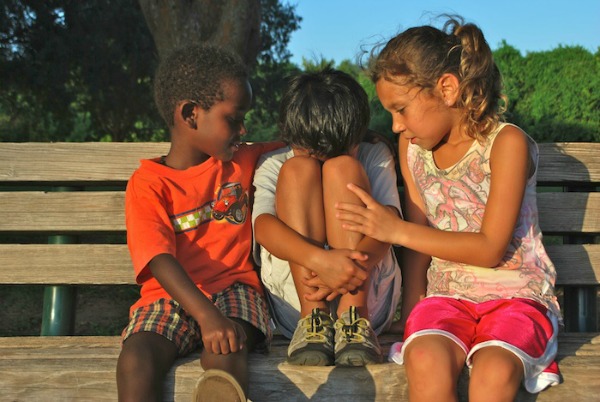
Children sharing ice-cream on stick near Sapa.
Why? How would the hard logic of evolution produce such outcomes? This is the subject of heated debate. One school of thought contends that altruism is a logical response to living in small groups of closely related people, and evolution has failed to catch up with the fact that we now live in large groups, mostly composed of strangers. Another argues that large groups containing high numbers of altruists will outcompete large groups which contain high numbers of selfish people. A third hypothesis insists that a tendency towards collaboration enhances your own survival, regardless of the group in which you might find yourself. Whatever the mechanism might be, the outcome should be a cause of celebration.
So why do we retain such a dim view of human nature? Partly, perhaps, for historical reasons. Philosophers from Hobbes to Rousseau, Malthus to Schopenhauer, whose understanding of human evolution was limited to the Book of Genesis, produced persuasive, influential and catastrophically mistaken accounts of “the state of nature” (our innate, ancestral characteristics). Their speculations on this subject should long ago have been parked on a high shelf marked “historical curiosities”. But somehow they still seem to exert a grip on our minds.
Another problem is that – almost by definition – many of those who dominate public life have a peculiar fixation on fame, money and power. Their extreme self-centredness places them in a small minority, but, because we see them everywhere, we assume that they are representative of humanity.
The media worships wealth and power, and sometimes launches furious attacks on people who behave altruistically. In the Daily Mail last month, Richard Littlejohn described Yvette Cooper’s decision to open her home to refugees as proof that “noisy emoting has replaced quiet intelligence” (quiet intelligence being one of his defining qualities). “It’s all about political opportunism and humanitarian posturing,” he theorised, before boasting that he doesn’t “give a damn” about the suffering of people fleeing Syria. I note with interest the platform given to people who speak and write as if they are psychopaths.
The consequences of an undue pessimism about human nature are momentous. As the Common Cause Foundation’s survey and interviews reveal, those who have the bleakest view of humanity are the least likely to vote. What’s the point, they reason, if everyone else votes only in their own selfish interests? Interestingly, and alarmingly for people of my political persuasion, it also discovered that that liberals tend to possess a dimmer view of other people than conservatives do. Do you want to grow the electorate? Do you want progressive politics to flourish? Then spread the word that other people are broadly well-intentioned.
Misanthropy grants a free pass to the grasping, power-mad minority who tend to dominate our political systems. If only we knew how unusual they are, we might be more inclined to shun them and seek better leaders. It contributes to the real danger we confront: not a general selfishness, but a general passivity. Billions of decent people tut and shake their heads as the world burns, immobilised by the conviction that no one else cares.
You are not alone. The world is with you, even if it has not found its voice.
An Israeli military court has extended the detention of Ahed Tamimi, a 16-year-old girl who has become the face of Palestinian resistance to Israel’s military occupation of the West Bank for many who follow the weekly protests in her village through social media.Ahed was arrested in an overnight raid of her family’s home in the village of Nabi Saleh last Monday.



















 The Free