The Long Struggle Against Brazil’s Land Barons

from thefreeonline by Jocelyn C. Zuckerman on January 12, 2023 at Yale Environment 360
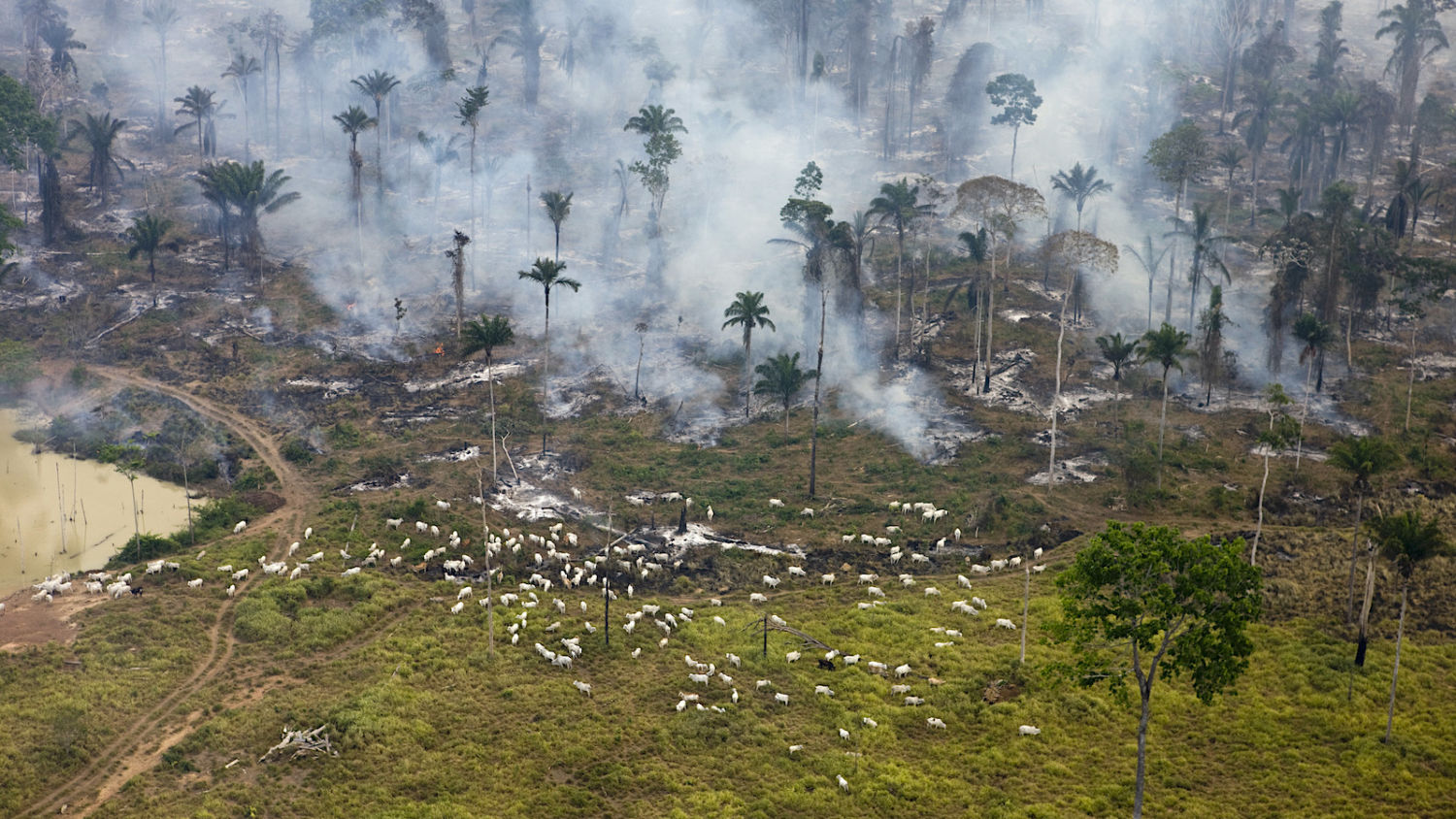
A fire set to clear land for farming in Pará state in the Brazilian Amazon.
A fire set to clear land for cattle in Pará state in the Brazilian Amazon. Daniel Beltrá / Greenpeace

INTERVIEW

Journalist Heriberto Araujo spent four years reporting on the destruction of the Brazilian Amazon. In an interview with Yale Environment 360, he talks about his new book, which explores the complex web of issues underpinning the deforestation of the world’s largest rainforest.

Last October, when former President Luiz Inácio Lula da Silva defeated the far-right incumbent, Jair Bolsonaro, in Brazil’s national election, environmentalists around the world breathed a sigh of relief.

Under Bolsonaro, who had weakened environmental protections and pushed to open Indigenous lands to commercial exploitation, deforestation in the Amazon had exploded.

Lula has pledged to safeguard his country’s rainforests, but, as Spanish journalist Heriberto Araujo says in an interview with Yale Environment 360, the job won’t be easy.Read more.. After two murders, a Brazilian Indigenous leader steps up the fight.
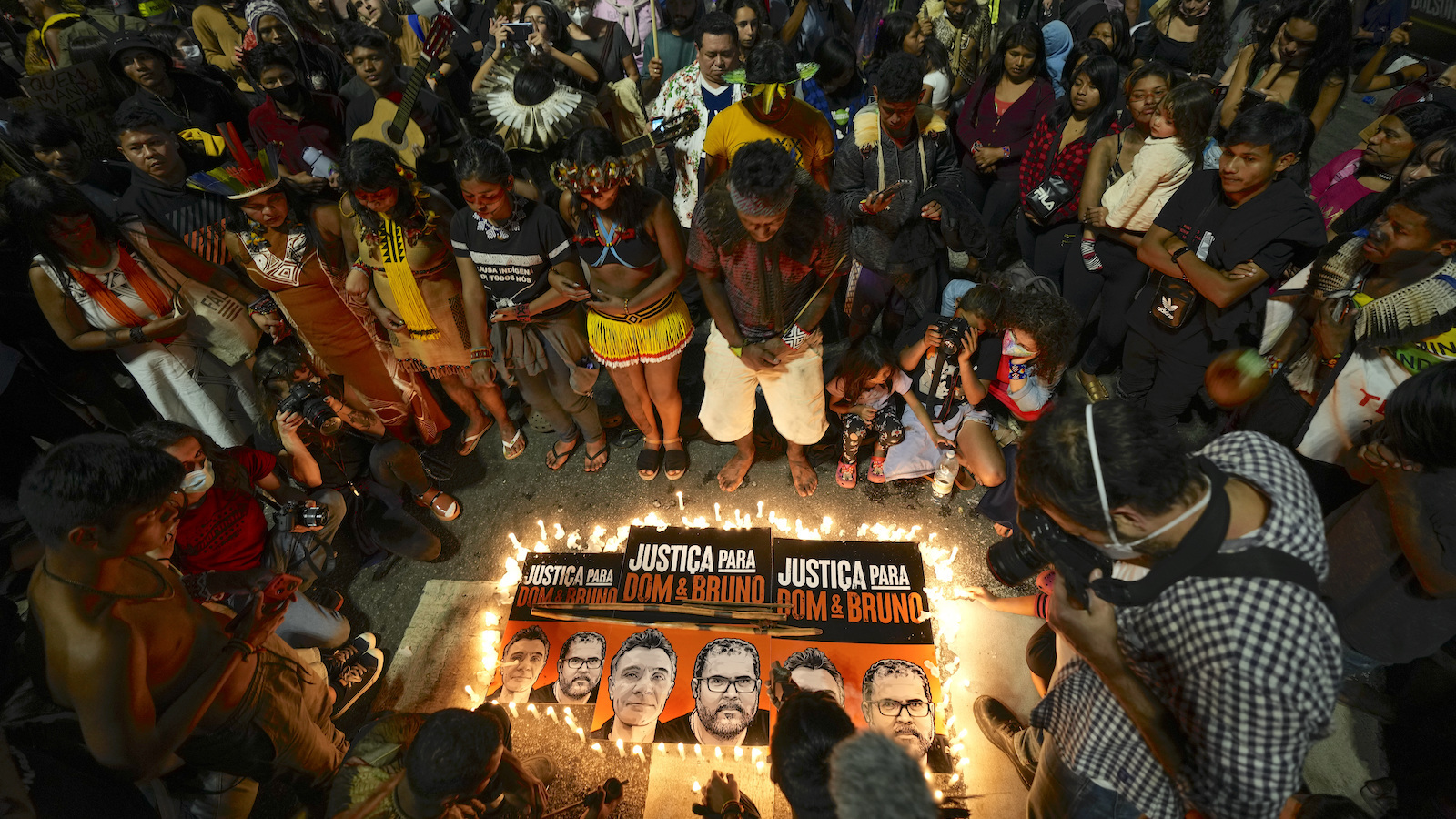
For his new book, Masters of the Lost Land, Araujo spent four years traveling from his home in Rio de Janeiro to Rondon do Pará, a town in the eastern Brazilian Amazon, to understand how, in less than 60 years, the largest rainforest on the planet has been transformed into an engine of economic growth.

Tracing the story of land rights activist José Dutra da Costa, or “Dezinho,” who, before his assassination in 2000, led a revolution among landless peasants, Araujo comes to see how a handful of ranchers managed to grab huge swaths of pristine rainforest and why deforestation, violence, and lawlessness remain pervasive in the region.

Heriberto Araujo.
Heriberto Araujo. Heriberto Araujo

When it comes to reining in the destruction, Araujo tells e360, stopping those holding the chainsaws must be only the beginning.

“The key issue will be making sure the bad guys are unable to benefit from global markets. Because if there’s a way to launder your deforestation-linked timber or beef and to sell it, you have an incentive to continue doing that.”

Yale e360: What made you decide to write this book?

Heri Araujo: I had begun making trips to the Amazon to report on deforestation, and at one point someone at Greenpeace told me about a town named Rondon do Pará and an activist there whose husband had been murdered — her husband had died in her arms.

So I traveled to Rondon and found Maria Joel. Eventually I realized that this little town allowed me to explain the whole story of the Brazilian Amazon.

In terms of deforestation, everything is pretty recent. It started in the 1960s. And every time I learned about a new person or event related to the phenomenon, I could always find a link to Rondon or Maria Joel.

e360: It must have been difficult to report.

Araujo: It was a complicated process. It helped that I had been a reporter in China for seven years. I learned to deal with censorship and other kinds of dangers — maybe not the danger of being murdered, but of being expelled from the country.

And I learned to avoid announcing my presence as a foreign reporter. I speak decent Portuguese, and I kind of look like an average Brazilian, so people were relatively open to talking with me.

“Today, something like 45 percent of the land in Brazil is controlled by 1 percent of the population.”

e360: Tell me about the progression of Rondon over the decades.

Araujo: As often happens in that area — the eastern edge of the Amazon — it started with an infrastructure project. In Rondon, it was an unpaved road, named the Nut Road.

There were several trails that collectors of Brazil nuts would follow to enter the rainforest. In the late ‘60s, the state began to think about developing a road to allow these nut gatherers to increase their production.

As soon as people became aware that it might be possible to claim a plot on the side of the road, they began to move in. At the time, Rondon was a frontier. It was inhabited by Indigenous nations.

Continue reading “The Long Struggle Against Brazil’s Land Barons”

Alexei Rozhkov.. anarchist Jailed for Firebombing Russian Recruitment Office, now free and tells his Story

from thefreeonline by Ivan Astashin on 17th Jan 2023 at The Russian Reader

“‘I believe I saved people’: an interview with one of the first to torch a military enlistment office in Russia,” DOXA,

Russian Protesters Released From Custody Vow To Fight On

(….. )Alexei Rozhkov responded with Molotov cocktails to the decision by the Russian authorities to launch a full-scale invasion of Ukraine.

On March 11, he set fire to a military enlistment office in the suburbs of Yekaterinburg.

He was detained the same day and charged with “attempted murder”: allegedly, there had been a watchwoman in the building at the time. The young man faced up to fifteen years in prison.

Alexei was held in a pretrial detention center for six months. The charges were then unexpectedly reduced to a less serious crime — “property damage” — and the insurgent was released on his own recognizance.

After a time, thanks to the support of a human rights organization, Rozhkov left Russia, and we were able to speak to him.

see also Support filmmaker on trial for a “seditious ” LIKE – Accuser backs down in Case of jailed Russian Anti-War Activist Vsevolod Korolevttp

****

Tell me what you did before February 24. Did you have a job? Any hobbies? Were you interested in politics?

Rozhkov: I lived in the city of Beryozovsky, a suburb of Yekaterinburg with a population of about 100 thousand. Yekaterinburg itself can be reached by bus in twenty or thirty minutes. I worked as a sales consultant at a DNS store.

I was fond of music — I’m a guitarist, a bassist. About six years ago, I had a band, Tell Me the Reason. I started recording a solo album [before February 24], which is still not finished due to the war, having to moving around, and being in prison.

I love dynamic, energetic music: it invigorates me, helps me get out of depression, and gets me warmed up and excited.

I have been interested in politics since I was fourteen. [Alexei is now twenty-five.] My views have changed over time. Previously, they were more democratic or something, more legal.

Now I can call myself a left-wing anarchist. I have always campaigned to open people’s eyes and make them see what is happening with the country — for example, with the standard of living. I talked to my family and acquaintances, friends and even strangers.

I drew leaflets and spray-painted walls. Do you know those big advertising banners? At night, I would climb up and write “Putin is a thief” on them. At the time, he was merely a thief. But now, of course, he is not just a thief but also a murderer.

I wrote on such billboards at night so that people would also start asking questions and arrive at the same opinion.

Tell Me the Reason

Tell me why you decided to set fire to the military enlistment office. What did you hope to achieve?

Rozhkov: Since February 22, I had been closely following independent media and social media channels. I expected the war to start in the last week of month, because Russian troops were amassed in Belgorod, Belarus, and other border areas.

Continue reading “Alexei Rozhkov.. anarchist Jailed for Firebombing Russian Recruitment Office, now free and tells his Story”

Spain: Brave Animal Rights Activists Protest Naked in Madrid Demanding Closure of all Fur Factories.

from thefreeonline at World Animals Voice  by Thema Newsroom on January 16, 2023

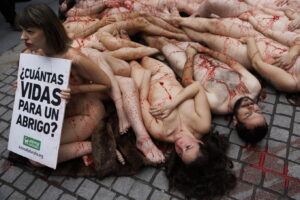
How many Lives For A FUR COAT?

They demanded the Spanish government close all fur factories

Related

More than 50 naked animal rights activists covered in red paint protested in Madrid shouting slogans. The members of the international animal rights organisation “AnimaNaturalis”, protested in the centre of the Spanish capital, demanding the closure of fur farms.

Protesters lay naked on the ground in a central square in the Spanish capital and having painted their bodies with blood-red paint – in an attempt to represent dead animals – they called for an end to their mass slaughter to make furs and leather belts.Image

Their aim is to raise public awareness of the huge number of animals that are killed to make a single fur coat and to put pressure on the Spanish government to hold discussions that will lead to the closure of all fur farms in the country.

At the same time, with the protest, they are trying to promote and support the European Citizens’ Initiative (ECI) #FurFreeEurope which will pressure the European Commission to ban such farms in the EU and introduce strict rules for the import of animal skins on the markets of the Old Continent.

Transnationals covet resources in Zapatista territory: SEDENA

Minerals, water, wood and fossil fuels are among the resources identified by the SEDENA in Zapatista Territory that transnationals want to loot.

  from thefreeonline on by Chiapas Support Committee By: Zosísimo Camacho

  1 Comment

This image has an empty alt attribute; its file name is 2-cuartoscuro.jpg

Las Margaritas, Chiapas, October 14, 2017 – Autonomous Zapatista authorities receive María de Jesús Patricio Martínez “Marichuy,” in the community of Guadalupe Tepeyac. Photo: ADOLFO VLADIMIR / CUARTOSCURO.COM

. They are of interest to transnationals such as FEMSA Coca Cola, Frontier Development Group and First Majestic, and to the public companies CFE and Pemex.

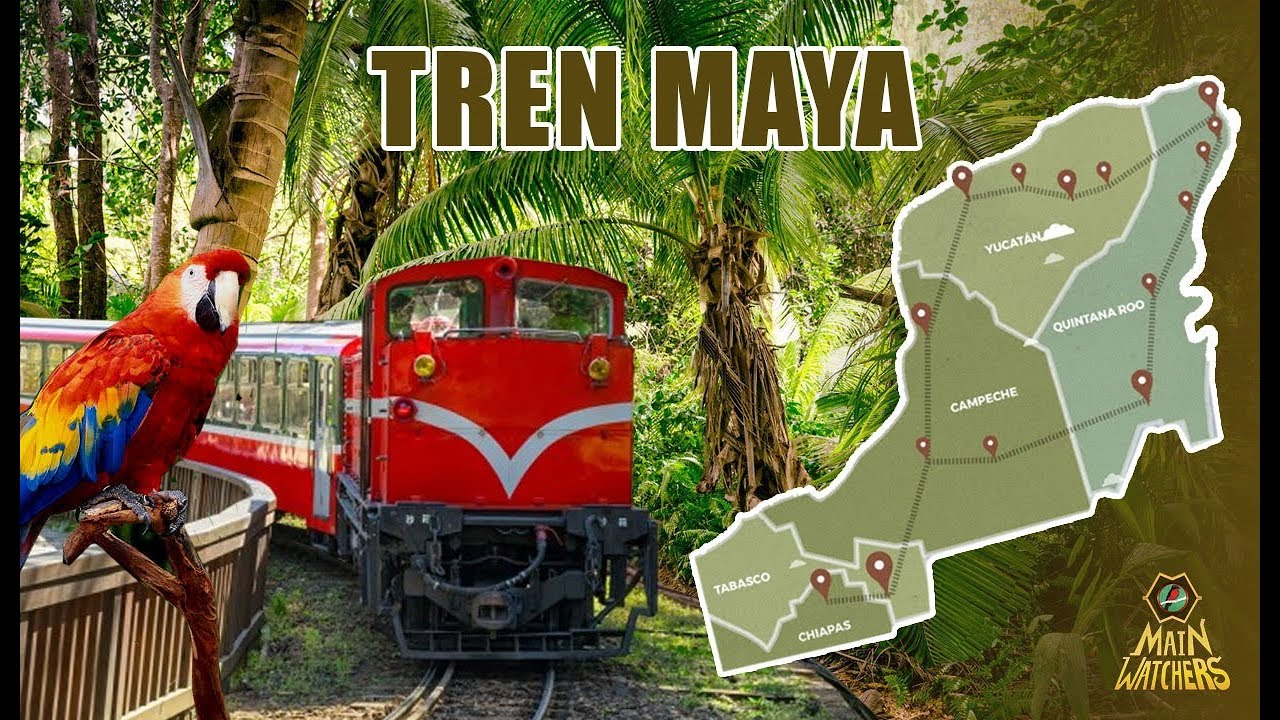
The “complaints” of the “self-named” Zapatista National Liberation Army (EZLN) to the Mexican State are focused on the current “mining, oil wells, super highways, highways and mega [water] wells” concessions, as well as on the construction of the Maya Train, according to an internal document of the Secretariat of National Defense (SEDENA), dated February 2020.

It warned that the policies and development projects of the federal government in the indigenous regions, as well as the continuity of the concessions granted in previous six-year periods, have “increased the tension” between the Zapatista bases and leaders and those of the federal government.

The study Socio-political Activism of the EZLN and its Impact on the National Security, ordered by SEDENA to its Mexican Institute of Strategic Studies in Security and National Defense, pointed out tensions between the Zapatista movement and the federal and state governments due to the arrival of public and private companies to indigenous territories throughout the country. And, particularly, the intentions to explore the Chiapas territory of Zapatista “influence.”

It cited the cases of the Federal Electricity Commission (CFE), Petróleos Mexicanos (Pemex), FEMSA Coca Cola, Frontier Development Group, First Majestic Silver Corp, Radius Gold and Blackfire Exploration.

It emphasized that at the heart of the complaints was the extraction necessary for development projects, from water, gas and oil, to timber and precious and industrial minerals.

The report placed the EZLN as one of the poles around which part of the leftist opposition to the 4T is articulated. The issues underpinning the discourse of this opposition are indigenous rights, water management, mining exploitation, electric power generation projects and the Maya Train (Tren Maya).

In the document “El Activismo Sociopolítico del EZLN” (The Sociopolitical Activism of the EZLN) — elaborated in February 2022– SEDENA identified what until then were, in its opinion, the main disputes between the Zapatista movement and the government of the so-called Fourth Transformation.

Continue reading “Transnationals covet resources in Zapatista territory: SEDENA”

Radical croissants: the Conquest of Bread

The anarcho-communist bakers serving the Paris suburbs

from thefreeonline on Jan 15 2023 at anarchist news.org by Nerea González EFE,

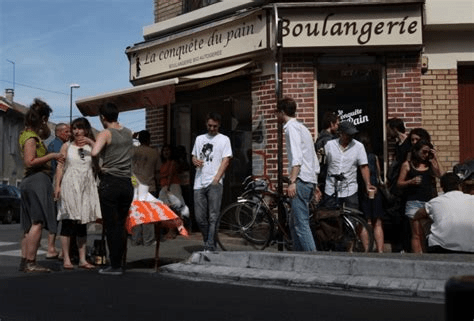
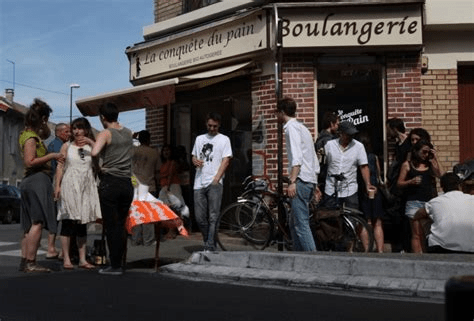
Montreuil, France, Jan 13 (EFE).- A bakery on the outskirts of Paris is combining classic French pastry with anti-capitalist political theory. 

La Conquête du Pain (The Conquest of Bread) takes its name from a text written by one of the most renowned anarcho-communist political analysts, Russian Peter Kropotkin.

“We are the owners of our work, there are no intermediaries or employers that take advantage of it,” Mexican Ricardo Alvarado, one of the six workers currently operating the bakery, tells Efe in an interview. 

Located on a street corner in the town of Montreuil, just over half an hour by public transport from the center of Paris, the bakery was inaugurated in 2010 inspired by the philosophy of Kropotkin.

Radical croissants: The anarcho-communist bakers serving the Paris suburbs

Thomas Anestoy and Pierre Pawin, founders of the project, wanted to demonstrate how workers can self-manage and master that most basic of human necessities — bread.

“The important thing is to show that the model works, that you can work without a boss and that you can sell bread at prices accessible to everyone (…),” says Bertrand Boulmé, another of the workers.

Anestoy and Pawin no longer work at La Conquête du Pain, but other teams have been taking care of the project. 

“For us, the important thing is not to make money, it’s not to get rich. The goal is to pay the rent, pay the suppliers and pay ourselves. There is no capitalist objective, only cost effectiveness,” says Boulmé.

Montreuil is a traditionally working-class and immigrant area, although workers say it has been gentrified in recent years.


The bakery offers a “normal” and a “crisis” price list for the same products, making it suitable for those on a limited budget

The French bakery’s star product, the artisanal baguette — recently listed by UNESCO as an intangible cultural heritage — has a reduced price of 0.75 euros and one euro for all other customers.

Other businesses sell baguettes for more than 1.20 euros, or even for 1.60 euros, in the most expensive places in Paris, but in the face of inflation, La Conquête du Pain has decided to keep the baguette at one euro.

“For electricity, we were paying a bill of 700-800 euros and the November bill was 1,600 euros,” says Alvarado. 

This Christmas, bakers in France led protests against the government of president Emmanuel Macron for excessive energy prices. 

In response, on January 6, the French president announced relief measures for small businesses, to avoid, among other things, a further rise in the price of bread.

Keeping this “anarchist business” afloat in 2023 is “hard”, the bakers themselves admit, but it is for them a preferable option to being accountable to a boss.EFE

La conquête du pain : Une boulangerie bio, coopérative et autogérée

Croissants radicales: La Conquista del Pan

Croissants radicales: los panaderos anarcocomunistas al servicio de los suburbios de París


desde thefreeonline Ene 15 2023 via La conquête du pain por Nerea González

Montreuil, Francia, 13 ene (EFE).- Una panadería de las afueras de París combina la clásica pastelería francesa con la teoría política anticapitalista.

La Conquête du Pain (La conquista del pan) toma su nombre de un texto escrito por uno de los analistas políticos anarcocomunistas más reconocidos, el ruso Peter Kropotkin.

“Somos dueños de nuestro trabajo, no hay intermediarios ni patrones que se aprovechen de él”, dice a Efe en una entrevista el mexicano Ricardo Alvarado, uno de los seis trabajadores que actualmente operan la panadería.

Situada en una esquina de la localidad de Montreuil, a poco más de media hora en transporte público del centro de París, la panadería fue inaugurada en 2010 inspirada en la filosofía de Kropotkin.

Thomas Anestoy y Pierre Pawin, fundadores del proyecto, querían demostrar cómo los trabajadores pueden autogestionarse y dominar la más básica de las necesidades humanas: el pan.

Continue reading “Croissants radicales: La Conquista del Pan”

‘White Tide’ of 30,000 take to the streets again in Madrid in defense of Public Health

from thefreeonline on 16th Jan 2923 by elcomunista.net

Some 30,000 people, according to data from the Government Delegation in Madrid, have attended the demonstration.

Through chants and banners we have shown our anger over the health conflict that the Community of Madrid is experiencing.

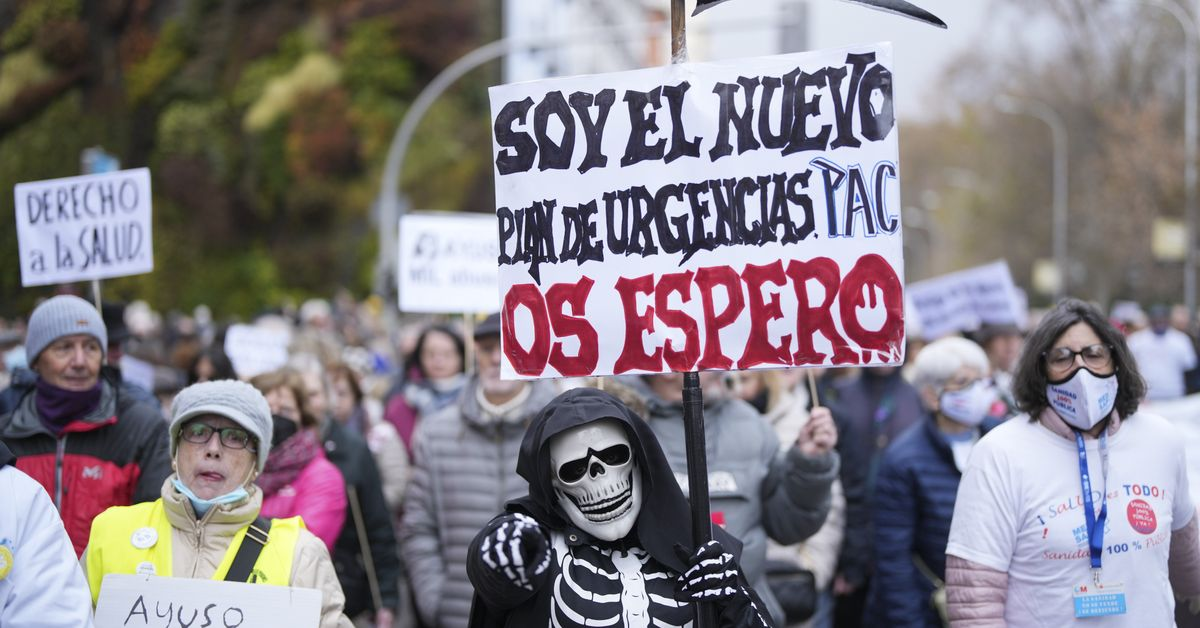
30,000 people took to the streets this Sunday in the capital, within the framework of the 97 White Tide, to criticize the rampant privatization and cuts in public health in the Community of Madrid and request more resources and financing for public services in the region.

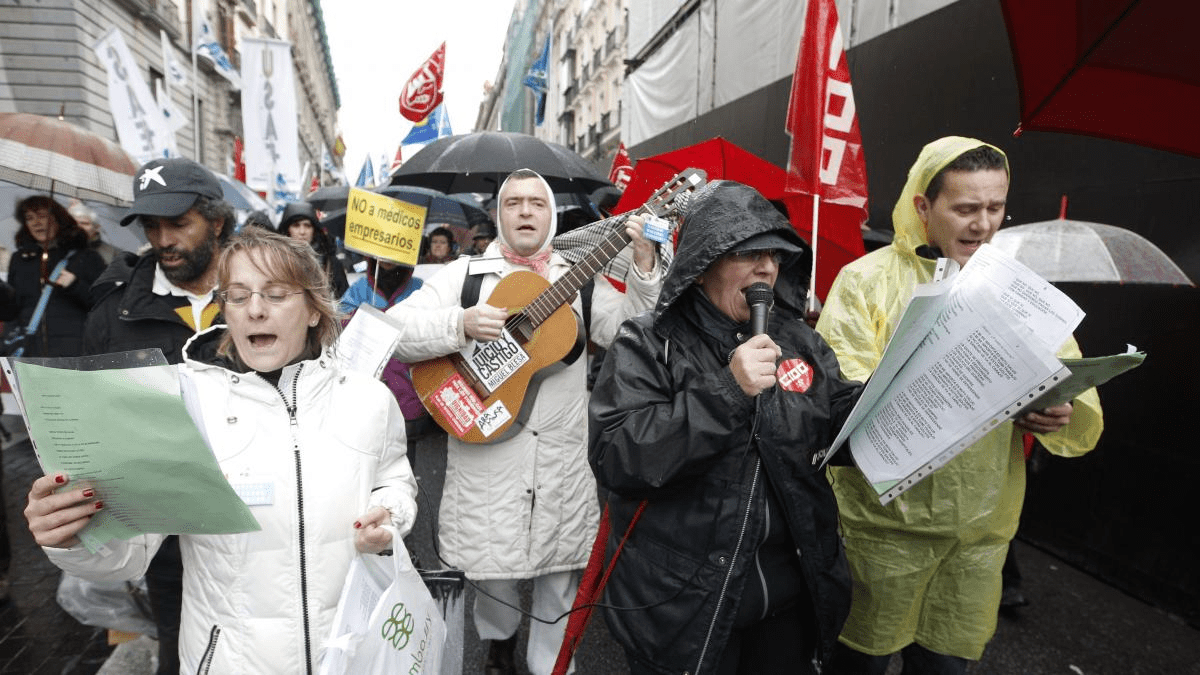
The low temperatures in the capital have not deterred the protesters, summoned by the Platform in Defense of Public Health – Marea Blanca, who through chants and banners have shown their rage over the health conflict between the unions and the regional government that has plagued Community of Madrid for months.

They have made it known through slogans such as “2023, public health without a solution”, “health is not for sale, health is defended”, “less speeches and more resources” or “cutting health is a criminal act”. , in a march in which criticism has also been made of the Ministry of Health and the regional president, Isabel Díaz Ayuso.

Demanding “action”

A

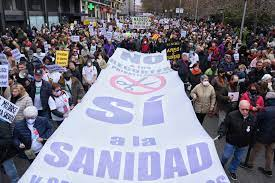
t the head of the protest, in front of a banner with the text “no to cuts and privatization, yes to health and public services”, Marisa Torres, spokesperson for the White Tide, has asked that the political leaders ” act once and for all” to solve the problem and has justified that there are “reasons” to be on the streets “with insistence and persistence”.

“If primary care is not given a solution now, together with the fact that the primary care emergency centers are not even working because we have them without equipment, everything is going to collapse in hospital emergencies, as we are seeing, and what is going to be generated is chaos and the collapse of the entire public system”, she stressed in statements to the press.

Torres has denounced that there are 800,000 patients in the region who are not assigned “neither a doctor nor a nurse nor a pediatrician”, which conflicts with the Health Regulation Law of the Community of Madrid.

“They want to implement the public-private system and we are totally against it, because public money has to go to the public”, she has argued.

‘More Madrid’ and ‘Unidas Podemos’ attend the demonstration

The leader of Más Madrid in the regional Assembly, Mónica García, has attended the protest to show her support for the demonstrators and, paraphrasing the new song by Shakira and the Argentine producer Bizarrap, has assured that the regional government “pretends to be our champion and when it is most needed he gives its worst version ”.

“Health professionals are no longer crying, the professionals are on strike and are acting”, she ironized in statements to journalists, while criticizing Ayuso’s “botch” and “arrogance” in the management of the health conflict and has asked that the politicians”Stop looking” at Moncloa presidential palace and focus on the problems of the people of Madrid.

The co-spokesperson for Unidas Podemos in the Madrid Assembly, Alejandra Jacinto, has also made use of a current song , who considering that the Community of Madrid, being the “richest region in all of Europe”, deserves a healthcare that is ” a Ferrari”, but Ayuso “is not even offering us even a Twingo”.

In her opinion, the president of the regional government intends to deploy a “business” plan so that people who want healthcare “have to pay for it.”

Demonstrations for health tour Spain

During this weekend, the demonstrations for public health have also traveled to other parts of Spain. In Terrassa, Barcelona, a rally on Saturday demanded improvements in primary care, having paediatricians and dentists in all outpatient clinics and making an appointment with a family doctor in a maximum of 2 days.

They have also taken to the streets in Bilbao, where they denounced saturated primary care and ask that 200 toilets be hired to be able to better care for patients.

These protests coincide with the saturated emergencies in several hospitals due to more respiratory diseases, the peak of flu and also the lack of personnel and toilets, and the strikes in some communities.

In some Madrid hospitals, such as La Paz, they assure that some patients have had to wait two or three days to even be able to go up to the floor to be admitted.

At least eight other communities are on the brink of strike action. Among them, the Valencian Community, Catalonia and Aragon, where the hospitals are saturated and whose doctors denounce the lack of personnel and a collapse in the emergencies sectionsthat has intensified with the wave of respiratory viruses across the country.

Continue reading “‘White Tide’ of 30,000 take to the streets again in Madrid in defense of Public Health”