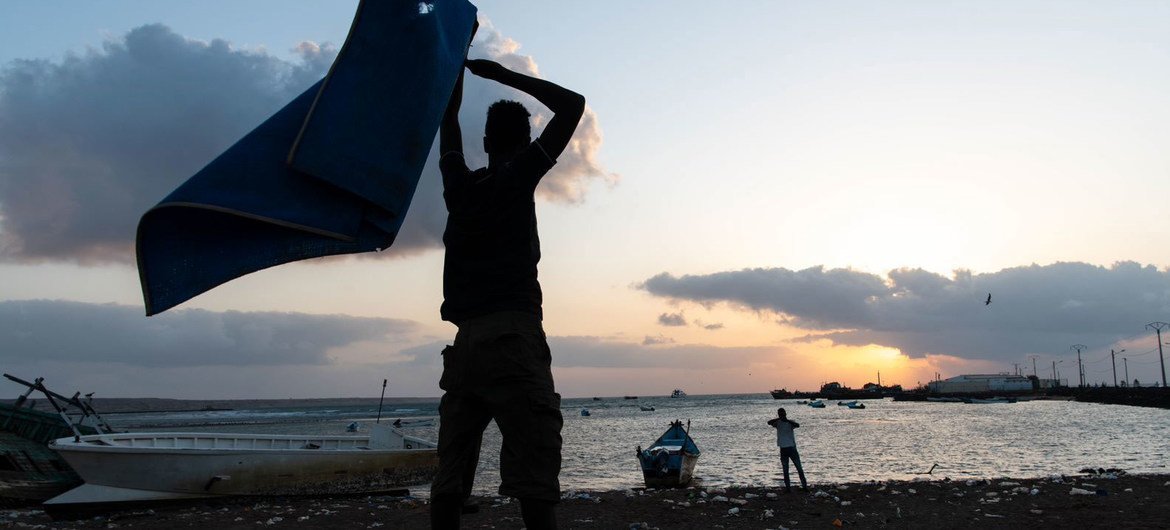
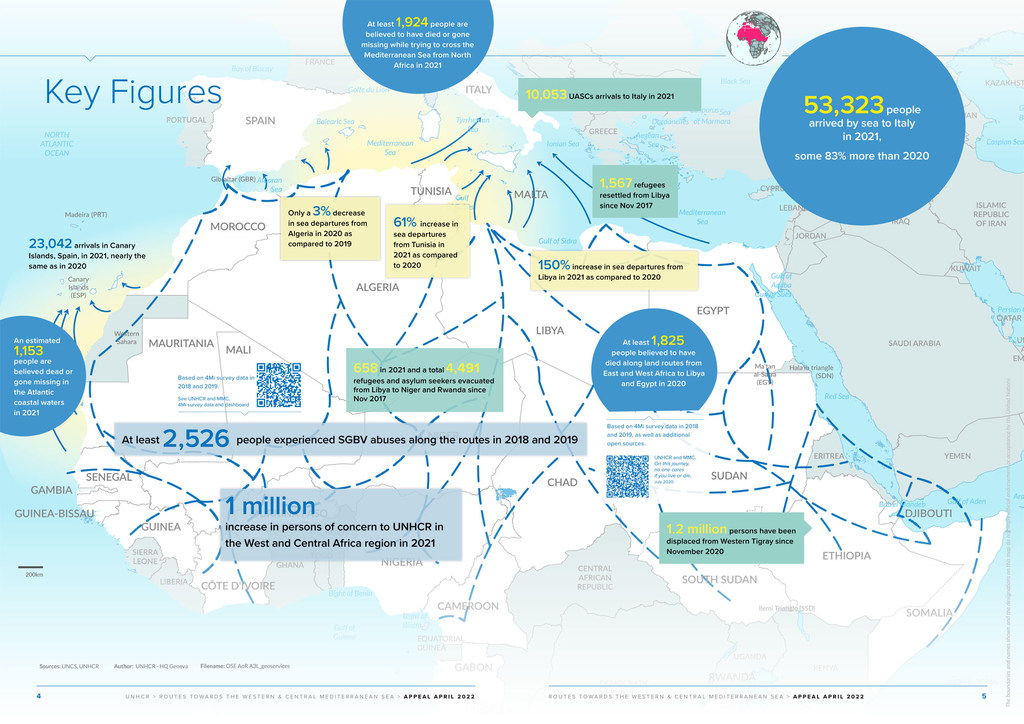
(UN News)* — More than 3,000 people died or went missing while attempting to cross the Mediterranean and the Atlantic last year, hoping to reach Europe, the UN refugee agency, UNHCR, said on Friday [29 April 2022], appealing for $163.5 million to assist and protect thousands of refugees and asylum seekers.
Of the 2021 total, 1,924 people were reported to have died or gone missing on the Central and Western Mediterranean routes, while an additional 1,153 perished or went missing on the Northwest African maritime route to the Canary Islands, according to UNHCR’s newly published report: Protection, saving lives, & solutions for refugees in dangerous Journeys.
Fatalities for 2020, stood at 1,776 for the three routes – reflecting an increase of 478 people since the beginning of this year.
“Most of the sea crossings took place in packed, unseaworthy, inflatable boats – many of which capsized or were deflated leading to the loss of life,” UNHCR spokesperson Shabia Mantoo told journalists at a regular press briefing in Geneva.
Dangerous crossings
The sea journey from West African coastal states, such as Senegal and Mauritania to the Canary Islands, is long and perilous and can take up to 10 days.
“Many boats drifted off course or otherwise went missing without trace in these waters,” she said.
Land routes also continue to be highly dangerous, where even greater numbers may have died on journeys through the Sahara Desert and remote border areas, in detention centres, or while being held by smugglers or traffickers.
Extrajudicial killings, arbitrary detention, sexual and gender-based violence, and forced labour and marriage are just some of the abuses reported by people traveling these routes.
Other challenges
COVID-related border closures impacted movements towards North Africa and European coastal countries, with many desperate refugees and migrants turning to smugglers.
“Continued political instability and conflicts, deteriorating socioeconomic conditions as well as the impact of climate change may increase displacement and dangerous onward movements,” Ms. Mantoo warned.
Plea for help
In launching an updated protection and solutions strategy for refugees on dangerous journeys along routes towards Europe across the Central and Western Mediterranean Sea and the Atlantic, UNHCR is appealing for support in providing meaningful alternatives to these dangerous journeys and prevent people from becoming victims of traffickers.
The approach calls for increased humanitarian assistance, support and solutions for people in need of international protection and survivors of gross human rights abuses.
It covers some 25 countries across four regions connected by the same land and sea routes used by migrants, asylum seekers and refugees, and includes countries of origin, departure, first asylum, transit and destination.
Much-needed actions
To address protection and solution challenges, UNHCR is also urging States to strengthen humanitarian, development, and peace action.
Additionally, it is calling on regional States in both Africa and Europe to enhance legal frameworksand operational capacities at land and sea borders and in urban centres while also guaranteeing inclusion, youth programming and local community-based development as credible alternatives to dangerous journeys.
“States must ensure unimpeded humanitarian access for the delivery of essential services to people on the move or stranded en route, intercepted at sea, or held in detention centres, and to determine whether they have international protection needs,” the UNHCR spokesperson said.
Treacherous alternative
If these important measures are not carried out, refugees, asylum seekers, internally displaced people and others will continue to move onwards in dangerous journeys in search of safety and protection.
Other people, including migrants, will move in search of a better life, hoping to find work or educational opportunities elsewhere in the absence of sufficient seasonal or longer-term legal pathways for safe and orderly migration.
Source: UNHCR | Risk Mitigation Strategy and 2022 Appeal.
“We’re looking at a form of corporate tyranny previously unseen in America.” Pam Martens, Wall Street on Parade.
by Brian ShilhavyEditor, Health Impact News
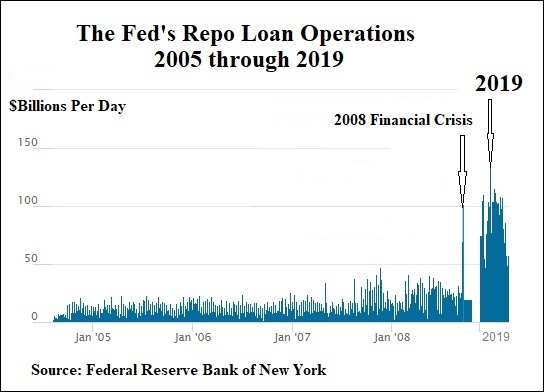
Pam and Russ Martens of Wall Street on Parade have reported on the mega giant bank bailouts during the 4th quarter of 2019, just months before COVID was declared to be a “pandemic” giving further evidence from a series of events at the end of 2019 that the “war on the virus” that has enslaved the entire world, was all planned long in advance by the Globalists.
Not reported in the media, either corporate news media nor anywhere else in the Alternative Media that I have seen, the Martens have exposed the fact that the bailouts of the biggest banks in New York far exceeded the bailouts during the 2008 financial crises.
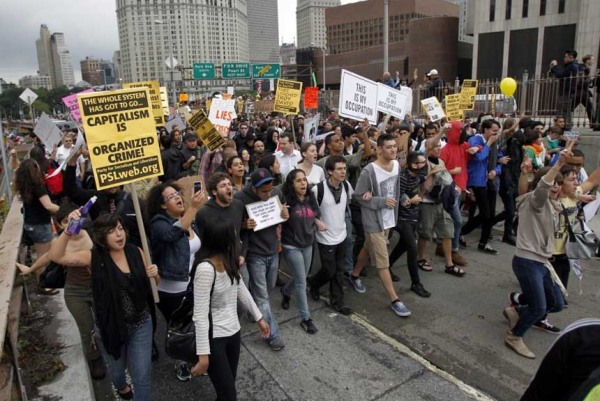
This bailout of Wall Street in 2008 was the fuel that gave rise to the “Occupy Wall Street” movement that started in September of 2011, and spread around the world.
Israeli occupation forces, detained thirteen Palestinian civilians, and shot six others with live rounds during military invasions into different parts of the occupied West Bank, local sources reported.
On Sunday evening, an undercover Israeli force (Musta’ribeen) stormed Al-Ram town, northeast of occupied Jerusalem and abducted a Palestinian young man identified as Muhammad Abu Sobeih.
Occupation forces detained, on Sunday evening, a resident of Silwan town in Jerusalem, identified as; Zain Simrin, while he was close to Bab Al-Asbat or Lion’s Gate, one of the main gates leading to the Old City of occupied Jerusalem.
East of Bethlehem, in the southern occupied West Bank, the army invaded and searched the home of a Palestinian young man, identified as; Muhannad Abu Qadoum, before detaining him.
Soldiers stormed, at dawn Sunday, the Al-Jalazoun refugee camp north of Ramallah, in the central West Bank, triggering fierce confrontations by local Palestinian youths.
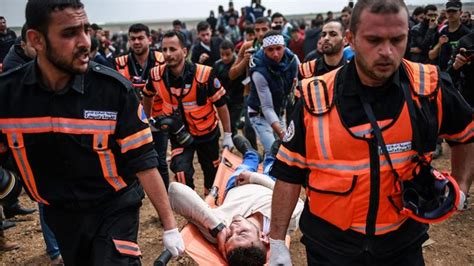
The army shot five young men with live rounds, one of whom was struck in the abdomen, and subsequently transferred to a local hospital for medical intervention, while four young men were shot in their legs with “Toto” expanding bullets.
Three civilians, identified as; Saeed Nakhleh, 64, a former prisoner, Amr Khalil Amer, 20, and Ahmed Mahmoud Amer, 18, were all detained by the occupation army.
May Day is one of the days on which anarchists celebrate self-determination and self-realization.
People have lit bonfires to mark the end of winter for thousands of years; it wasn’t until industrialization forcibly disconnected people from the land base that nourished them that May Day came to be observed as a labor holiday. At base, May Day isn’t about labor: it’s about abundance. It’s about excess, pleasure, freedom—the burgeoning source of life itself.
As a millennia-old holy day honoring the return of spring, May Day directs our thoughts to nature—a wild and beautiful chaos that flows through us and nourishes us, which we can enjoy but never control.
Our joyous acts of rebellion do not point to a world in which workers are paid a little better for their labor, but to the possibility that we could sweep away all the forms of oppression that stand between us and the tremendous potential of our lives.
May Day 2012 in Seattle.
Here follow a few recent exciting moments in the centuries-old legacy of May Day. All the best in your own efforts today: as the folk singer croons, “To fight for something is to make it your own.”
Before May Day became the international day to celebrate labor struggles, workers and other rebels observed March 18, the anniversary of the beginning of the Paris Commune in 1871.
For example, on March 18, 1877, the young Peter Kropotkin joined Pindy, Stepniak, and anarchists from all around Switzerland for a march in Bern. Kropotkin is largely remembered as a peaceable advocate of science and mutual aid, but he and his friends brought flagpoles, brass knuckles, and other weapons to defend themselves.
After a lengthy street confrontation, they managed to rescue their red flag from police who tried to seize it, and proceeded to a 2000-strong meeting at which they recited speeches, sang revolutionary songs, and read out telegrams of encouragement from France and Spain.
Meeting in Chicago on October 7, 1884, the Federation of Organized Trades and Labor Unions resolved to demand that the workday be limited to eight hours by May Day 1886. The leadership of this organization, which later became the American Federation of Labor (AFL), secretly issued a statement advising members not to become involved in the movement around this demand, but the rank and file embraced it in large numbers.
1886
The anarchist organizers Albert and Lucy Parsons led 80,000 people down Chicago’s Michigan Avenue in the first modern May Day Parade, chanting, “Eight-hour day with no cut in pay!” Over the next few days, 350,000 workers around the US went on strike at 1200 factories, including 70,000 in Chicago, 45,000 in New York, and 32,000 in Cincinnati.
Four days later, the police attacked a labor rally in Chicago, someone responded by throwing a bomb, and the rest is history.
Albert Parsons and four other anarchists lost their lives in the ensuing show trial, which was so widely regarded as rigged and unjust that in 1893 the governor overturned the convictions and criticized the court proceedings. Lucy Parsons, later a co-founder of the Industrial Workers of the World, dedicated herself to a life of revolutionary organizing.
1891
Determined to avenge the Haymarket martyrs and build a revolutionary movement capable of abolishing capitalism and the state, the seasoned anarchist organizer Errico Malatesta secretly returned to Italy in order to prepare fierce demonstrations for May Day.
On the afternoon of May 1, 1891, thousands of workers gathered in the plaza of Santa Croce in Rome to hear a series of speakers. A march of thousands more soon arrived, including members of the anarchist federation with red-trimmed banners. As the police chief noted, “The appearance of the Federazione Anarchica stimulated immediate excitement in the crowd.”
The anarchist Amilcare Cipriani, who had been condemned to death and then exiled to New Caledonia as punishment for acting as Chief of Staff during the defense of the Paris Commune, rose to speak. Noting the forest of bayonets with which hundreds of soldiers and mounted cavalry had surrounded the plaza, Cipriani pleaded for calm, arguing that it was not the proper time to confront the authorities. Yet an unscheduled speaker, the anarchist Galileo Palla who had lived in exile in Argentina with Malatesta, leapt onto the rostrum and exhorted to the crowd to rise in revolt, concluding, “Long live the revolution!”
The ensuing riots spread throughout the city and lasted well into the night.
1894
Massive rioting swept Cleveland, Ohio on May Day 1894 in protest against unemployment stemming from the economic crisis of the previous year. The Pullman Strike began a few days later, on May 11, culminating with countrywide disruptions and the murders of many workers by police and other mercenaries.
In response, President Grover Cleveland announced that Labor Day in September would become a national holiday, attempting to coopt workers’ struggles without affirming the anniversary of the Haymarket incident. Samuel Gompers, a founder of the AFL and a virulent opponent of immigration, anarchism, socialism, and, later, the Industrial Workers of the World, supported the federal government in crushing the Pullman Strike and backed Grover Cleveland’s effort to undermine the momentum of May Day. Make no mistake: the official leadership of legalized labor organizations has largely aimed to tame and hobble them from the very beginning.
A collection of posters illustrating the diverse ideologies competing to define the meaning of May Day.
1909
Two labor rallies were announced for May Day 1909 in Buenos Aires. One was organized by the socialist General Union of Workers (UGT); the other, by the anarchist Argentine Regional Workers’ Federation (FORA).
As historian Osvaldo Bayer recounts, “After noon, the Plaza Lorea began to fill with folk not habitués of the city: lots of mustaches, berets, neckerchiefs, patched trousers, lots of fair hair, lots of freckled faces, lots of Italians, lots of ‘Russians’ (as the Jewish immigrant was called in those days) and quite a few Catalans. Along came the anarchists with their red flags: ‘Death to the bourgeois! War on the bourgeoisie!’ were the first cries heard.”
The rowdiest crew seemed to be the anarchists from the association “Luz al Soldado” (“enlighten the soldier”). According to the day’s police report, they wrecked trams, liberated horses from city cabs, and smashed bakeries that refused to shutter their storefronts in observance of the workers’ holiday.
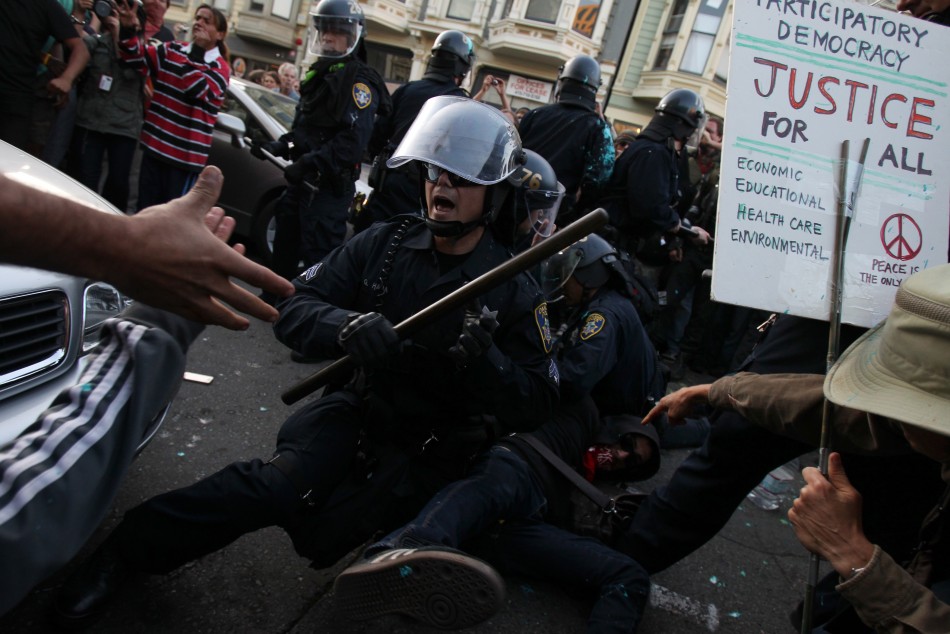
Police chief Colonel Ramón Falcón arrived and gave the order to attack. Police cracked heads, shot demonstrators, and trampled them on horseback, killing several workers and severely injuring dozens more.
Socialists joined the anarchists in calling for an open-ended general strike demanding Falcón’s resignation. The Colonel responded with arrests and raids and shut down the anarchist press. On May 4, 33 years to the day after the Haymarket incident, a crowd of up to 80,000 gathered to accompany their martyrs’ remains to the cemetery. Falcón’s police showed up again to beat and shoot at the bereaved.
One of the anarchists impacted by the May Day massacre was a Ukrainian-born teenager, Simon Radowitzky. Six months later, Radowitzky used a homemade bomb to blow up Falcón’s carriage, killing the Colonel and his secretary Juan Lartigau. When finally caught and beaten by police, he shouted, “Viva el anarquismo!” Radowitzky became one of the most prominent political prisoners in Argentinian history.
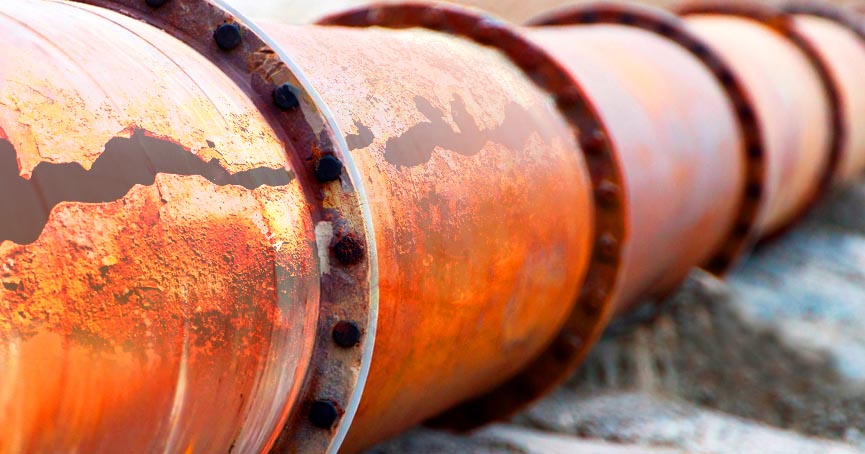
Nuclear: the stress corrosion phenomenon could affect all of France’s reactor models. Four additional reactors, including one of 900 megawatts (MW), could be affected by the “stress corrosion” phenomenon detected on portions of auxiliary piping in the primary circuit of certain EDF nuclear reactors.
This announcement is part of the review of certain welds initiated at the end of 2020 and which should be completed in 2024. The company is continuing its discussions with the Nuclear Safety Authority (ASN) “on the overall strategy of controls, expertise and treatment of this phenomenon”.
On April 14, when updating its information note on the subject, EDF announced that “indications were detected during the performance of non-destructive ultrasonic testing” on portions of the pipes of the B3 reactors at Chinon (Indre-et-Loire), reactor 3 at Cattenom (Moselle), reactor 2 at Flamanville (Manche) and reactor 1 at Golfech (Tarn-et-Garonne).
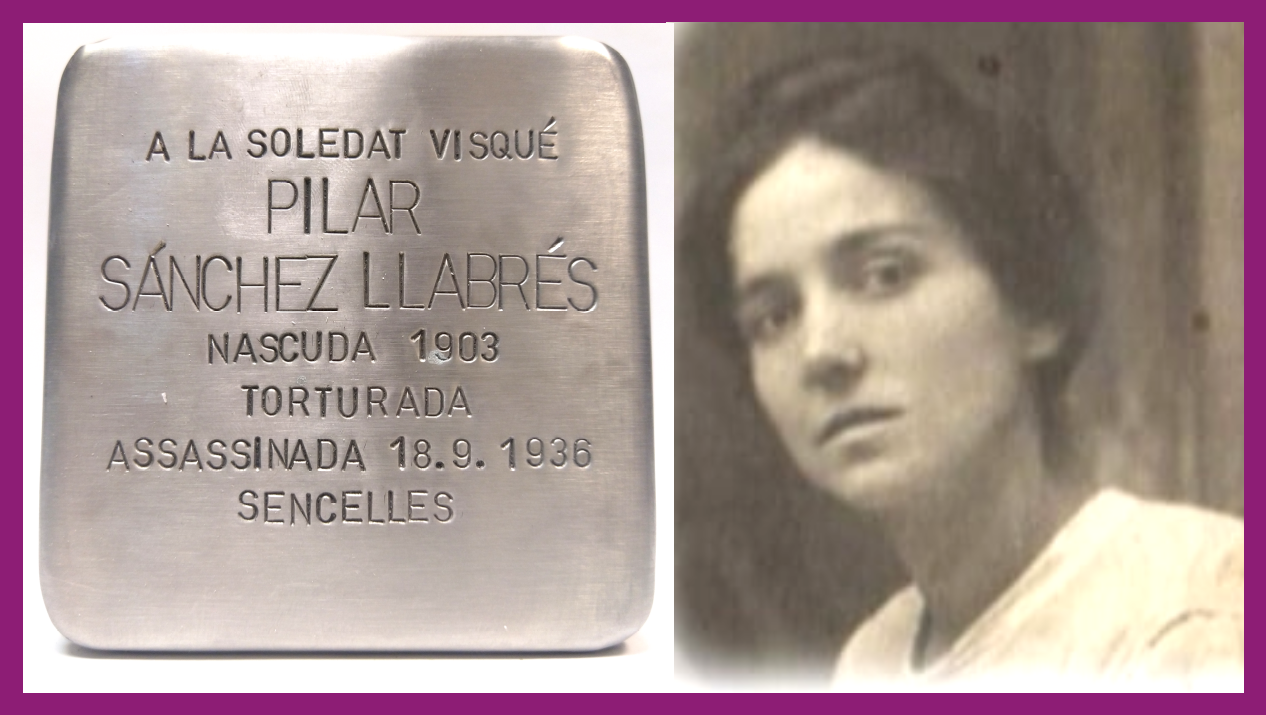
Pilar Sánchez Llabrés nació en Palma (Mallorca) en 1903. Vivía en el barrio obrero de la Soledad. Estaba casada con Miquel Borel. Eran padres de 4 hijos y militaban en el Partido Socialista, circunstancia que Pilar llevaba de forma muy activa y apasionada. Pilar se dedicaba a vender comestibles en la actual plaza Mayor de Palma, donde manifestaba públicamente sus posiciones políticas, era una mujer de empuje que no se arrugaba ante las adversidades.










 Pilar Sánchez Llabrés nació en Palma (Mallorca) en 1903. Vivía en el barrio obrero de la Soledad. Estaba casada con Miquel Borel. Eran padres de 4 hijos y militaban en el Partido Socialista, circunstancia que Pilar llevaba de forma muy activa y apasionada. Pilar se dedicaba a vender comestibles en la actual plaza Mayor de Palma, donde manifestaba públicamente sus posiciones políticas, era una mujer de empuje que no se arrugaba ante las adversidades.
