It was supposed to be the forum where the world finally committed to emissions reductions sufficient to meet the target of the Paris Agreement: […]
The majority of the capitalist class recognises in theory that climate change is a grave problem requiring drastic steps, but each government wants to protect their own capitalists.
The Australian Government is conspicuous by being on the list of bad guys at almost every point. Liberal Prime Minister Scott Morrison signed up to a commitment to net zero emissions by 2050, but only after almost every other advanced country (and many others) had done so.
However, its 2030 target is only a 26-28% reduction from 2010 levels. Even without lifting a finger it will definitely achieve 30% and possibly 35%, so the refusal to promise more is ferociously political.
In sectoral negotiations, 40 countries promised to phase out coal, but Australia was not one of them. More than 80 countries pledged to cut methane emissions by 30% by 2030, but Australia was not one of them. Neither were other big natural gas producers (and therefore producers of fugitive emissions) Russia and Iran.
And the Australian Government’s zeal in funding expansion of fossil fuel exports is joined with almost matching enthusiasm by the main opposition party, Labor. Similar stances have been taken by other large fossil fuel exporters, including Canada.
There is a reason for this. Capitalist governments exist, first and foremost, to protect the interests of their own capitalist class. There is enormous sunk capital invested in fossil fuels and the industries using them as inputs.
Governments want to protect these investments to the maximum extent possible. So when a problem is identified and specific action is required to address it, the governments that could make the biggest difference are ones least likely to sign up to it.
And on the rare occasion where a government that can make a big difference signs up (as Brazil has over attempts to stop deforestation), it is an attempt at fishing for international assistance that won’t have to be returned if targets aren’t met.
Professor Ian Jones, a virologist at the University of Reading, alluded to the fact that catching the new Omicron variant is better than getting a vaccine, as the strain functions like a “natural vaccine.” The new variant is reportedly too mild to cause any real harm other than a few sniffles and a snotty nose but generates enough antibodies needed for lasting immunity.
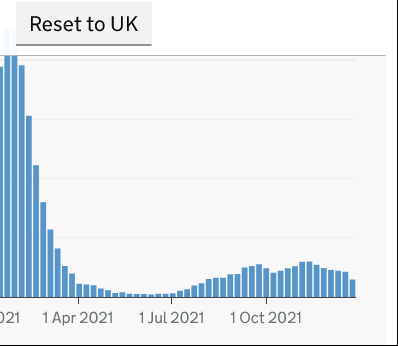
Covid figures available on 23rd Dec 21 had just 40 deaths on English Death Certs, ZERO in Wales and no info for Scotland. https://coronavirus.data.gov.uk/…
The more jabs that people receive, the more difficult it will be for people to develop this type of natural immunity, even if their immune system still works post-vaccine, that is.
An estimated 3,270,800 people in England, or about 6% of the population on average, had Covid in the week ending 31 December. The week before the figure was about one in 25.
But the last Covid figures available, on 23rd Dec, had just 40 deaths on English Death Certs, ZERO in Wales and no info for Scotland. https://coronavirus.data.gov.uk/…
40 deaths is too many (though more may have died with flu if it wasn’t largely displaced by Covid: see Disappearance of influenza). Also the 40 Covid deaths on 23rd Dec should be seen in context of 13.014 deaths from all causes in the same week https://www.ons.gov.uk/…
According to reports: “Some experts claim the benefits of extra jabs are minimal because their primary purpose – preventing deaths and hospitalizations – has barely waned after a year and several Covid variants, effectively meaning boosters are adding to an already high base level immunity.”
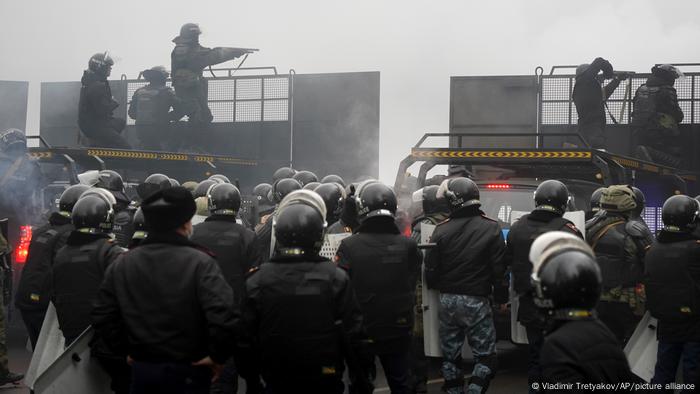
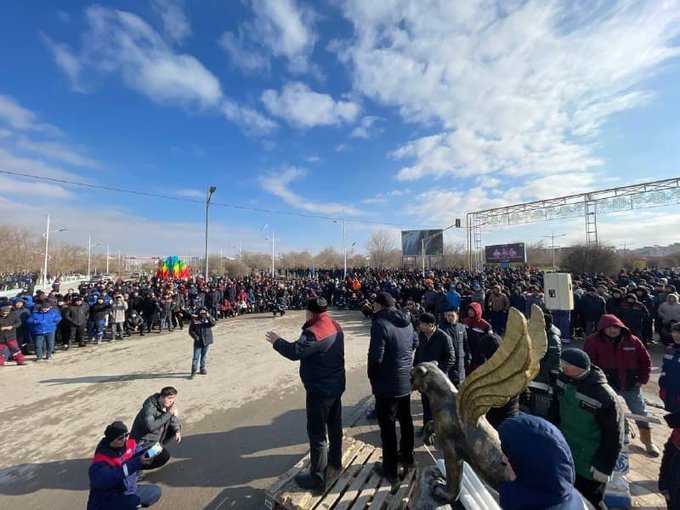
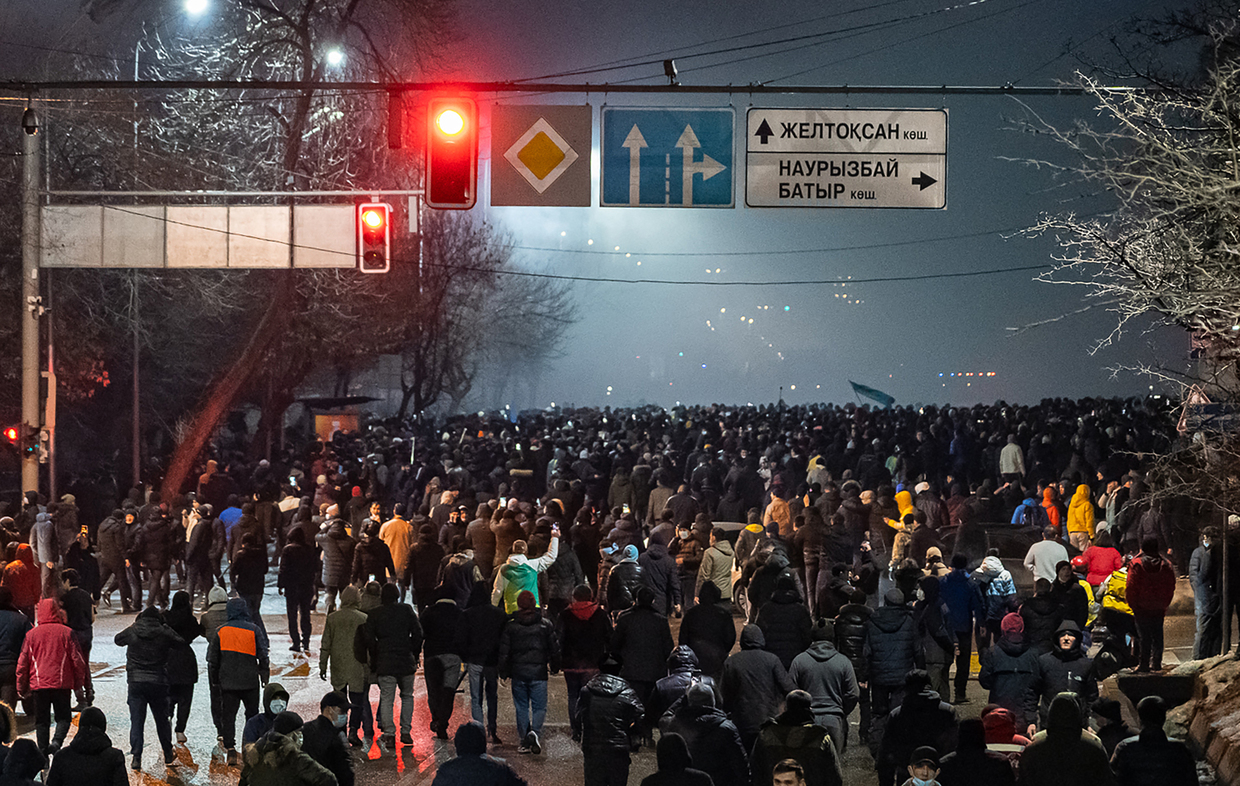
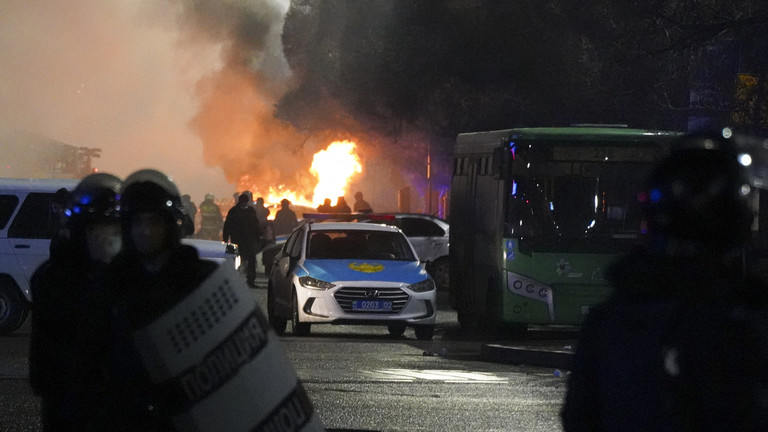
A full-scale uprising has broken out in Kazakhstan in response to the rising cost of living and the violence of the authoritarian government. Demonstrators have seized government buildings in many parts of the country, especially in Almaty, the most populous city, where they temporarily occupied the airport and set the capitol building on fire. As we publish this, police have recaptured downtown Almaty, killing at least dozens of people in the process, while troops from Russia and Belarus arrive to join them in suppressing the protests.
We owe it to the people on the receiving end of this repression to learn why they rose up. In the following report, we present an interview with a Kazakhstani expatriate who explores what drove people in Kazakhstan to revolt—and explore the implications of this uprising for the region as a whole.
“What is now happening in Kazakhstan has never happened here before.
“All night there were explosions, police violence against people, and some people burned police cars, including some random cars. Now people are marching around the main streets and something is happening near Akimat (the parliament building).”
-The last message we received from our comrade in Kazakhstan, an anarcha-feminist in Almaty, shortly before 4 pm (East Kazakhstan time), before we lost contact.
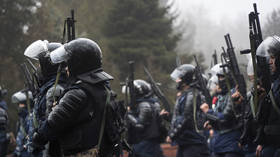
#Kazakhstan Armed security forces are in Almaty. There are also armoured personnel carriers, armoured vehicles, and military trucks. Local police reported that dozens of protesters had been killed. pic.twitter.com/h1vzkKdmjV
We should understand the uprising in Kazakhstan in a global context. It is not simply a reaction to an authoritarian regime. Protesters in Kazakhstan are responding to the same rising cost of living that people have been protesting all around the world for years. Kazakhstan is not the first place where an increase in the cost of gas has triggered a wave of protests—exactly the same thing has happened in France, Ecuador, and elsewhere around the world, under a wide range of administrations and forms of government.
What is significant about this particular uprising, then, is not that it is unprecedented, but that it involves people confronting the same challenges we confront, too, wherever we live.
The urgency with which Russia is moving to help to suppress the uprising is also significant. The Collective Security Treaty Organization [CSTO], a military alliance comprised of Russia, Armenia, Belarus, Kazakhstan, Kyrgyzstan, and Tajikistan—with Russia calling the shots—has committed to sending forces to Kazakstan. This is the first time that the CSTO has deployed troops to support a member nation; it refused to assist Armenia in 2021, during its conflict with Azerbaijan.
It is instructive that the war between Armenia and Azerbaijan did not warrant CSTO intervention, but a powerful protest movement does. As in other imperial projects, the chief threat to the Russian sphere of influence (the “Rusosphere”) is not war, but revolution.
Russia has profited considerably from the civil war in Syria and the Turkish invasion of Rojava, playing Syria and Turkey against each other to gain a foothold in the region. One of the ways that Vladimir Putin has held on to power in Russia has been by rallying Russian patriots to support him in wars in Chechnya and Ukraine. War—perpetual war—is part and parcel of the Russian imperial project, just as war has served the American imperial project in Iraq and Afghanistan. War is the health of the state, as Randolph Bourne put it.
Uprisings, on the other hand, must be suppressed by any means necessary. If the millions of people in the Rusosphere who languish under a combination of kleptocracy and neoliberalism saw an uprising succeed in any of those countries, they would hurry to follow suit. Looking at the waves of protest in Belarus in 2020 and in Russia a year ago, we can see that many people are inclined to do so even without hope of success.
In capitalist democracies like the United States, where elections can swap out one gang of self-seeking politicians for another, the illusion of choice itself serves to distract people from taking action to bring about real change.
In authoritarian regimes like Russia, Belarus, and Kazakhstan, there is no such illusion; the reigning order is imposed by despair and brute force alone. In these conditions, anyone can see that revolution offers the only way forward.
Indeed, the rulers of all three of those countries owe their power to the wave of revolutions that took place starting in 1989, bringing about the fall of the Eastern Bloc. We can hardly blame their subjects for suspecting that only a revolution could bring about a change in their circumstances.
Revolution—but for what purpose? We cannot share the optimism of liberals who imagine that social change in Kazakhstan will be as simple as chasing out the autocrats and holding elections. Without thoroughgoing economic and social changes, any merely political change would leave most people at the mercy of the same neoliberal capitalism that is immiserating them today.
And in any case, Putin will not give up so easily. Real social change—in the Rusosphere as in the West—will require a protracted struggle. Overthrowing the government is necessary, but not sufficient: in order to defend themselves against future political and economic impositions, ordinary people will have to develop collective power on a horizontal, decentralized basis. This is not the work of a day or a year, but of a generation.
updates.. Latest figures put police deaths at 13, with 2 claimed to be beheaded. No numbers available for demonstrators deaths, but videos show dozens of bodies.A bloody battle is now likely as troops face newly armed insurrectionists .. see also> The Uprising in Kazakhstan / news and interview.. from Crimethinc
Analyst Alya Kaminskaya does not rule out that the Pentagon seeks to use the Almaty hub [in Kazakhstan] as “an air base for reconnaissance and military cargo planes.”
She points out that Almaty International Airport no longer belongs to Kazakhstan since news emerged in May that 100% of its shares had been purchased by Turkey’s TAV Airports Holding.
“There are two alarming things. First, Turkey is an active NATO member and the Americans can benefit from Ankara’s geopolitical expansion into Central Asia and the South Caucasus,” military expert retired Colonel Shamil Gareev noted.
“Second, the Almaty airfield is the closest to China. For the US and Turkey, it is a perfect facility for reconnaissance activities related to China, including the Xinjiang Autonomous Region,” he added.
According to military expert, retired Lieutenant General Yuri Netkachev, “another reason why the US and Turkey are interested in Kazakhstan is because the country produces about 40% of the world’s raw uranium.
“If the Americans and Turks manage to put Russia and Kazakhstan at odds with each other, they might try to choke off our Strategic Nuclear Forces. So, Russia should better maintain friendly relations with Kazakhstan in order to be able to protect its strategic interests,” the expert noted.
Updates: CSTO invokes Article 4, sends troops to Kazakhstan
The world news is uniformly vague about what constitutes the opposition and who the insurgents are.
Much is made of the word nationalist but no information is available about the role of pro-Western, pan-Turkic and Islamist factions, for example. The government Kazinform news site has been offline all day.
Whatever the nature of the steadily mounting conflict in Kazakhstan, whether it was initially and remains motivated by rising gasoline prices as in France with the emergence of the Yellow Vest movement three years ago, or whether it has been or is developing into something more political – and geopolitical – will become more clear in the ensuing days.
Irrespective of the nature and course of the situation, this background information is worth recalling.
Kazakhstan is one of three nations bordering both Russia and China, far the most strategically vital one at that. (The others are Mongolia and North Korea.)
It is a member of the Commonwealth of Independent States, Collective Security Treaty Organization, Eurasian Economic Union, Shanghai Cooperation Organization and the recently-renamed Organization of Turkic States as well as the Organization for Security and Co-operation in Europe.
It also was among the first former Soviet states to join a NATO partnership program, the North Atlantic Cooperation Council, in 1992, which was replaced by the Euro-Atlantic Partnership Council/Partnership for Peace in 1997, Kazakhstan remaining a member in the new structure. In 2006 it became the first non-European nation to sign an Individual Partnership Action Plan with NATO.
It borders three of the other four former Soviet Central Asian republics: Kyrgyzstan, Turkmenistan and Uzbekistan. There were uprisings and so-called color revolutions in Kyrgyzstan in 2005 and 2010 and in Uzbekistan in 2005. Kazakhstan accounts for some 60% of Central Asia’s gross domestic product, mainly through natural gas and oil production and distribution.
DW is an anti/Russian German state media
Kazakhstan is one of five Caspian Sea littoral states, along with Azerbaijan, Iran, Russia and Turkmenistan.
It hosts the Baikonur Cosmodrome, leased to Russia, the world’s largest space launch facility.
Kazakhstan’s border with Russia, at 7,000 kilometers, is the longest continuous land border in the world.
In several significant ways it is a geostrategically vital country. It could be argued that there is none more so.
THE DEVELOPER of a controversial new Covid microchip that is embedded in the skin has hit back at critics who slammed the project in an exclusive interview with Express.co.uk.
By Antony Ashkenaz 00:00, Mon, Jan 3, 2022 | UPDATED: 00:01, Mon, Jan 3, 2022 1.6k Sage expert slams Boris for avoiding COVID restrictions We use […]
The following zines were released in the broad anarchist space over the past month or so. They include a mix of new texts engaging with the dying planet and the anti-police uprisings of 2020, as well as several reprints of older texts.
We’re concluding this introduction with a quote from the zine Please Riot:
The deck is stacked against any change, let alone revolution. But, in the words of anarchist science fiction writer Ursula K. Le Guin: “We live in capitalism. Its power seems inescapable. So did the divine right of kings.”
Those kings are dead.
Zines Released in December 2021
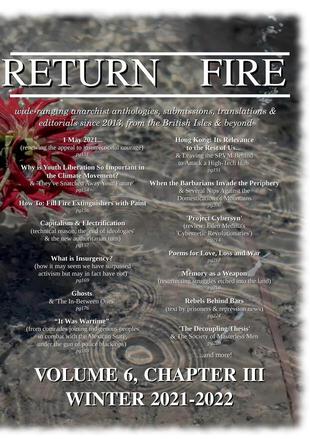
Return Fire: Winter 2021-2022
This is the latest issue of Return Fire. The publication’s tag line is “anti-authority // daily revolt // individual will // de-civilisation.” To that end, there are numerous articles covering a wide range of topics including COVID-19, debates around insurgency and activism, lessons from recent struggles in Hong Kong, eco-anarchist actions in Mexico, and writings from anarchist prisoners. This publication is always worth reading.
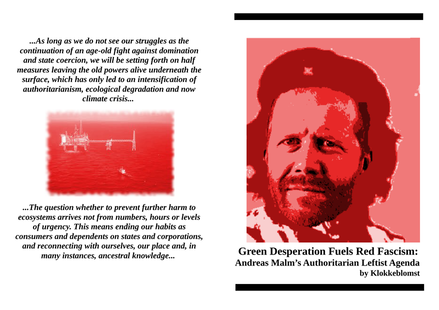
Green Desperation Fuels Red Fascism: Andreas Malm’s Authoritarian Leftist Agenda
Released as a supplement to the latest issue of Return Fire, this zine expands on similar ideas. It critiques the work of Swedish academic Andreas Malm who advocates for Leninist approaches to climate change. While Malm’s writing may not be widely known, it’s representative of the leftist approach to climate change which advocates for state control and “humane” technologies. Moreover, Malm argues for hierarchal movements with strict discipline a la Deep Green Resistance and trashes decentralized direct action. This critique thoroughly debunks Malm’s ideas and other similar approaches.
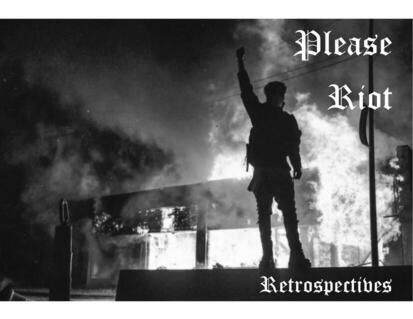
This zine – written by anarchists in Colorado – analyzes what they assert are the key events of the past year and a half: 1) the racial domination by the state via racist police killings that led to the death of George Floyd and so many other Black, Brown, and Indigenous people every day, 2) the management of COVID-19 that has killed or maimed millions in the “US”, and, 3) the failures of representative government to improve social wellbeing. It’s always refreshing to see folks analyzing where the prospects for revolt are at and the role that anarchists can play. In the end, the authors argue for a strategy of “building revolutionary potential called dual power.” There is no elaboration on what this means in practice, instead, the authors plan to outline its meaning in the future.
The generalized revolts of the summer of 2020 were awe inspiring, it was likely the largest redistribution of wealth in US history, it also attacked society on various levels ( capital, police, media, etc.). After years of watching social movements form, flounder, and not a damn thing changing…this is seemingly different. While nothing “officially” has changed in terms of the system, this wave of insurrections demonstrated peoples capacity to absolutely destroy the illusion of order the state likes to project. The incomprehensibility of the insurrections lended to their power, there was nothing for the state to grasp at, nothing for the recuperative forces to hop onto, this was something that lay outside of their frameworks.
This is a collection of 93 aphorisms against work by Len Bracken, a former member of the Industrial Workers of the World (IWW) and Northeast Federation of Anarcho-Communists (NEFAC). The brief statements do a good job of accessibly critiquing work. This has been reprinted many times since its original publication.
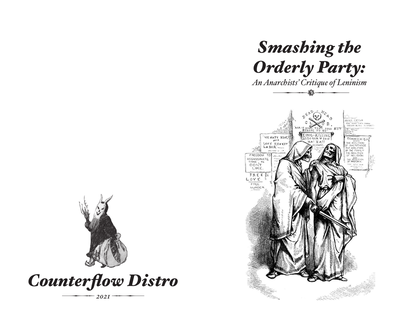
Smashing the Orderly Party: An Anarchists’ Critique of Leninism
This is a newly formatted (by Counterflow Distro) version of an older (~2011) critique of Leninism. It’s a solid critique of Leninism and worth reading if you are unfamiliar. It’s always surprising that the corpse of Leftism hangs on, but unfortunately it’s still something anarchists encounter from time to time. This zine is a good thing to distribute amongst newer folks.
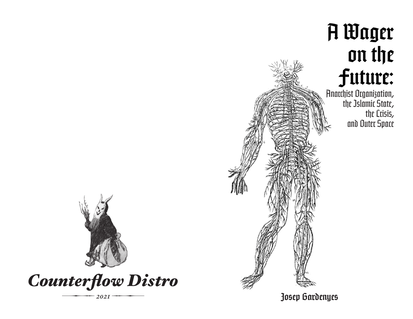
A Wager on the Future: Anarchist Organization, the Islamic State, the Crisis, and Outer Space
This is a newly formatted version of an essay by Josep Gardenyes that came out a few years ago (~2016). It’s still a solid analysis of the contemporary anarchist movement based on the global events of the early 2010s and the spread of various anti-government struggles. While the context may have shifted somewhat, the questions about how anarchists relate to widespread social movements are still relevant. This is highly recommended!
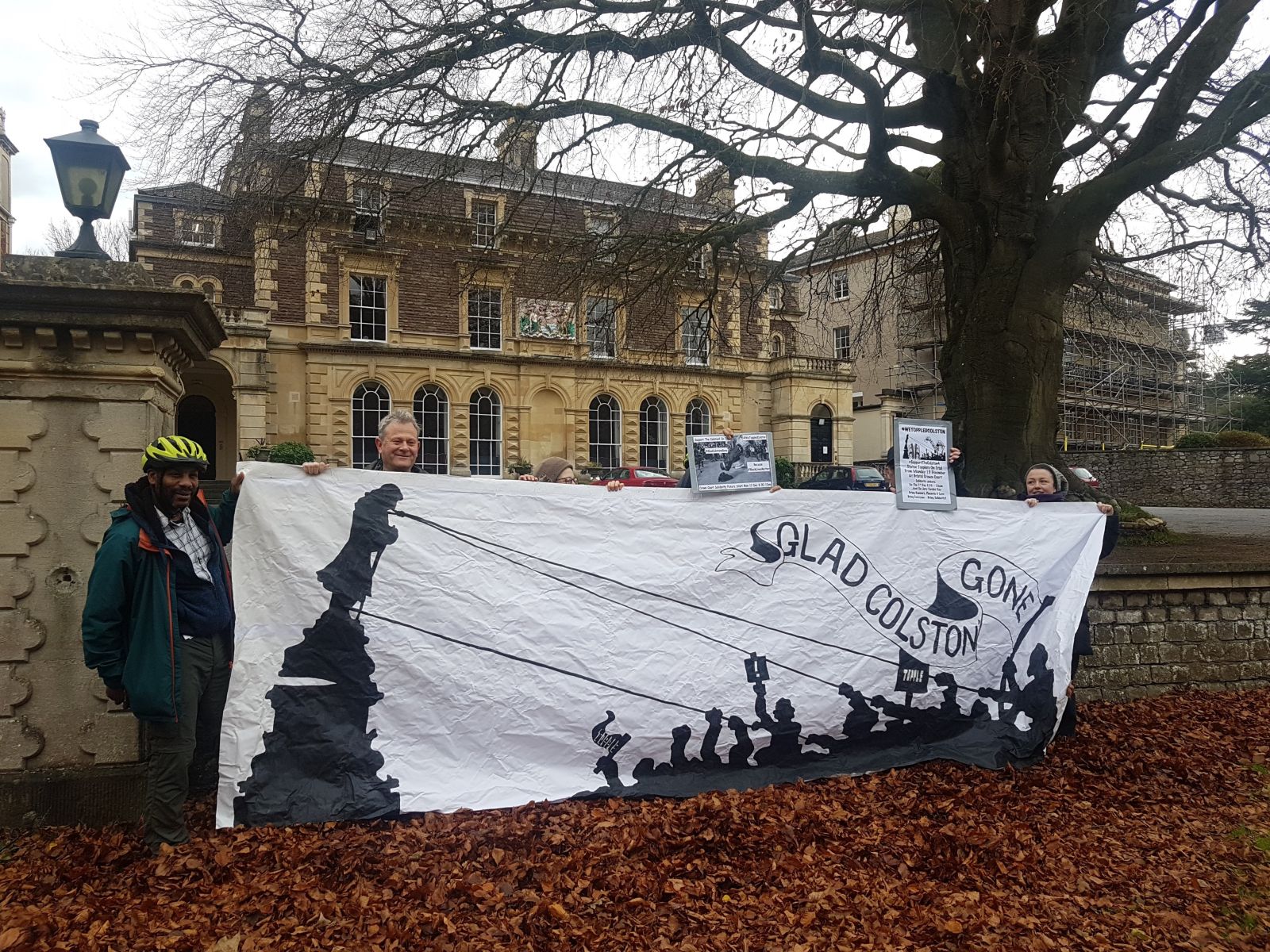
The trial saw plenty of complex legal arguments, but ultimately it came down to a question of doing the right thing.
With the verdict in the Colston 4 trial announced, many, not least the right-wing media and Twitterati, are asking how the defendants managed to win what seemed like a clear-cut case against them.
With video evidence of them committing the charges against them, Rhian Graham, Milo Ponsford, Jake Skuse and Sage Willoughby were left to argue that their actions were morally justified.
Speaking after yesterday’s verdict, Raj Chada, of Hodge Jones & Allen Solicitors, who defended Graham, said that the defence came down to ‘the righteousness of the cause.’
He also said that a conviction would be a disproportionate interference with the defendants’ rights to free speech and conscience.
So what does this look like in practice?
Preventing Greater Harm
One of the arguments put forward by Mr Chada, and the other defendants’ lawyers, was that in pulling down the statue, the four were in fact ‘preventing a crime from happening’ as ‘it was a criminal offence to keep that statue up, because it was so offensive.’
Or, to put it in legalese, the statue constituted an indecent display under Section 1 of the Indecent Displays (Control) Act 1981, according to Liam Walker, the barrister who appeared for Sage Willoughby.
I believe I had a lawful excuse, preventing further harm to the people of Bristol
The view that the statue itself was the real act of vandalism was evidenced by testimonies in the courtroom.
Gloria Daniels, a Bristol resident and descendant of former enslaved people, submitted a statement to the court during the trial. In it she said she felt a ‘wave of huge relief,’ when she learned of the toppling.
She went on to say that ‘the statue of a slave trader had remained up for so long, and without contextualisation, was in my view profoundly shameful.’
During the trial it was noted that Bristol City Council, who owned the statue, had multiple opportunities to remove the statue following petitions to that effect and general public sentiment against the statue, as was confirmed by the council’s head of culture and creative industry.
In his evidence to the court, Ponsford recounted how he himself had signed petitions to have the statue removed, but felt that the council had ‘abandoned’ the issue.
He said: ‘I believe I had a lawful excuse to damage that statue, preventing further harm to the people of Bristol.’
Meanwhile, Skuse, who was accused of helping roll the statue to the harbour, said: ‘If there was racist graffiti on the wall, the council would remove it. But they didn’t remove this statue.’
In comments after the trial, Mr Chada said that it was wrong of the council to allow the statue to stand for so long, and that: ‘If the democratic process wasn’t going to do it for the council, then these four individuals were going to do it,’ he said.
Milo Ponsford seen here standing between Jake Skuse and Rhian Graham, siad that he believed he had a lawful excuse to damage the statue. Image: James Ward.
Context is Key
Despite the best efforts of the prosecution to maintain a narrow focus on the acts of the defendants, the trial turned on the wider context in which those acts took place.
Each defendant spoke at length of their motivations to act against the Colston statue based on the latter’s involvement in the slave trade and responsibility for tens of thousands of deaths.
In her initial police interview, Graham is reported to have said: ‘Whether [the toppling] is criminal or not, I think, is up for debate… because of all the context around the statue, and the fact that people have campaigned to take it down… and it is just an abhorrent offence to a lot of the population of Bristol.’
The defendant’s arguments of context were substantiated by the expert evidence of historian and TV presenter David Olusoga.
On December 17th, Olusoga told the jury of how Colston became deputy governor of the Royal African Company, which held a monopoly on slave trading in the 17th Century.
He also described the way in which Colston’s legacy has been managed and moulded over the years by the Society of Merchant Venturers, of which Colston was a member during his lifetime. Olusoga said that the Society sought to focus attention on Colston’s later philanthropy and not his slave trading.
Day 4: Edward Colston was “heavily involved” in the most prolific slave trading organisation in British history, celebrated historian @DavidOlusoga told the jury. https://t.co/xEov4TDA8S— The Bristol Cable (@TheBristolCable) December 17, 2021
Beyond helping to convince the jury, Olusoga’s testimony helped broadcast the truth about Colston’s, and Bristol’s, role in the slave trade to a wider audience than ever before.
Speaking after yesterday’s verdict, Graham gave thanks to David Olusoga for the testimony he gave, which, she said, amounted to ‘a two-hour lecture on slavery and the empire’ in the court.
This trial did not set any new legal precedents. However, Mr Chada stated his desire that the trial should signal to other judges and courts that juries should be given full information about a case, including all relevant context and background.
Precedent
Yesterday’s verdict was surely shocking to some given the evidence against the defendants. However, it was not unprecedented.
The verdict gives us hope that conscience and justice can win
In December, three members of Palestine Action were acquitted on charges of criminal damage after the magistrate determined that the prosecution had failed to prove that convicting the defendants would be proportionate with their freedom to protest, A similar argument was made in regard to the Colston 4 as well.
Later in December, six members of XR employed the Ziegler defence and were acquitted by a jury for climbing onto and glueing onto a Docklands Light Railway train in London.
The right-wing press are already decrying yesterday’s verdict as granting a “licence to destroy” But as Priti Patel’s Police, Crime, Sentencing and Courts Bill, which makes a specific offence of damaging a statue, nears passing into law, the reality is that many of us will face trials like this one.
Yesterday’s verdict, and that of the Ziegler case, are a lesson in how to win against the odds. They give us hope that conscience and justice can win and that a better world is possible.
What did you think of the trial and the verdict? What does this mean for other activists? Leave a comment below.