Source – marcseifer.com at RIELPOLITIK shared with thanks!
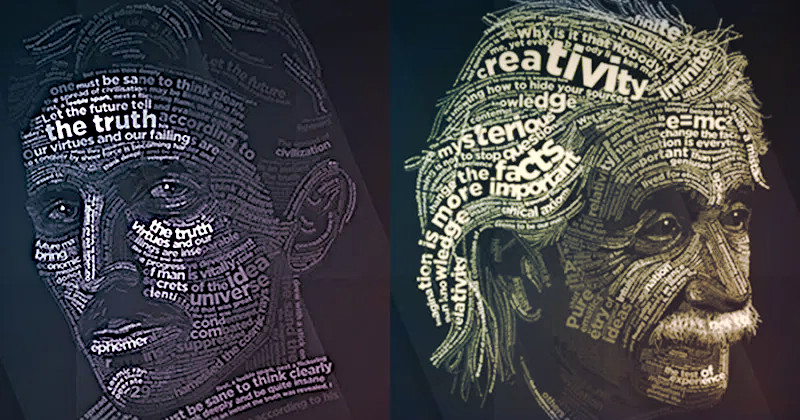
– “…Tesla understood ether theory a lot better than Einstein did, but obviously, Tesla also did not truly understand the ramifications of Einstein’s famous equation E=mc2. He dismissed it as mathematical poppycock. Had he lived a few more years to see the explosion of the atom bomb, Tesla would have been forced to re-evaluate what he had discarded, and had Einstein re-evaluated the full ramifications of Tesla’s ether theory, he may have been able to achieve his grand dream of unifying gravity with electromagnetism, a process explainable by a full understanding of ether theory”
Tesla vs. Einstein: The Ether & the Birth of the New Physics – By Marc Seifer
Nikola Tesla (1856-1943) was an electrical inventor, well known as a competitor of arch rival Tom Edison. Where Edison’s inventions include the light bulb, the microphone in the telephone and the phonograph, Tesla’s inventions include fluorescent lighting, the AC hydroelectric power system and wireless communication. Tesla is therefore mostly billed as an inventor.
The fact is, Tesla was also a physicist who studied in college such courses as analytic geometry, experimental physics and higher mathematics.1 In his early 1890s lectures at Columbia University, the Chicago World’s Fair and at Royal Societies in Paris and London, building on the ideas of Isaac Newton and Lord Kelvin, Tesla demonstrated and discussed the structure of atoms as being similar to solar systems and wave-like and particle-like aspects to what later became known as the photon. Colleagues he lectured before and corresponded with included many Nobel Prize winners like Wilhelm Roentgen, J.J. Thompson, Lord Raleigh, Ernst Rutherford and Robert Millikan and other scientists such as Elmer Sperry, Sir William Crookes, Sir Oliver Lodge, Lord Kelvin, Heinreich Hertz and Hermann von Helmholtz.
SPOOKY ACTION FASTER THAN LIGHT!
As far as I know, no standard text on the history of physics mentions Tesla even though these ideas would lead to Nobel Prizes when they were further developed by Rutherford and Bohr (with their solar-system description of the atom with electrons orbiting the nucleus) and Einstein’s discovery of the photoelectric effect, which was equivalent to Tesla’s wave and particle-like description of light.
nota: traducción del inglés. Ofrecemos este traducción del ensayo de Dr Jaeckle porque da un sumario de la novela The Free que solo existe en el inglés, y que puede ser interesante.
“El tratamiento ficticio más detallado del movimiento de un mundo reconociblemente como el nuestro a una sociedad anarquista que he leído … imaginado con la suficiente fuerza como para permitir que los lectores crean que los eventos podrían suceder de esta manera”.
Uno de los temas más espinosos que enfrentan los anarquistas es imaginar un proceso viable mediante el cual el mundo contemporáneo de dominación y opresión pasa a un mundo de libertad e igualdad. ¿El proceso debe ser evolutivo o revolucionario, y si es lo último, debe ser violento o no violento? Curiosamente, no hay muchas ficciones anarquistas dedicadas a describir un proceso tan transformador. La mayoría asume que la sociedad anarquista ya existe y prestan poca atención a cómo surgió, o postulan algún evento catastrófico que acaba con el antiguo orden y permite que surja uno nuevo.
Rara vez un autor esboza pacientemente un proceso de transformación que muestre un progreso continuo desde algo parecido al estado actual de la sociedad a uno anarquista. 1*
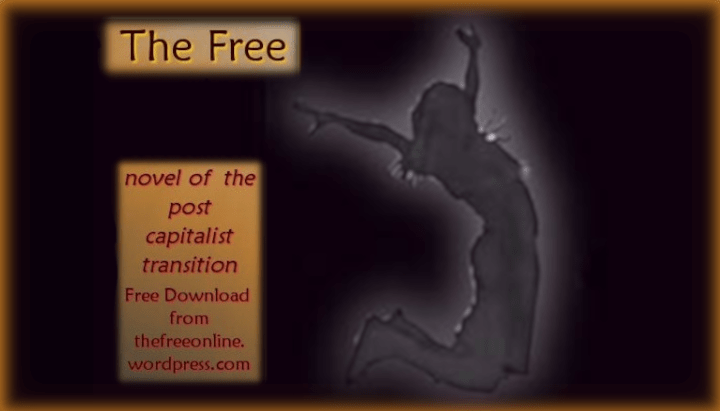
Es por esta razón que The Free de M. Gilliland merece un ensayo aquí. Es el tratamiento de ficción más detallado del movimiento de un mundo reconociblemente como el nuestro a una sociedad anarquista que he leído. Más importante aún, se imagina con la suficiente fuerza para permitir que los lectores crean que los eventos podrían suceder de esta manera. Es decir, da respuestas plausibles a las dos preguntas más importantes con respecto a tal transformación: ¿bajo qué condiciones previas es probable que ocurra y, una vez que comience, qué factores contribuyen más a su éxito? Después de un breve resumen de la trama, trazo las respuestas que The Free da a estas preguntas.3*
” the most detailed fictional treatment of the movement from a world recognizably like our own to an anarchist society that I have read.. imagined strongly enough to allow readers to believe that events could happen this way.”
One of the thorniest issues faced by anarchists is imagining a viable process by means of which the contemporary world of dominance and oppression passes into a world of freedom and equality. Is the process to be evolutionary or revolutionary, and if the latter, is it to be violent or non-violent? Interestingly, not many anarchist fictions are dedicated to describing such a transformative process. Most either assume that the anarchist society already exists and devote little attention to how it came about, or they posit some catastrophic event that ends the old order and allows a new one to emerge.
Rarely does an author patiently outline a process of transformation that shows a continuous progress from something like the current state of society to an anarchist one. 1*
It is for this reason that M. Gilliland’s The Free merits an essay here.2.*
It is the most detailed fictional treatment of the movement from a world recognizably like our own to an anarchist society that I have read. More importantly, it is imagined strongly enough to allow readers to believe that events could happen this way. That is to say, it gives plausible answers to the two most important questions regarding such a transformation: under what preconditions is it likely to occur, and once it starts what factors most contribute to its success? After a brief summary of the plot, I trace the answers that The Free gives to these questions.3*…
BY TYLER DURDEN Zero Hedge All is not going according to plan in the biggest global rollout of what is arguably the most important vaccine in a century, and it is not just growing US mistrust in the covid injection effort that was rolled out in record time: an unexpected spike in allergic reactions to […]
Do you remember taking multiple-choice exams in school? I hated these tests because there were certain instances when I knew the answer to a question, but the answers that were available to select didn’t fit the question.
As an associate professor of clinical sciences, I always made my exams in an essay format. I wanted to see if my students knew the subject matter and could articulate those answers intelligently.
What do you do in an uncomfortable situation where a multiple-choice question doesn’t have an acceptable choice for an answer? Hopefully, if the exam is written properly, you can choose the detractor “none of the above” and move on.
There is never a time when taking one of these tests that you should select a multiple-choice answer you know is the wrong one.
When should you receive an untested, unproven, experimental vaccine?
Continuaron las movilizaciones populares y bloqueos de carretera en rechazo de la norma avalada por la comisión de Economía y que el Congreso de la República debería ser aprobada hoy lunes. Por Alix Santamaría Dirigentes de los trabajadores de la agro-exportación de Perú han manifestado que el nuevo proyecto de ley para el sector agrario no […]
Tensions in society are on the rise on daily basis. The epidemic is increasingly revealing the contradictions and cracks of the capitalist system, whose manager – the state – no longer even tries to give the impression that its aim is to reduce the devastating effects of the deadly virus.
In our bureaucratically managed and highly monitored world, nothing comes naturally and by chance, even if the rulers try to convince us that the pandemic is just that. What is weakening society’s ability to combat this kind of crisis is not some irresponsible “merry partygoers” or private gatherings, but decades of deliberate destruction of public services that should be available to all, and their gradual conversion into consumer goods.
The failure of the current government to make major investments in public infrastructure is not a reflection of the malignancy of Janez Janša and his accomplices. It is a symptom of a policy that can see no further than achieving short-term economic growth, even if that means the general destruction of people and nature.
The consequences are felt by all of us who are not represented by the lobbies of capital and are therefore forced to obediently accept ever harsher working and living conditions as any form of criticism is banned and sanctioned. The government and capital see us as nothing more than a consumable commodity whose only duty is to produce, spend and obey.
In this crisis, the death of the elderly and the weak is collateral damage to the fierce efforts to maintain the system of exploitation and devastation.
On top of all this, we as a society are struggling not only with the consequences of dealing with the pandemic that rewards capitalists and increasingly excludes, neglects, and disables the vast majority of people, but also with the aggressive attempt to impose authoritarian rule.
It is clear that this episode of “Janšizem” [the policy named after the prime minister Janez Janša] is not just a provincial and local symptom of a kind of Slovenian psychosis, but a reflection of the global transformation of neoliberal consent into a new model of organizing society.
One of its features is the final dissolution of the so-called liberal and democratic “rubbish” that to some extent restrained authoritarian intervention and capital accumulation. A number of countries, including Slovenia, have turned into experimental fields during the epidemics in order to push the boundaries of governance under the conditions of the state of emergency.
This process is neither accidental, nor necessary, nor spontaneous, nor chaotic, as the people who benefit from it try to show. All of this is illustrated by the fact that, in circumstances that are still primarily a health crisis, the political extreme centre easily discarded the postures of the “rule of law” and “civil society” to quickly find out that it is much easier to satisfy the interests of the capital networks through authoritarian governance.
The only thing that bothers the representatives of the extreme centre is the sheer straightforwardness of their far-right partners. Unlike the latter, the extreme centre likes to cloak the implementation of the same policies as the extreme right under a veil of inconspicuousness. The goal of both the extreme centre and the extreme right is to deliberately create an atmosphere of arbitrariness and chaos in which only the arbitrary decrees of the state political and economic elite prevail.
At the same time, the vulgar, insulting and aggressive communication media prevents any criticism of their measures.
While the rulers try to convince us that we must stand together in times of crisis, they are widening the gap between those who have all the privileges and those who are more and more sidelined. At the end of the crisis, the rich will be even richer, the political elite and the state bureaucracy will greatly expand their authority and control over our lives, while we face even more brutal precarity, the loss of our loved ones, the dismantling of our rights, and a future filled with anxiety and terror.
Yet even in this darkest of times there is a ray of hope. After all, all the wealth of the few, as well as their privileges and their power over our lives, depends on our labor and our cooperation in the system of exploitation. It is enough to reject the role of expendable human material into which they force us, in order to gain the right to make real choices about our lives.
The idea of a general strike, already circulating in public, seems a good step in this direction. However, we cannot rely on servile syndicates imbued with the interests of their leaders. There will be no savior to lead us out of this disaster. We can only rely on each other, on the levers of social power, and on a shared vision of a better future made up of freedom, dignity, autonomy and equality.
In these times rebellion has even greater importance than usual. The authorities, with perhaps unprecedented repression, have crushed the ways of rebellion to which we were accustomed, but have not thereby removed the causes of it. On the contrary, it has only produced more reasons and firmly confirmed them. Under these conditions the spark may come from unexpected directions.
Perhaps from the workers whose bosses will not let them go on sick leave, or from the school-age youth who are locked in their homes and left alone with electronic devices.
Maybe it comes from the technical specialists in health care, or from young and old people who are labeled expendable, criminal, and spoiled by capital. Even if we do not create this spark ourselves, let’s help it grow into the fire of rebellion.
Let’s spread the virus of rebellion in the workplaces, on the streets and in the neighborhoods!





 Dr. John Reizer


