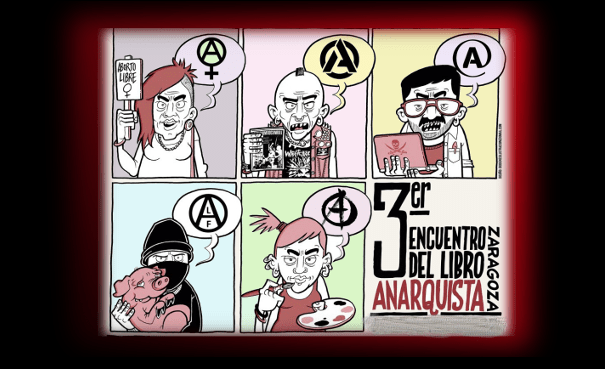

The Dispossessed… + The Day Before The Revolution…READ HERE


”I started by reading a whole mess of utopias and learning something about pacifism and Gandhi and nonviolent resistance. This led me to the nonviolent anarchist writers such as Peter Kropotkin and Paul Goodman. With them I felt a great, immediate affinity. They made sense to me in the way Lao Tzu did. They enabled me to think about war, peace, politics, how we govern one another and ourselves, the value of failure, and the strength of what is weak.

So, when I realised that nobody had yet written an anarchist utopia, I finally began to see what my book might be. And I found that its principal character, whom I’d first glimpsed in the original misbegotten story, was alive and well—my guide to Anarres. [4]”
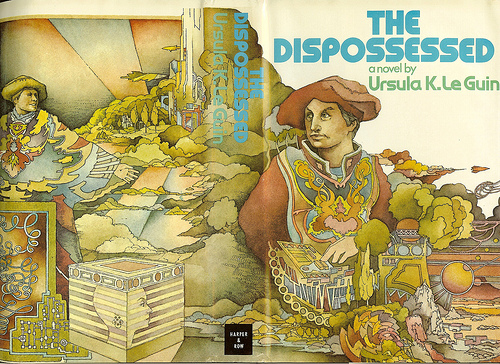
EM: The Dispossessed is one of your most well-known works. Was there any novel which explored anarchism so explicitly before then?

UG: I don’t think so. That’s one of the reasons I thought of writing it. I’d been educating myself about pacifist anarchism for a year or more. I started reading the non-violence texts—Ghandi, Martin Luther King and so on—just educating myself about non-violence, and I think that probably led me to Kropotkin and that lot, and I got fascinated. Portland used to have a hundred independent bookstores, and one of them was rather political, and in the back room, if he knew you, he would take you in to see his anarchist stuff.

EM: When would this have been?

UG: When was that book? The early 80s? Late 70s? That store had some wonderful stuff, which at the time was very hard to find. Not so much anymore. And of course I found out about some of the modern anarchist writers. I was excited following that up. And then at the same time I was reading utopias. And there was a utopia for every political thing you could think of, but not for anarchism. Isn’t that odd? Well maybe I should write one. So then I had to re-read and read things to plan how on Earth would you organize an anarchist society, which was a lot of fun, but difficult.

EM: Especially on the scale of a world.

UG: Even a very thinly populated planet, there’s a lot of people to organize.

EM: You said in an essay that a Utopia, with a capital U, should be a practical alternative. That really struck me.

UG: I’d have to think about that. In my own mind I’ve moved on quite far from the utopia of The Dispossessed to the semi-utopia of Always Coming Home, where I did try to make it simply a lifestyle. There was no political basis at all, in the sense of European or large nation politics, therefore people think that I was trying to idolize the American Indians or something.

What I took from the Indians was, essentially, running your lives without a central government and using consensus as the basic mode, which you can’t do in a big society, it’s a matter of numbers. But I wanted to think out what it might be like. I think the lack of politics, for some of the readers, makes them think that it must be primitivist, and it ain’t necessarily so.

EM: It’s been influential in bringing the dialogue into the mainstream.

UG: Yeah. Writing a serious utopian novel that is an anarchist novel. It hadn’t been done, and there were hardly any anarchist texts that weren’t non-fiction, so just having a big fiction work that’s all about anarchists, I think made quite a difference.

EM: Especially with things like gender-neutral pronouns. It’s a conversation that’s been happening for a while, but is getting louder now. It shows how important linguistics is.

UG: Oh gosh yes. When you start looking for languages which have a gender neutral common pronoun, what have you got? Some kinds of Japanese and Finnish… I believe Finnish is gender neutral, which is cool. So translating The Left Hand of Darkness is a cinch for them.


   The Dispossessed. Ursula Le Guin’s anarchist utopia…Free Download HERE:

The New Utopian Politics of Ursula K. Le Guin’s The Dispossessed   or

Listen to Thye Dispossessed by Ursula K. Le Guin at Audiobooks.com

“You cannot buy the revolution. You cannot make the revolution. You can only be the revolution.”
— Ursula K. Le Guin, The Dispossessed.leguin-the-dispossessed
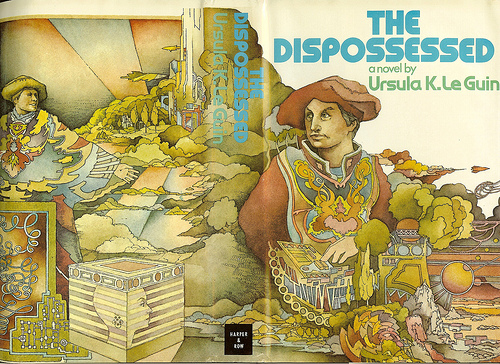
Thoughts on The Dispossessed
There are some books that even with my untrained, unskilled and inexperienced eye can detect and confirm are true works of art, mastery in literature. Continue reading “The Dispossessed… + The Day Before The Revolution…READ HERE”

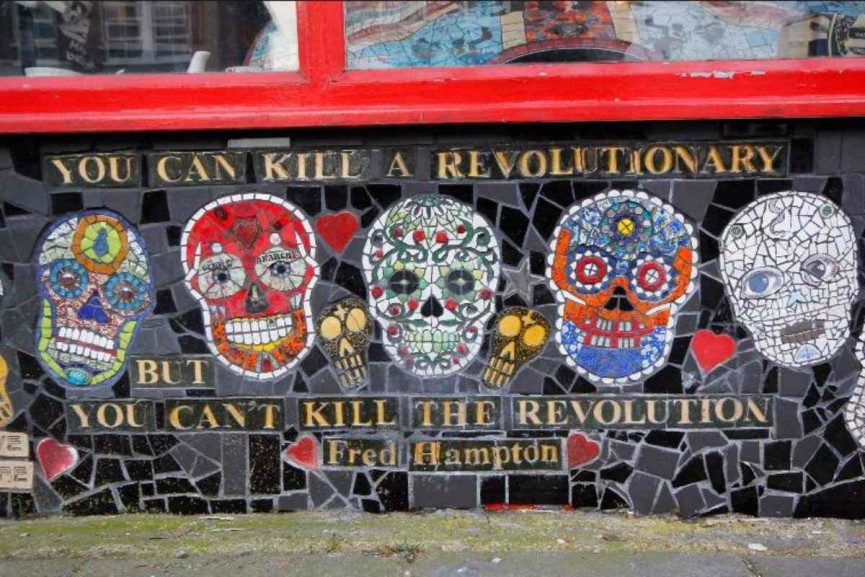
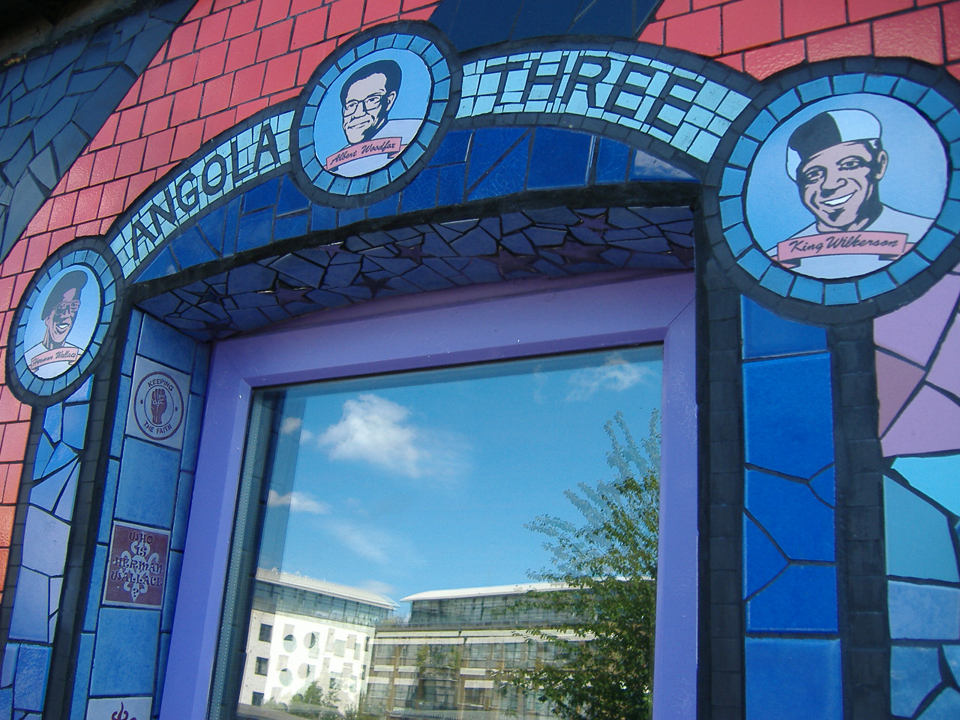
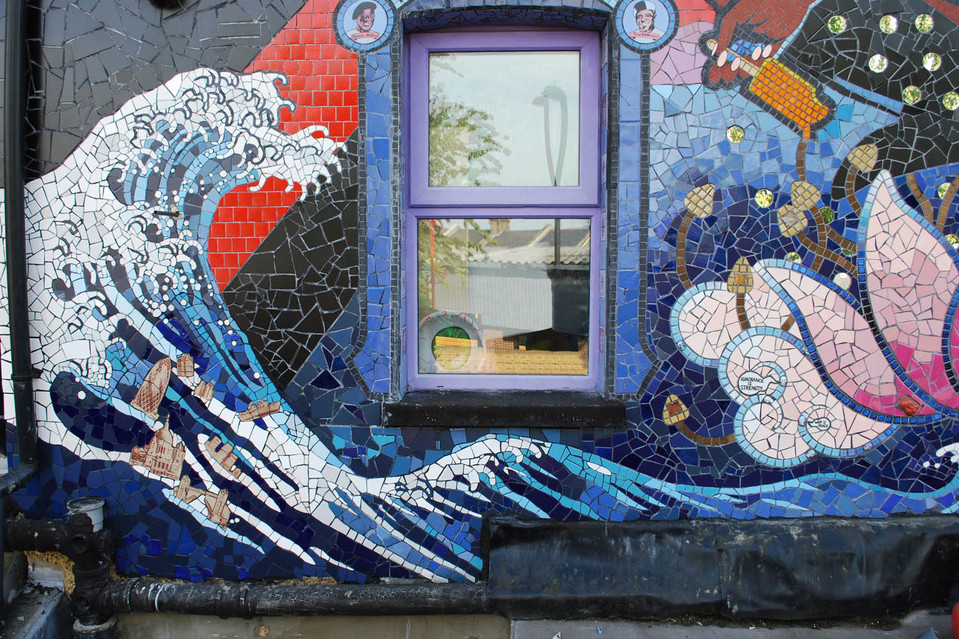
Show #125 Carrie Reichardt’s Revolutionary Art

First a small gallery of Carrie’s art.. 

to listen to her INTERVIEW click The Circled A

Mayday demonstration at Bank. People protest against police violence and dress as convicts, prisoners or police. Organised by Space Hijackers. London. © Jess Hurd/reportdigital.co.uk Tel: 01789-262151/07831-121483 info@reportdigital.co.uk NUJ recommended terms & conditions apply. Moral rights asserted under Copyright Designs & Patents Act 1988. Credit is required. No part of this photo to be stored, reproduced, manipulated or transmitted by any means without permission.
Mayday demonstration at Bank. People protest against police violence and dress as convicts, prisoners or police. Organised by Space Hijackers. London.

Capture12-865x577

2671039669_5182226fa4

Angola-3-mosaic-on-house-in-Chiswick-West-London-suburb-082508-by-Carrie-Reichardt

Carrie-Reichardt-in-Chiswick

Riot-here-Riot-now

artist1

BN-HL280_0317WA_J_20150317124453

fight for your roght to be arty

to listen to her INTERVIEW click The Circled A


Loosey Parsuns's avatarThe Circled A

image

Carrie Reichardt is a contemporary artist, who works from a mosaic-covered studio in London. A member of the Craftivism movement, she uses murals, ceramics, screen-printing and graphic design in her work. She is a dedicated advocate of the movement and curated one of the few exclusively Craftivist exhibitions in the UK. She talks about the ‘Disobedient Objects’ exhibition at the V&A, Angola 3 and much more!

Listen Now:

View original post

Transition Movement explodes into Life: watch film here

in transition 2.0

In Transition 2.0: A Story of Resilience & Hope in Extraordinary Times

Transition is an idea that has gone viral, a social experiment that is about responding to uncertain times with solutions and optimism. In a world of increasing uncertainty, here is a story of hope, ingenuity and the power of growing vegetables in unexpected places. Continue reading “Transition Movement explodes into Life: watch film here”

Mutual Aid at the Bolt Occupied Hostel in Dublin

bolt-hostel

“Mutual aid is arguably as ancient as human culture; an intrinsic part of the small, communal societies universal to humanity’s ancient past. From the dawn of humanity, until far beyond the Invention of agriculture, humans were foragers, exchanging labor and resources for the benefit of groups and individuals alike.” – Wikipedia

Since the establishment of the Bolt Hostel just over a week ago, there have been many people that have arrived at the door to donate furniture, cloths, bed linin, volunteering their time, labour and skills. There has been a communal kitchen area/ TV area created, all by the donations of fridges, microwave, washing machine, cooker, table and chairs, sofa, TV and DVD player by people.CJTR88bWcAAMxWZ

Continue reading “Mutual Aid at the Bolt Occupied Hostel in Dublin”

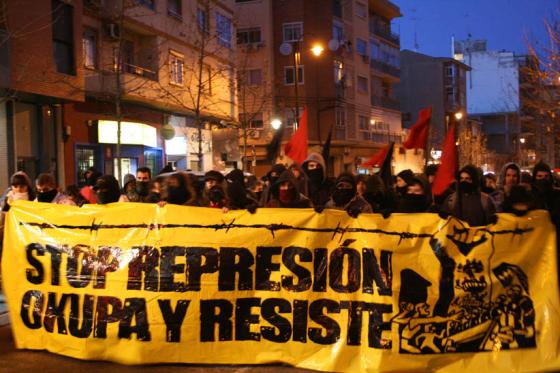
Zaragoza Occupiers declare for Anarchism

en Castellano abajo

IMG_0402  

Dilar Dirik promotes Women’s Revolution in Rojava

The Women’s Revolution in Rojava: Defeating Fascism by Constructing an Alternative Society

by Dilar Dirik

This piece is a book chapter in “A Small Key Can Open A Large Door: The Rojava Revolution” by Strangers in a Tangled Wilderness (Ed.), March 2015 (Combustion Books).24795b9d45550d61cc9f6bee7a09a629_LThe resistance against the Islamic State in Kobanê has woken the world to the cause of Kurdish women. Typical of the media’s myopia, instead of considering the radical implications of women taking up arms in a patriarchal society – especially against a group that systematically rapes and sells women as sex-slaves – even fashion magazines appropriate the struggle of Kurdish women for their own sensationalist purposes today. Continue reading “Dilar Dirik promotes Women’s Revolution in Rojava”

Exploring the Commons, 1. Open Assemblies, now and in History.

–  “The assembly is a central part of the Spanish left tradition. Social movements have always seen themselves through the prism of assemblies.”

open assembly in Catalunya

We don’t mean controlled school assemblies, much less those of religious sects, who use the form just for a semblance of participation without the danger of maybe taking a vote.

We mean real assemblies.. to sit around in a circle with no fixed agenda and no attempt to control, talking things out until decisions can normally be reached by consensus.

The Spanish 15M movement evolved from occupying Squares to hundreds of local assemblies, which in turn set off thousands of community initiatives. The beauty of a real assembly is that no one can take power, and predatory Parties, Unions and egoistic self seeking ‘leaders’ get sidelined, allowing revolutionary energy to flow.

Continue reading “Exploring the Commons, 1. Open Assemblies, now and in History.”