blog of the post capitalist transition.. Read or download the novel here + latest relevant posts
Author: thefreeonline
The Free is a book and a blog. Download free E/book ...”the most detailed fictional treatment of the movement from a world recognizably like our own to an anarchist society that I have read...
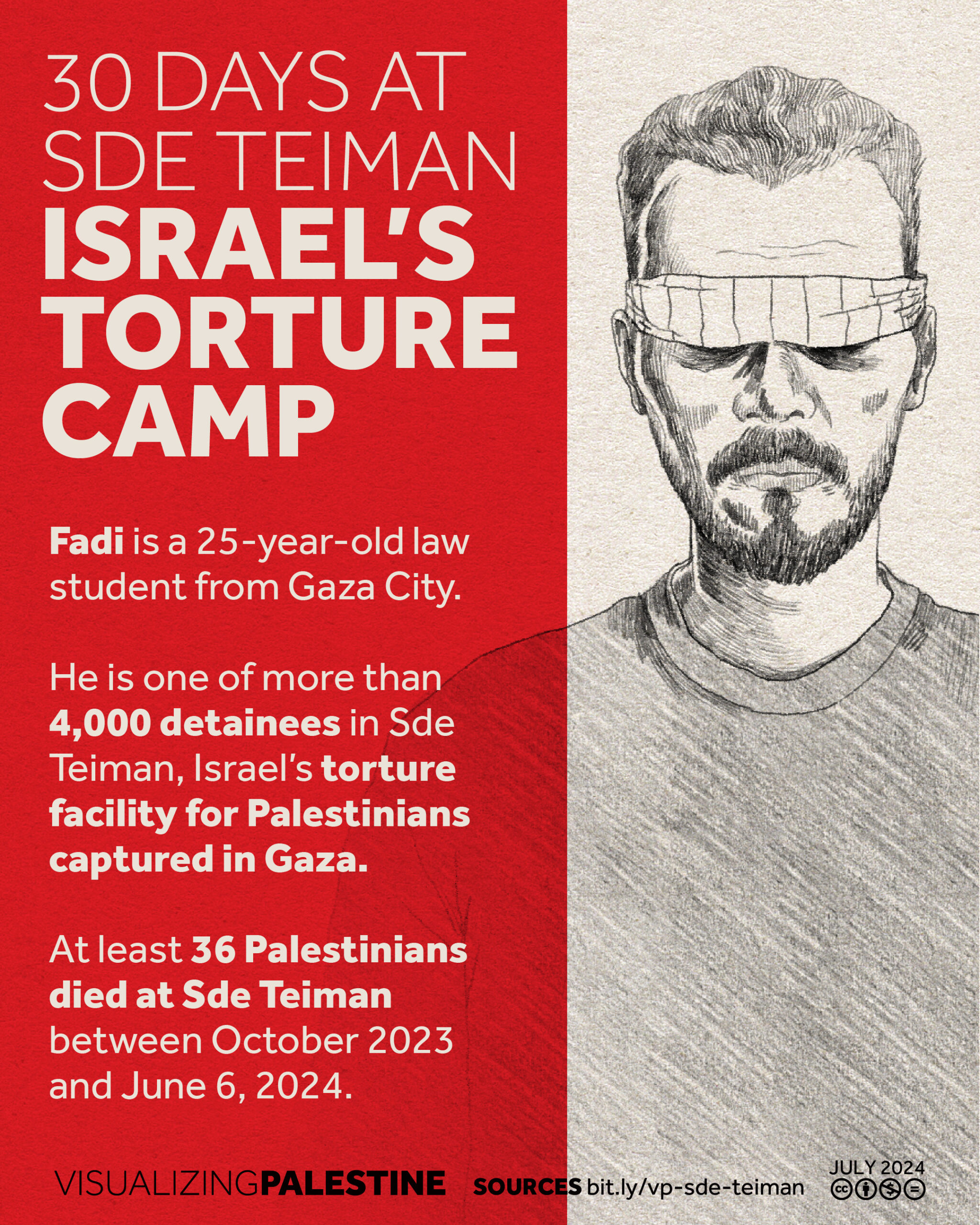
It has been 10 months since the Israeli government began their most recent assault on Gaza and the West Bank. The retaliation for the October 7 Hamas attack in Israel, has escalated to what the international community has called genocide, therefore, GRIID will be providing weekly links to information and analysis that we think can […]
Iran’s new ‘moderate’ leader needs to retaliate dissuasively to the Israeli killing of Haniyeh while avoiding tit for tat escalation and US intervention
Amidst the cascading tensions in the Middle East we follow the assassination of Hamas leader Ismail Haniyeh by Israel and the vows of ‘revenge’ in Tehran.
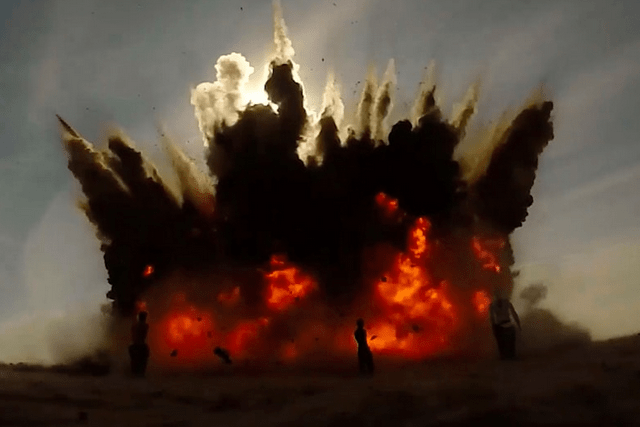
Iran’s retaliation after Israel’s killings of Iranian leaders in April was a master stroke, with a public spectacle of 100’s of drone and missile attacks, with prior warnings, calculated to cause minimum damage or injury, along with a probable hypersonic attack, with warning, destroying a military base.
Iran’s clever response, along with US reluctance to join in, forced Israel for the first time to back down and stop its tit for tat terrorist escalation policy, enhancing Iranian prestige with the ‘global south’ majority.
Huge demonstrations continue by Israelis against ‘mad dog’ Netanyahu and his neo fascist military regime, even as he is feted and applauded in Washington.
Iran’s supreme leader Ayatollah Khamenei has already ordered a direct retaliation strike on Israeli territory for the terrorist Haniyeh killing . Haniyeh was a key leader managing the shuttle diplomacy seeking a ceasefire in Gaza, and his elimination saves the Netanyahu faction from pressure as the ceasefire is shelved for now.
But what can Iran do to successfully stand up to Israeli terrorism, satisfy its supporters and allies, and avoid a bloody war with the west provoked by ‘mad dog’ Netanyahu?
And could Israel now even roll out a False Flag with its ‘Hannibal Option’ and massacre its own civilians to force a US vs Iran war?
In remarks at the Majlis on Tuesday after the swearing-in ceremony, new moderate President Pezeshkian reaffirmed that his government’s foreign policy will strive for constructive engagement with the world while upholding Iran’s national dignity and interests.
It is naive to believe that Israel acted on its own to attack Iran’s sovereignty, which is tantamount to an act of war, without some sort of US approval. It is this ‘known unknown’ factor that makes the situation very dangerous.
Israel also fears a renewed Iranian push for negotiations for a nuclear deal that might open a pathway for the removal of western sanctions as well as a vista of broad-based peace and cooperation.
And the Israeli regime is desperate to change the media narrative away from the ongoing Gaza genocide and West Bank annexations.
Israel can no longer count on Western US instigated hatred and isolation of Iran. Even the Saudi Crown Prince Mohammed bin Salman congratulated Pezeshkian by phone on his election victory and last Thursday, the Saudi Minister of State handed over to Pezeshkian a letter from King Salman bin Abdulaziz Al Saud expressing hope for more constructive steps in developing bilateral relations with Iran
Similarly, the historic Arab League delisting of Hezbollah recently shows the extent to which Saudi Arabia and other Arab states are moving away from Washington’s anti-Iranian positions.
The bottom line is, Pezeshkian’s call for regional unity to counter extremist influences. The Iranian leader proclaimed, “Radical voices should not drown out the voices of the nearly two billion peace-loving Muslims. Islam is a religion of peace.”
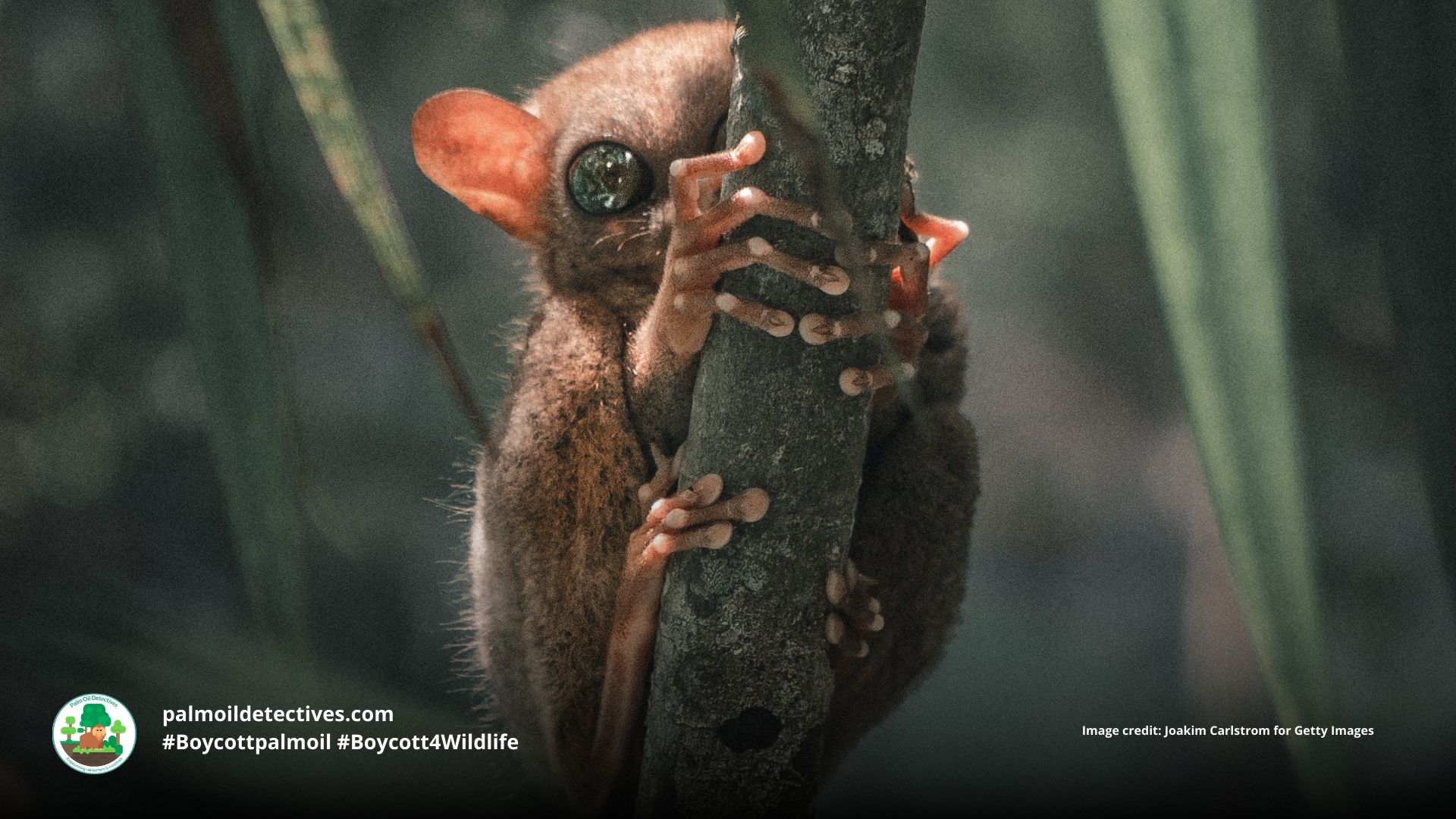
The Philippine tarsier, Carlito syrichta, epitomises nocturnal secrecy, leading a mostly concealed life in the dense recesses of impenetrable bushes and forests. They boast large and mesmerising eyes that aid in night vision, these tiny creatures have a distinct appearance. Measuring around 8 to 16 cm, their fur is soft and comes in various shades, often blending with their natural surroundings. Known for their incredible leaping abilities, tarsiers are agile hunters, relying on their keen sense of hearing to locate prey. Despite their small size, they play a vital role in maintaining the ecological balance in their habitat. They are now vulnerable due to multiple human-related threats including palm oil deforestation and the pet trade. Help them to survive #Boycottpalmoil #Boycott4Wildlife
via MEE After failing to achieve his military objectives, the indicted war criminal travelled to the US to incite a war against Iran and prolong his genocidal campaign in Gaza Reposted from Middle East Eye The first US response to the double assassinations this week in Beirut and Tehran came from Secretary of Defence Lloyd Austin on […]
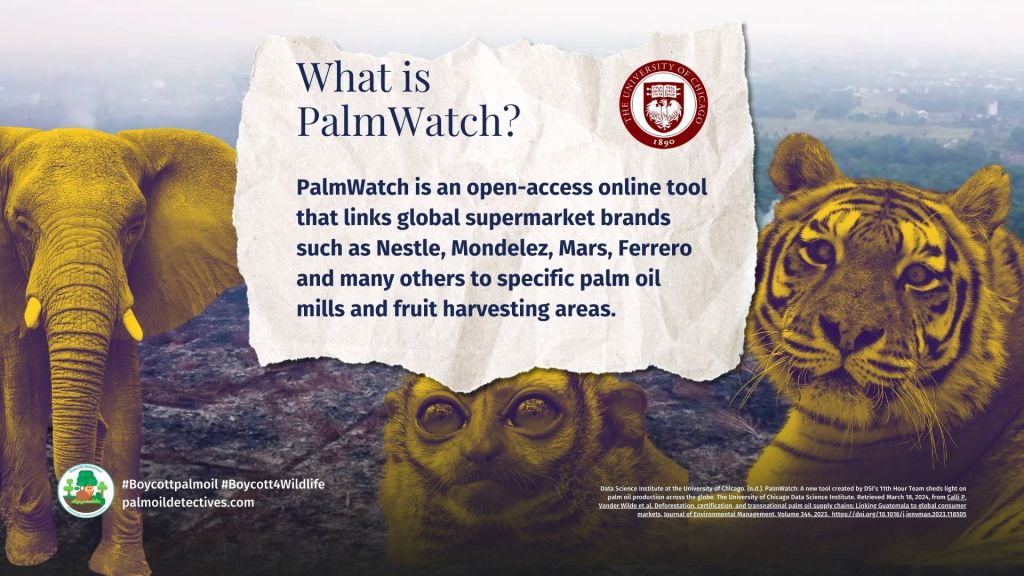
More than simply a tool, PalmWatch is a clarion call to consumers to look carefully at their purchases. And where possible, to boycott brands causing the ecological crisis of tropical deforestation.
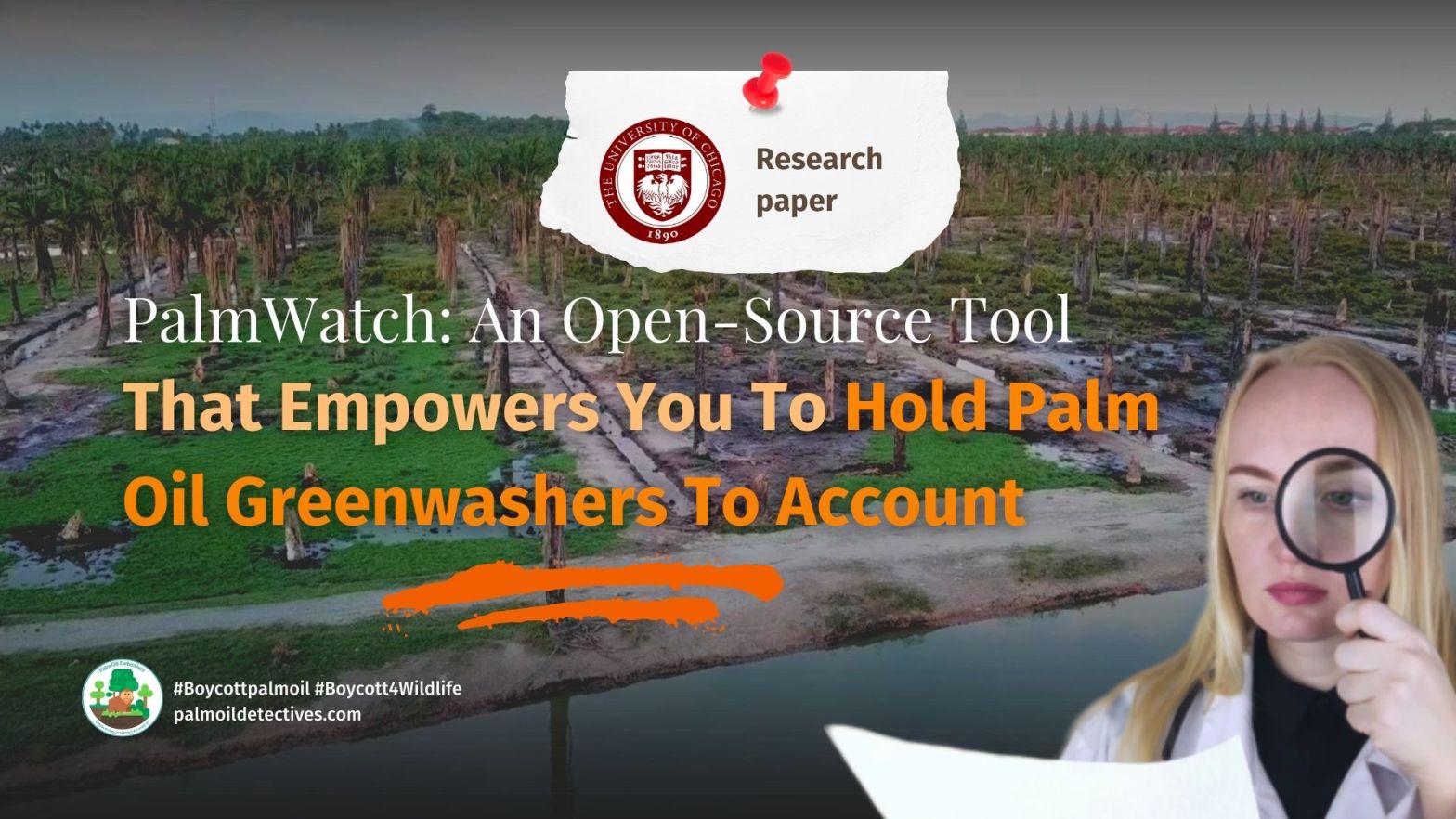
A groundbreaking open-source tool by the University of Chicago called PalmWatch, shines a light on the darkest parts of the palm oil industry.
PalmWatch is a free web-based tool that reveals links between major multinational brands using supposedly “sustainable” palm oil, and palm oil supply chain.
This means that concerned consumers, animal rights advocates and human rights advocates can clearly see the toll of palm oil ecocide in their daily supermarket purchases.
Covering hundreds of thousands of kilometres, PalmWatch gives everyone open-source, free and unprecedented access to what “sustainable” palm oil really looks like..
Help animals and indigenous peoples and #BoycottPalmOil #Boycott4Wildlife every time you shop!
Pioneering #opensource tool #PalmWatch reveals dark and #corrupt corners of the #palmoil industry. Including so-called “sustainable” palm oil used by global #supermarket brands.
Uncover the #greenwash and #Boycottpalmoil #Boycott4Wildlife @palmoildetect https://wp.me/pcFhgU-7lp
Game-changing free tool #PalmWatch helps you track #palmoil #deforestation and #humanrights abuses by “sustainable” RSPO members: @Nestle @CP_news @MDLZ @Unilever @Kelloggs_US. Uncover their #ecocide and #Boycottpalmoil #Boycott4Wildlife @palmoildetect https://wp.me/pcFhgU-7lp
The media release below is provided by the University of Chicago and had the original title ‘PalmWatch, a new tool created by DSI’s 11th Hour Project team, sheds light on palm oil production across the globe’, published February 22nd, 2024. Read the original.
Palm oil is a required ingredient for a plethora of household products, from food items like packaged pastries and chips to cosmetics and soaps or even biofuels. But most palm oil is produced on mono-crop plantations, grown on huge tracts of land that were once tropical rainforests and other biodiverse ecosystems.
“Every day Rojava survives is a testament that another world is not only possible but essential, which is why outside forces continue to conspire to suffocate this collective gasp for air”
Dr. Thoreau Redcrow reflects on the significance of the Rojava Revolution on its twelfth anniversary, emphasising its philosophical and practical impacts in North and East Syria.
I was asked by Hawar News Agency to give my thoughts on the anniversary of the Rojava Revolution and what it signified for the world, based on my trips to the region.
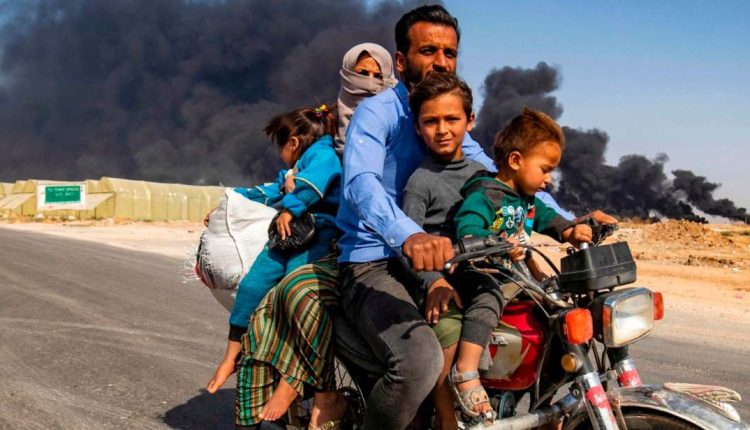
This allowed me to observe the perseverance of martyrs’ widows living and educating themselves at the Jinwar Women’s Village the small joy of children riding a Ferris wheel in Amûdê, and the psychological scars left from the liberated dungeons and former execution sites of ISIS in Raqqa.
My time in Rojava (north and east Syria) witnessed events spanning from the Battle of Kobanê in 2014, to Turkey’s invasion and occupation of Serê Kaniyê and Girê Spî in 2019.
Interviewing ISIS prisoners and their wives showed me the dark alternate reality that was planned for this region if the YPG, YPJ, and SDF had not sacrificed so much to free it from their grasp.
And now, as the Turkish Air Force continues to rain down death upon the valiant population of Rojava, while threatening to renew and complete the extermination that their mercenaries in ISIS began, it is incumbent on the outside world to remember what is at stake.
Rojava is more than a geographical place; it is a philosophical idea brought to life, a seed scratched out of the sky by blistered hands grasping for a better future, and watered with the blood of countless şehîds (martyrs) who gave their lives so it could live.
Every day Rojava survives is a testament that another world is not only possible but essential, which is why outside forces continue to conspire to suffocate the collective gasp for air that it represents.
YPG and YPJ defense of the Rojava Revolution takes the ISIS Capital of Raqqa – now once again a thriving multi-cultural city
Rojava has already changed the world by etching its example into the annals of history, but on this 12th anniversary, we are left with the uncertainty of whether it can continue to inspire the next generation to fight for their due deliverance.
So, perhaps when considering that question, it is useful to reflect on what the Rojava Revolution represents. I am including my poem ‘All that Rojava is’ (2022), which aims to do just that.
The Cradle | August 1, 2024 The US, UK, and France blocked a Russian-proposed statement at the UN Security Council (UNSC) condemning the assassination of Hamas politburo chief Ismail Haniyeh in Tehran, Iran’s envoy to the UN Amir Saeid Iravani said on 1 August. “Russia’s proposed statement condemning Israel’s heinous act was blocked by the US, UK, […]