via https://anarchistnews.org.. shared with thanks
update> Police deaths now put at 14. Casualty numbers of demonstrators not available but may be hundreds of deaths.. see also.. U.S., Turkey eye Kazakhstan to penetrate Central Asia, spy on China, grab 40% of world’s uranium. CSTO troops move in./

from CrimethInc.
An Interview and Appraisal
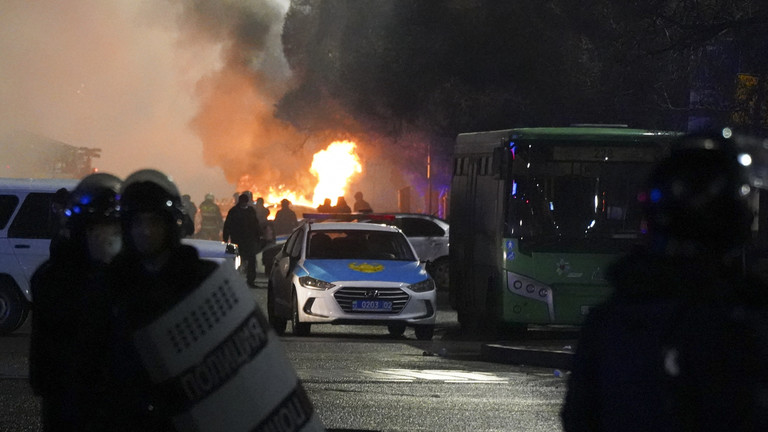
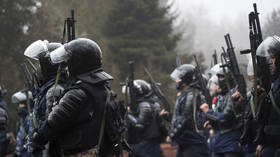
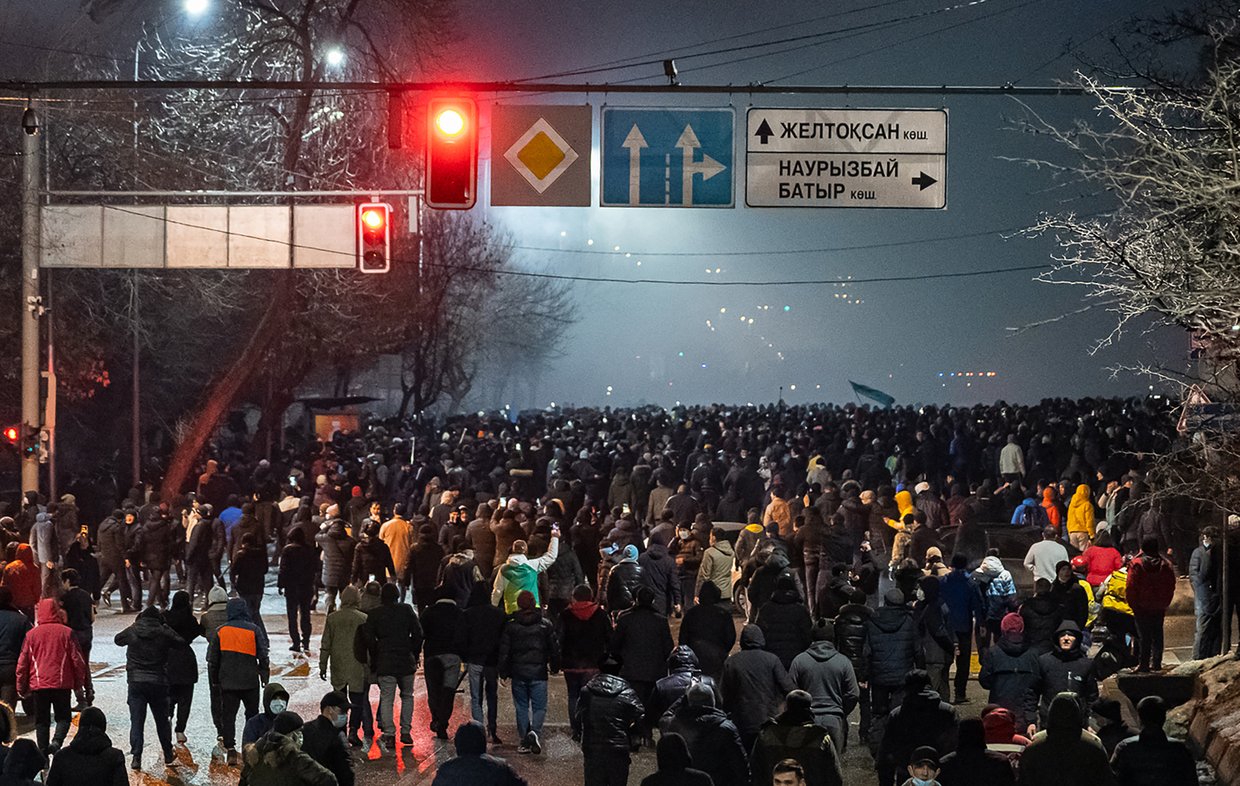
A full-scale uprising has broken out in Kazakhstan in response to the rising cost of living and the violence of the authoritarian government. Demonstrators have seized government buildings in many parts of the country, especially in Almaty, the most populous city, where they temporarily occupied the airport and set the capitol building on fire. As we publish this, police have recaptured downtown Almaty, killing at least dozens of people in the process, while troops from Russia and Belarus arrive to join them in suppressing the protests.
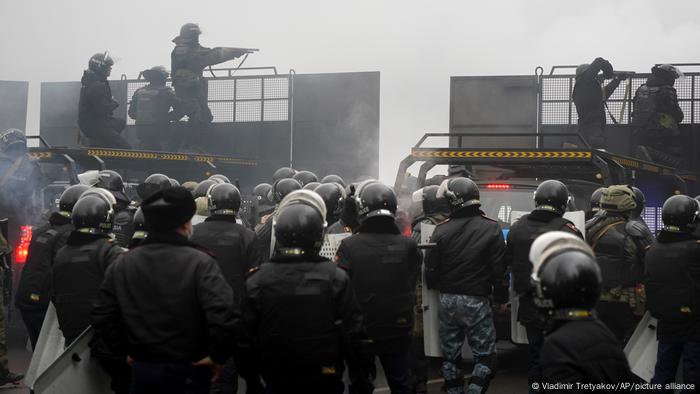
We owe it to the people on the receiving end of this repression to learn why they rose up. In the following report, we present an interview with a Kazakhstani expatriate who explores what drove people in Kazakhstan to revolt—and explore the implications of this uprising for the region as a whole.
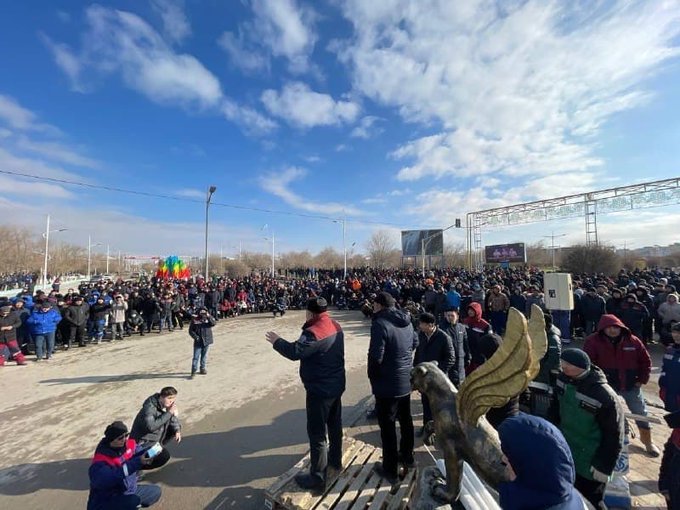
Integration Nightmares@bad_immigrant·Rallies without big police repressions are happening all around #Kazakhstan
“What is now happening in Kazakhstan has never happened here before.
“All night there were explosions, police violence against people, and some people burned police cars, including some random cars. Now people are marching around the main streets and something is happening near Akimat (the parliament building).”
-The last message we received from our comrade in Kazakhstan, an anarcha-feminist in Almaty, shortly before 4 pm (East Kazakhstan time), before we lost contact.
We should understand the uprising in Kazakhstan in a global context. It is not simply a reaction to an authoritarian regime. Protesters in Kazakhstan are responding to the same rising cost of living that people have been protesting all around the world for years. Kazakhstan is not the first place where an increase in the cost of gas has triggered a wave of protests—exactly the same thing has happened in France, Ecuador, and elsewhere around the world, under a wide range of administrations and forms of government.
What is significant about this particular uprising, then, is not that it is unprecedented, but that it involves people confronting the same challenges we confront, too, wherever we live.
The urgency with which Russia is moving to help to suppress the uprising is also significant. The Collective Security Treaty Organization [CSTO], a military alliance comprised of Russia, Armenia, Belarus, Kazakhstan, Kyrgyzstan, and Tajikistan—with Russia calling the shots—has committed to sending forces to Kazakstan. This is the first time that the CSTO has deployed troops to support a member nation; it refused to assist Armenia in 2021, during its conflict with Azerbaijan.

It is instructive that the war between Armenia and Azerbaijan did not warrant CSTO intervention, but a powerful protest movement does. As in other imperial projects, the chief threat to the Russian sphere of influence (the “Rusosphere”) is not war, but revolution.
Russia has profited considerably from the civil war in Syria and the Turkish invasion of Rojava, playing Syria and Turkey against each other to gain a foothold in the region. One of the ways that Vladimir Putin has held on to power in Russia has been by rallying Russian patriots to support him in wars in Chechnya and Ukraine. War—perpetual war—is part and parcel of the Russian imperial project, just as war has served the American imperial project in Iraq and Afghanistan. War is the health of the state, as Randolph Bourne put it.
Uprisings, on the other hand, must be suppressed by any means necessary. If the millions of people in the Rusosphere who languish under a combination of kleptocracy and neoliberalism saw an uprising succeed in any of those countries, they would hurry to follow suit. Looking at the waves of protest in Belarus in 2020 and in Russia a year ago, we can see that many people are inclined to do so even without hope of success.
In capitalist democracies like the United States, where elections can swap out one gang of self-seeking politicians for another, the illusion of choice itself serves to distract people from taking action to bring about real change.
In authoritarian regimes like Russia, Belarus, and Kazakhstan, there is no such illusion; the reigning order is imposed by despair and brute force alone. In these conditions, anyone can see that revolution offers the only way forward.
Indeed, the rulers of all three of those countries owe their power to the wave of revolutions that took place starting in 1989, bringing about the fall of the Eastern Bloc. We can hardly blame their subjects for suspecting that only a revolution could bring about a change in their circumstances.
Revolution—but for what purpose? We cannot share the optimism of liberals who imagine that social change in Kazakhstan will be as simple as chasing out the autocrats and holding elections. Without thoroughgoing economic and social changes, any merely political change would leave most people at the mercy of the same neoliberal capitalism that is immiserating them today.
And in any case, Putin will not give up so easily. Real social change—in the Rusosphere as in the West—will require a protracted struggle. Overthrowing the government is necessary, but not sufficient: in order to defend themselves against future political and economic impositions, ordinary people will have to develop collective power on a horizontal, decentralized basis. This is not the work of a day or a year, but of a generation.
Continue reading “The Uprising in Kazakhstan / news and interview.. from Crimethinc”