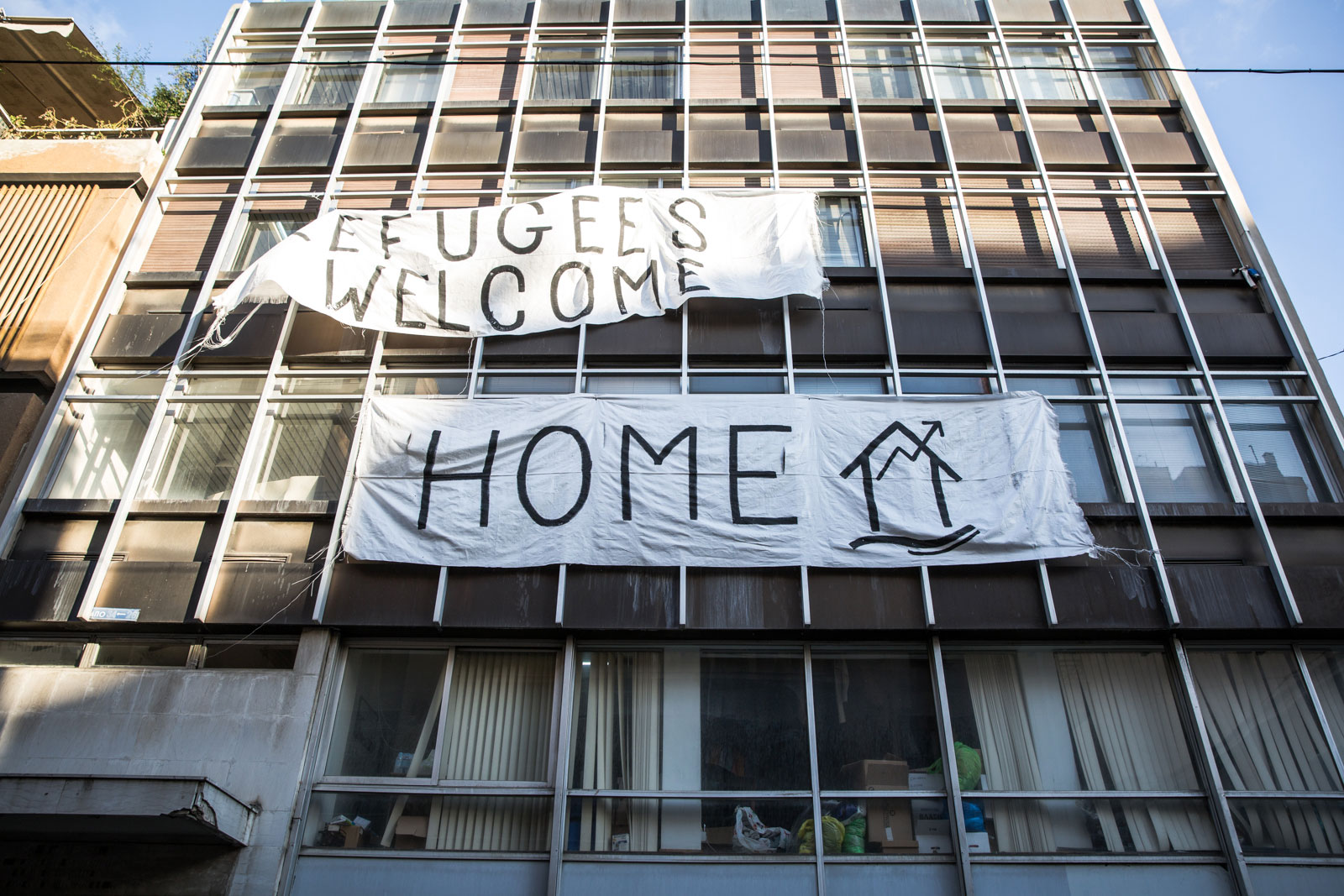
A few hundred metres away on the corner, the Notara refugee solidarity centre provides temporary housing to refugees stopping over in Athens
Manan, 30, who gave only his first name as he has family back in Afghanistan, fled home in early 2014 as fighting raged and the Taliban made gains in many parts of the country. He was stuck in Iran for several months waiting for a smuggler to organise his trip, then Turkey for a year while he worked and saved money to continue the journey.
Arriving in Greece more than a year ago, Manan says that the warm welcome he found among solidarity activists in places such as Exarcheia prompted him to change his mind and not go on to other European countries, as he originally intended.
In Exarcheia, a graffiti-daubed neighbourhood which the locals have dubbed an independent republic within the Greek capital, anarchists are squatting in the former tax administration building.
They call the place “Notara”. It lies on Notara Street and has now become a home for some of the refugees in the city. Many are Iranian, others from Algeria or Morocco. Some Syrian and Afghan refugees who have problems with their documents or are awaiting money from home have also found shelter here.
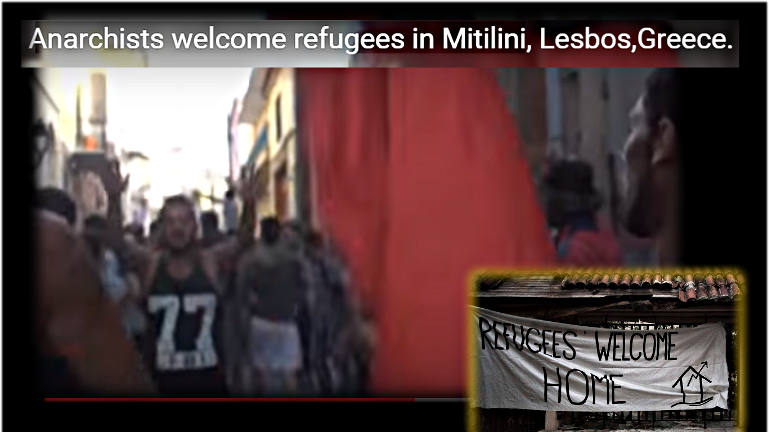
A huge banner reading “Refugees Welcome Home” is draped across the front of a derelict building in Exarchia, Athens – a district that’s generally regarded as the spiritual home to the city’s anarchist movement. On Tuesday morning, members of the Anti-authoritarian Movement Athens (AK) occupied a former university dining hall, with the aim of transforming it into a temporary residence for refugees.
New International Refugee Occupation
From Squat.net
In the evening of Sunday, January 10th 2016, we occupied the empty building on Themistokleous St. 58, in Exarchia, Athens. The intention is to open up a place where migrants who are blocked here in Greece, because of the European migration policies, can live and self-organize free from state control. We are a group of individuals from different places and of different contexts, connected through the fight against States, nations, borders, lager, prisons, capitalism; eventually against every part of this rotten system of domination that oppresses us. We are open to anyone who agrees with our basic principles and wants to participate in the project without a hidden political agenda.
This squat isn’t meant to be a public service. We aren’t “volunteers” and we don’t see migrants as victims. One of the challenges of this project will be to overcome in practice the separation imposed on us by borders and citizenship. This house seeks to become a place where people organize themselves and learn from one another mutually, regardless of their origins.
This is an act against the system and the migration policies. It is not our intention to assist the humanitarian aid provided by the State. The integrated and/or assimilated, non-critical humanitarian aid is in fact helping the State to focus on repressive measures in order to persecute and control migration. We strongly refuse to cooperate not only with the State and political parties, but also with NGOs and other organizations or formations that do so (officially or unofficially). All of these scumbags take advantage of the situation of migrants either to profit, protect their interests, gain political power, or to build a social profile.
The control of migration is a tool in the hands of those in power. Right now the Greek State uses the situation of migrants stranded here to put pressure during negotiations for better conditions enabling the implementation of the third memorandum. At the same time, European States regulate migrant flows according their need for cheap labor force, and the rest of migrants are murdered (in land and maritime borders and the streets of European cities), incarcerated or deported. The European Union upgrades its repressive border policies and negotiates deals with States at the inner and outer European borders to continue and intensify the war against migration by more effective means. Those in power hope to secure their property and privileges from those who are being exploited by the capitalist system and suffer their wars. Private and public corporations try to make as much profit of this situation as possible. NGOs represent the interests of their employers, mainly the State, and are well paid for their job.
Because of property rights, people are sleeping in the streets while thousands of houses remain empty. There are enough goods for everyone. We just have to take what we need ourselves.
We declare our solidarity and support to all forms of action that attack borders, nations, prisons, the critical infrastructure that reproduce the existent, and all those who directly or indirectly defend the status quo!
No racism
No sexism
No homophobia
No discrimination
No exploitation
No oppression
No hierarchy
No authority
No patriotism
NOT welcome are:
Journalists/media
Politicians
Cops
All organizations that cooperate with the State
We welcome people willing to self-organize, regardless if they have papers or not, and regardless if they have a refugee status or not. Priority in housing is given to those who have no chance to stay somewhere else.
We call people in solidarity to support the squat outside of the building. Soon enough we will announce the date and time for the administrative assembly of the project.
Translation in Greek, German
Contra Info https://en-contrainfo.espiv.net/2016/01/10/athens-new-squat-in-themistokleous-st-58-in-exarchia/
Athens: Update from Themistokleous 58 squat in Exarchia
At about 10pm on January 10th 2016, a few hours after we occupied the empty building on Themistokleous 58 St. in Exarchia, a guy appeared outside the premises who claimed to represent ‘ANASKEVI M EPE’ and said that the building belongs to this real estate company.
What he pretty much told us is that, if we don’t evict ourselves from the building until tomorrow, he will call the cops.
We make clear that we do not acknowledge private property, and we have no intention of leaving the squat.
We call for continued presence of people in solidarity, inside and outside the building, to defend the project by all available means.
Themistokleous 58 squat
Translation in Greek
https://en-contrainfo.espiv.net/2016/01/10/athens-update-from-themistokleous-58-squat-in-exarchia/


![The anarchist food collective EL CHEf uses the image of the infamous Che Guevara as a symbol of their project [Sorin Furcoi/Al Jazeera]](https://thefreeonline.com/wp-content/uploads/2016/01/415a34a5555d4db38b0c10a4af8d4d37_18.jpg?w=257&h=144) cloaked in political graffiti, with slogans denouncing authority and others pledging solidarity with new arrivals as the refugee crisis continues to shake
cloaked in political graffiti, with slogans denouncing authority and others pledging solidarity with new arrivals as the refugee crisis continues to shake the volunteers reject funding from either the government or humanitarian organisations. “Empty places should always be used as housing for people without it, or as social centres, or serve a good for people who need them,” Stathis adds.Even the decision to choose this neighbourhood was born from deeply held political convictions.
![The entrance to the EL CHEf food collective in Athens' Exarcheia neighbourhood [Sorin Furcoi/Al Jazeera]](https://thefreeonline.com/wp-content/uploads/2016/01/ed2371d8a91041bb9d87ed6cb6fd8eea_18.jpg)




 The Free