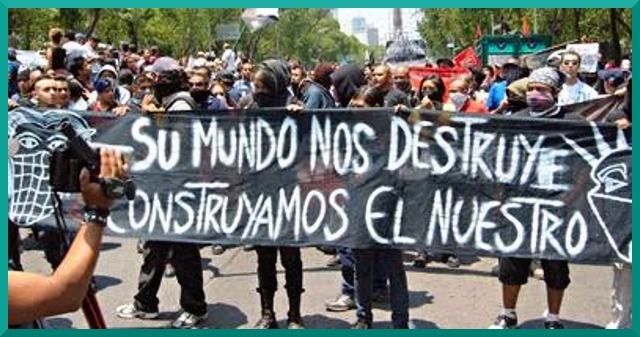
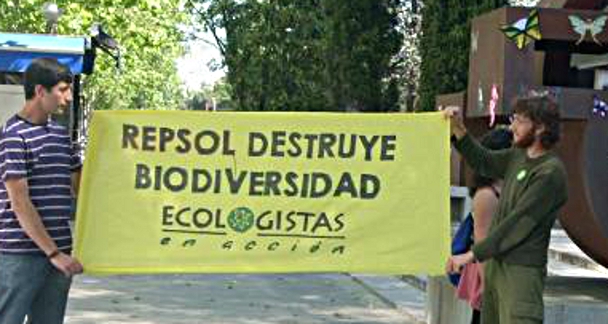
Repsol gana 5% con ‘Fracking’ Argentina

note. posts on NH3 the CO2-Free fuel now have their own blog HERE.. http://co2freefuelexistsnow.wordpress.com/
Repsol YPF amenaza con el ‘fracking’ una región argentina.
Con el truco de declarar ‘nuevos’ depósitos que podrían ser explotados con la nueva técnica de ‘fracking’ Repsol ha ganado 5% en valor, no sé cuantos milion. No les importa que ‘fracking’ envenena permanentement el acuífer.
Pero los depositos de hydrocarburos ya conocidas son más que suficientes para llevar el Cambio Climático al límite absoluto de +2·C , así que
las prospecciones de Repsol son crimenes masivos contra el futuro de la tierra, denegando una vida a nuestros hij*s y condenando miles o miliones de especies maravilosas a la extinción.

| Continue reading “Repsol gana 5% con ‘Fracking’ Argentina”

Repsol se enriquece Matando

¡ Encontraron el Dorado!

Repsol se enriquece con los lotes y mercados cautivos de América Latina

Domingo 4 de diciembre de 2011, por repsolmemata

Las pasadas semanas Repsol sorprendió a los accionistas con la noticia del descubrimiento histórico de 927 millones de barriles equivalentes de petróleo en el yacimiento de Vaca Muerta, Neuquén, Argentina. La noticia coló y los inversores premiaron a la compañía con un aumento del 6% de la cotización bursátil a las pocas horas de su difusión. Aunque exagerada por su contenido (pues según los analistas, ni son reservas probadas, ni el shale oil es todavía petróleo ya que necesita de costosos procesos de refinación)[1] pareciera que la crisis mundial no afecta a la compañía petrolera, que sigue amasando altísimos beneficios. Pero si ellos ganan, quién pierde?

En el último lustro la estampa de Antoni Brufau, presidente de Repsol-YPF, abrazado a presidentes de diferentes países de América Latina se ha hecho familiar . No en vano, la compañía petrolera ha apostado millonarias inversiones en la exploración de nuevas áreas y el desarrollo de campos productivos que han engrosado unas reservas muy cotizadas en los mercados bursátiles. Otra estrategia ha sido formar sociedades mixtas con las empresas nacionales, para conseguir áreas prioritarias y superar las resistencias gubernamentales. De este modo, los países productores, que a la vez son consumidores, abren sus puertas a la compañía, entregando unos combustibles para que la compañía los exporte, o los venda al propio país con un gran margen de ganancias.

Mientras la compañía anuncia en las bolsas sus fabulosos hallazgos en zonas no tradicionales, los habitantes de estas regiones sufren los pasivos ambientales del avance de la frontera extractiva. Y los conflictos afloran con el petróleo.

Petróleo bajo el mar

En Brasil, Repsol materializó a finales del pasado año un acuerdo con la empresa china Sinopec para desarrollar conjuntamente los proyectos de exploración y producción que posee en las Cuencas de Santos, Campos y Espírito Santo, donde participa en 14 bloques, de los cuales opera siete.

En las últimas semanas, el consorcio Repsol Sinopec Brasil anunció descubrimientos de importantes reservas en varios pozos en la costa de Vitoria y Sao Paolo a profundidades entre 2 y 5 kilómetros. Estos hallazgos se añaden a otros mega-yacimientos que Repsol ya contabilizó en los pasados años y que le posicionaron en una de las empresas líderes en descubrimientos en aguas profundas.

Pero entre la detección de reservas ubicadas a kilómetros bajo la superficie y su posterior extracción, existen riesgos e impedimentos tecnológicos que – sirva el desastre del golfo de México de 2010 como precedente- conviene no subestimar.
En aguas colombianas, Repsol se propone realizar exploración y explotación petrolera en las Cayos del Norte, parte del archipiólago de San Andrés, Providencia y Santa Catalina. El proyecto ha levantado la oposición del pueblo indígena raizal y de organizaciones ambientalistas por poner en peligro los sistemas coralinos del conocido Mar de los Siete Colores.

Gas guaraní para la exportación

En Bolivia, Repsol se asoció a YPFB para formar la empresa PetroAndina SAM y conseguir nuevas áreas de exploración en la Amazonía.

Más al sur, en el Chaco, la compañía sigue perforando pozos exitosos en el interior de territorios indígenas. El Bloque Caipipendi, de 123.000 hectáreas que se superponen a los Territorios Comunitarios de Orígen Itika Guasu, Tentayapi, y al Parque Nacional Aguaragüe, ya se han puesto en marcha 5 pozos a profundidades de hasta 6.000 metros. En 2010 Cristina Fernandez y Evo Morales inauguraron un nuevo gasoducto de 40 kilómetros para unir este bloque con la red de gasoductos argentinos y asegurar mayores flujos de exportación hacia el mercado argentino, deficitario de este combustible – a pesar de que este país permite a las empresas exportar el gas a chile y otros países.

El pasado octubre, Repsol anunció la inversión, junto a su socia Pan American Energy de 1.400 millones de dólares para seguir perforando nuevos pozos con el horizonte de aumentar la producción de 3 a 14 millones de metros cúbicos diarios de gas en los próximos tres años. Con este repunte productivo “se garantizará los contratos de exportación a Argentina y por supuesto satisfacer el mercado interno”, el cual, valga decirlo, todavía es mínimo por no contar con una red de suministro domiciliario.

Amenazada por el bloque Caipipendi, la comunidad guaraní de Tentayape, declarada como Patrimonio Historico Cultural de los Guaranís en 2006, ha defendido a ultranza una posición de determinante rechazo a cualquier entrada de la compañía en su territorio. La empresa, a sabiendas de las reservas gasíferas que aguardan bajo el suelo de la comunidad, acorrala su territorio implantando cada vez más infraestructuras en la zona.

Amenazas a los pueblos amazónicos
Repsol opera en varios lotes en la Amazonía del Perú. Al norte, en el controvertido Lote 39, se discute la existencia o invención de pueblos en aislamiento voluntario. Mientras las organizaciones indígenas piden la creación de una reserva territorial que los proteja, Repsol niega su existencia en base a la colocación de trampas fotográficas. Mientrastanto, la francesa Perenco, ha obtenido la licencia para la construcción de un oleoducto en el vecino Lote 67, también en territorios de posible presencia de pueblos aislados.

Al sur del país, Repsol es socia del consorcio Camisea, que opera al interior de la Reserva Territorial Nahua Kugakapori Nantis. Pluspetrol, la operadora del Lote 88, ha iniciado hace unos meses cuestionados movimientos no previstos al interior de la reserva, contratando a comunarios del pueblo Nahua, en situación de contacto inicial, para actividades de vigía ante posibles encuentros con grupos aislados.

A parte, el descubrimiento de enormes bolsas de gas en el vecino Lote 57 ha empujado a Repsol a iniciar un ambicioso proyecto de industrialización de la selva. Para este año, peinará sus bosques con un proyecto de sísmica 3D que afectará 2.360 Km de la Reserva Comunitaria Machiguenga, así como su área de amortiguamiento y la del Parque Nacional Otuqui. También proyecta la contrucción de 22 pozos más que se añadirán al pozo ya perforado Kinteroni I y una conexión de gasoductos entre los pozos de los lotes 57, 56 y 88.[2]

En la región del Madre de Dios, el lote 76 operado por Repsol y Hunt, genera conflictos por la invasión con la Reserva Comunal Amarakaeri, pues se superpone a casi todo el territorio de la reserva y sin que se les haya efectuado la consulta previa a sus habitantes.

Repsol obtuvo un beneficio neto de 1.901 millones de euros en los nueve primeros meses de 2011, un 6,4% superior al año anterior. Buenas noticias para la bolsa, malas para los pueblos que cobijan el filón hidrocarburífero.

[1] Aleardo F. Laría , El misterio de Loma de la Lata, Diario Río Negro, Neuquen, 24/11/2011

[2] Agunos artículos sobre el tema: “ El desembarco de la modernidad, la sobmra de Repsol en Nuevo Mundo” http://servindi.org/actualidad/50232, “Repsol barrerá 5.000 km2 en reservas comunales” http://servindi.org/actualidad/48268, “La historia se repite para los pueblos aislados de la Reserva del Estado Nahua Kugakapori” http://www.kaosenlared.net/noticia/…

por  repsolmemata

Antarctica: Climate deniers murder Mother Nature

There is a myth among the climate change denial industry that the climate of Antarctica is actually cooling rather than warming, and that this disproves the case for global warming. One theory is that the (man made) ozone hole has temporarily cooled the stratosphere and this makes for local cooling in spite of global warming; but needless to say, even this week, outright deniers claim that the thinning and breaking of huge swathes of glaciers is meaningless.

This surprising claim is in the face of the 1.2C average increase in Antarctic temperatures between 1959 and 1996. And it also ignores the plain fact that on a more front line level, there is clear warming taking place – for example, the Antarctic tourist industry (yes, there is such a thing, now) is rubbing its hands with glee at the profitable prospect of being able to take tourists deeper into Antarctica – one tour has been extended from 11 to 14 days because there are far more opportunities to disembark and sight see compared to a few years ago.

And study after study, including this year, has shown increasing thinning and melt of ice shelves, with massive icebergs resulting. while a plague of parasitic crabs moving south with warmer water is currently causing concern for local flora and fauna. By contrast, the supposed cooling evidence comes from data collected at just one location on the Continent – the McMurdo Dry Valleys Long-Term Ecological Research Station, along with rather a lot of extrapolation.

Antarctica has been described as the canary of the world – perhaps we should be listening harder to its faltering song.

from Viridis Lumen with thanks  http://viridislumen.blogspot.com/2011/11/antarctica.html

Greedy climate politicians trash the World

greedy politicians doom our children

note. posts on NH3 the CO2-Free fuel now have their own blog HERE.. http://co2freefuelexistsnow.wordpress.com/

The latest climate Talks in Durban are set to be an obscene farce as countries vie to be the greediest, stupidest, cruelest and most destructive. We need a revolution NOW, since the Nation States  REFUSE to adopt any reformist solutions, in the name of humanity and the millions of other species threatened with extinction…lets Occupy the Environment

Not content with burying the remains of the Kyoto Protocol the proposal is to  DO NOTHING until at least 2015. Continue reading “Greedy climate politicians trash the World”

Corrupt Brazil Senate votes for Amazon slaughter.

In what may go down as one of the worst environmental crimes of the 21st Century, the Brazilian Senate voted on Wednesday to retain most of the bad changes to the national Forest Code that had passed the House of Deputies earlier this year.

Brazil’s international commitments to mitigating climate change, maintaining biodiversity and it’s status before the upcoming RIO+20 global environmental meetings are now on collision course with the insatiable demand of its agri-business sector. In the coming months the issue will be laid squarely before President Dilma Rousseff who has thus far avoided comment.

re-posted from JustMeans    A revised version of Brazil’s Forest Code, a piece of legislation that regulates the use of forest coverage on private properties in Brazil, and whose draft was approved in Congress on Wednesday (23), has sent shockwaves through the sustainability community in the country and abroad.

An incensed debate has gripped the country over the last year, which culminated in yesterday’s vote. The new draft, which is designed to meet the requirements of the rural business, has been rushed through the House and the Senate and did not take into account expert opinion from scientists, who object to the new version of the law vehemently.

“The report continues to pardon those who deforested illegally and will promote more deforestation. What used to be an environmental crime now has become fantastic business”, said Mrcio Astrini, Greenpeace’s head of Amazon campaign.

Scientists have warned the new law will open way for the clearance of more than 175 million acres, or roughly the size of Germany, Italy and Austria combined, which would be come mostly pasture for livestock and soy monocultures to feed cattle, mostly.

This volume of deforestation would release more than 25 billion tons of CO2 into the atmosphere, or four times the goal for global reductions in greenhouse gas emissions under the Kyoto Protocol during 2008-12.
WWF, which has been campaigning against the revised legislation from the beginning of the debate, said the proposed changes severely contradict Brazil’s efforts to become an environmental and sustainability leader on the global stage.

“Brazil will be cutting itself off from a growing global market for responsibly sourced goods, in addition to forgoing the countless benefits provided by a healthy Amazon, such as clean air and water, stable weather patterns and various other environmental services”, it said.

“We are watching, just before Brazil hosts Rio + 20, a clear attempt to dismantle Brazil’s environmental legislation,” stated WWF-Brazil’s CEO Maria Cecilia Wey de Brito. “This is something unprecedented in our history.”

The bill will go back to the House before being sent to President Dilma Rousseff, who can still veto it. “In the next phase, she will have to keep her word to veto or break her campaign promises”, said Mr. Gasparini in reference to Ms. Rousseff’s promise to not pardon those who have deforested.

The current Forest Code was written in 1965 and requires landowners to keep a certain percentage of their land as untouched forest, from 20 percent in certain areas to 80 per cent in the Amazon. The new laws would give amnesty from heavy fines to landowners who cleared forest illegally between 1965 and July 2008.

Rules related to the clearing of hills would be relaxed and forest areas near rivers would have to be between 100 and 330 feet from the river bank, which conservationists say will are not enough.

A recent report compiled by Imazon and Proforest found that Brazil lags behind other BRIC countries in terms of legislation that protects forest coverage. Compared with China, Russia and India, Brazil loses the race towards sustainability by deforesting more than it reforests.

MORE INFO SEE HERE 

Belo Monte site OCCUPIED. Work still stopped..

Altamira, Brazil – Hundreds of indigenous leaders, fishermen and riverine people from the Xingu River basin have gathered to occupy the Belo Monte Dam construction site in a peaceful protest to stop its construction in Altamira, located in the state of Pará in the heart of the Brazilian Amazon. They Poor barrio of Altimira to […]

On sat 20th Aug a massive demo took place against the ongoing Amazon destruction for the Belo Monte dam. Also against the new Forest Law, now in the Senate, which ‘relaxes’ the already unenforced deforestation  code. Brazil had been a constructive leader in Climate talks, which came to nothing due to the greedy demands of […]

The greedy corrupt Brazilian politicians are voting to give free rein to their fascist landlord colleagues  and the McDonalds backed Ranching industry to  destroy the Amazon Rainforest. The politicians appeal to nationalist sentiment.. saying we have already destroyed our forests and they have every right. But 79% of Brazilians are AGAINST the new laws going […]

BRAZIL Politicians Out of Sync with Public Sentiment on the Environment By Mario Osava* Trans-Amazonian Highway outside Altamira in the northern Brazilian state of Pará. Credit:Mario Osava/IPS with thanks BRASILIA, Jun 29, 2011 (Tierramérica) – The environmental movement continues to gain credibility and support as scientific findings confirm its warnings and natural disasters become increasingly […]

Deforestation in the Brazilian Amazon from August 2009-May 2011.The analysis by Imazon suggests that the Forest Code debate may be a factor in rising deforestation. It found a 363 percent increase in forest degradation — logging and burning of forest that typically precedes deforestation — over the past 10 months, reaching 6,081 sq km. Most […]

”The surprise passing of the new Forest Law in the lower house of the Brazilian congress is due to a campaign by multinational  agribusiness and the big landlords who still own most of the country. The proposed amnesty for forest crimes has caused a 6 fold increase in deforestation already. The huge majority in favour […]

Dark Day for Brazil’s Amazon Jungle By Fabiana Frayssinet

foto. José and Maria. ‘They gunned them down and cut off their ears” An Amazon environmental activist and his wife were killed late on Monday and the crime is being investigated as a possible assassination to silence the outspoken forest defender, according to police. José Claudio Ribeiro da Silva, also known by his nickname of […]

URGENT AMAZON FOREST ALERT [UPDATE 20 May 2011: The Guardian UK reports, “Brazil forms ‘crisis cabinet’ following unexpected deforestation surge”.] Events are moving quickly in Brazil’s epic battle over a new national Forest Code. The struggle has has reached a critical stage full of both danger and opportunity. Please take action. EMERGENCY — BRAZIL’S NATIONAL […]

By Clarinha Glock* A solitary cow in a slash-and-burn clearing where there was once Amazon rainforest. C PORTO ALEGRE, Brazil, May 16, 2011 (Tierramérica) – The adoption of a new Forest Code in Brazil could threaten efforts to curb Amazon deforestation, which was reduced 70 percent between 2004 and 2010. The proposal to amend the […]

Golf: Sick Mental Capitalist vs. The Planet

Saw a great documentary last night and was both horrified and inspired by it that I thought I would recommend itto as many as I can. It is about the environmental catastrophe caused by Donald Trump building his golf course in Aberdeenshire and the resistance of local residents.

They have a website for the film
and you can contact the director and producer to arrange showings for community groups.
It resonates with the occupy mood. You can see Trump in action in the film to make yourselves aware just in case he really runs for president one day and you can learn about the
campaign against the course which is still active.
Peace@Love
Miguel from
The Irresistible Urges

Discovery Channel BANS Climate Change News

Discovery Channel has stated that it was taking out the last episode due to ‘scheduling conflicts’, but others believe the channel is cutting the episode ‘On Thin Ice’ because it deals directly with the impacts of global warming on the Arctic and Antarctic.

My bet is that Discovery and other channels were yet again quietly bought off by the Climate Change Deniers, financed by the swill of 100s of billions profit made by the criminal oil companies every year, while paying NONE of the costs to the  climate, environment and pollution caused ill health and deaths which they caused.

And the US is not alone, around one third of the networks to air the series worldwide have opted on accepting the series from the BBC without the last episode.

“It’s a bit like pressing the stop button on Titanic just as the iceberg appears,” a representative with Greenpeace told The Telegraph. “Climate change is the most important part of the polar story, the warming in the Arctic can’t be denied, it’s changing the environment there in ways that are making experts fearful for the future.”

There is a cheap, CO2 and pollution free alternative to oil, at least for transport, suppressed by the oil companies.. That’s NH3 fuel, check it out here.  note. posts on NH3 the CO2-Free fuel now have their own blog HERE.. http://co2freefuelexistsnow.wordpress.com/ Continue reading “Discovery Channel BANS Climate Change News”