A Highway Megaproject Tears at the Heart of New Guinea’s Rainforest
main text by William Laurance at e360.yale.edu/featu…. illustrations and #FreeWestPapua info added…. The Indonesian government is building a 2,700-mile road network on the island of New Guinea, opening up some of the world’s last great tropical rainforests to development and threatening unique indigenous cultures. Can international pressure force Indonesia to scale back this megaproject?
The Pacific island of New Guinea, which harbors one of the world’s largest and most intact tropical rainforests, is the epicenter of Australasia’s tropical biodiversity. The island’s unique denizens, including tree-kangaroos and birds of paradise, are representative of a regional flora and fauna so fantastically diverse that Charles Darwin once mused such creatures must have been made by a “separate Creator.” Today, researchers are still merely sampling its primeval intricacies.
The Indonesian military clears trees for a segment of the Trans-Papua Highway in northern Papua. Daniel Beltrá / Greenpeace
New Guinea is also among the most culturally and linguistically diverse places on earth, with human populations that are genetically distinct from all others alive today. Not until the 1930s did the Western world discover many hundreds of unique indigenous societies in New Guinea’s vast mountains and highlands. And only in the 1950s did European colonists, miners, and loggers begin to exploit the region.
Today, these unique rainforests are being carved up by a massive, ill-advised, and exceptionally risky road-building scheme. The Trans-Papua Highway will sprawl like a massive spiderweb over much of the Indonesian-ruled, western half of New Guinea, known as Papua or West Papua.
The areas circled are projected to experience intense deforestation when the Trans-Papua Highway is completed. Courtesy of William Laurance
Totalling 2,700 miles in length, this highway network will penetrate deeply into densely forested or remote mountainous regions to increase access to minerals, fossil fuels, timber, and land for agri-business ventures, including vast palm oil plantations. Many road segments will traverse precariously steep, virgin terrain. Continue reading “#FreeWestPapua: Trans-Papua Highway.. Ecocide and Genocide for Quick Cash $$”
#FridaysForFuture: “We have come here to let you know that change is coming, whether you like it or not”
FridaysForFuturePublished by Enough is Enough. Written by Riot Turtle. More and more cities across the globe are joining the Frifays for Future school strikes.
On the German territory alone students will go on strike in more than 50 cities on Friday January 18. The school strikes for climate justice were started by 16 year old Greta Thunberg last year.
Students and others hold up placards with climate messages during a demonstration against climate change in Brussels, Thursday, Jan. 17, 2019. Thousands of students as part of the Youth for Climate movement took time off school Thursday to call for stronger action against climate change. (Geert Vanden Wijngaert/Associated Press)
Is it an anarchist movement.? .. No its not, but many of the school strikes are self-organized and there are many cities where young anarchists are involved in the school strikes. The movement for climate justice is growing fast, many young people are getting active because they see that the “traditional” political system is not acting against climate change. Continue reading “Climate Emergency School Strikes going Viral ..#FridaysForFuture”
info from La_Directa and Twitter.. Violent attacks and charges were made by the Mossos local police while protecting an illegal eviction executed by Desokupa, the private Eviction Company, in the Poble-sec barrio of Barcelona . One supporter and three from the squatting collective were arrested, instead of the hired thugs.
”Although the converted ‘luxury’ flats were finally lost the emergency neighbourhood mobiization brought crowds of people onto the streets in record time to block the private mercenaries of the speculation company until the police charged twice”..
Feminisms
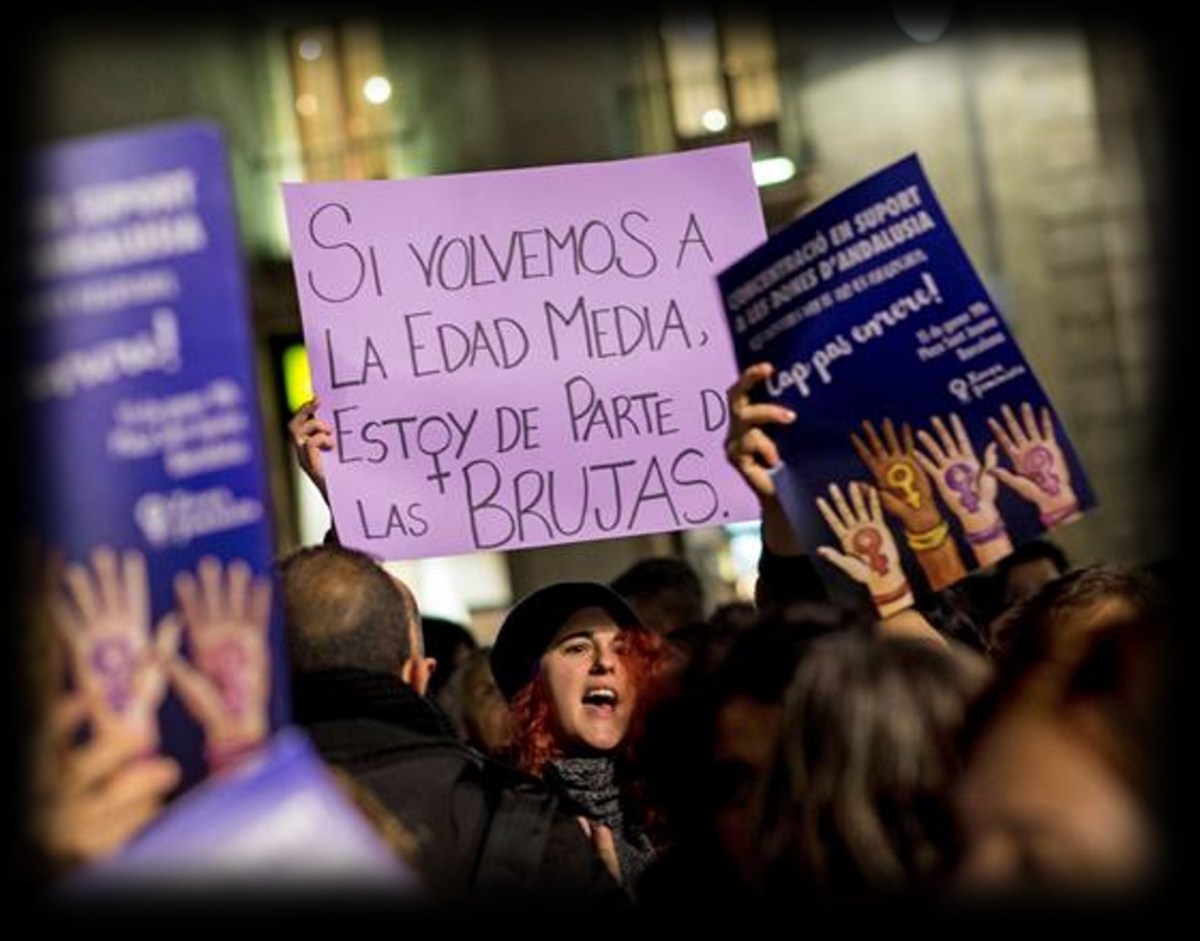
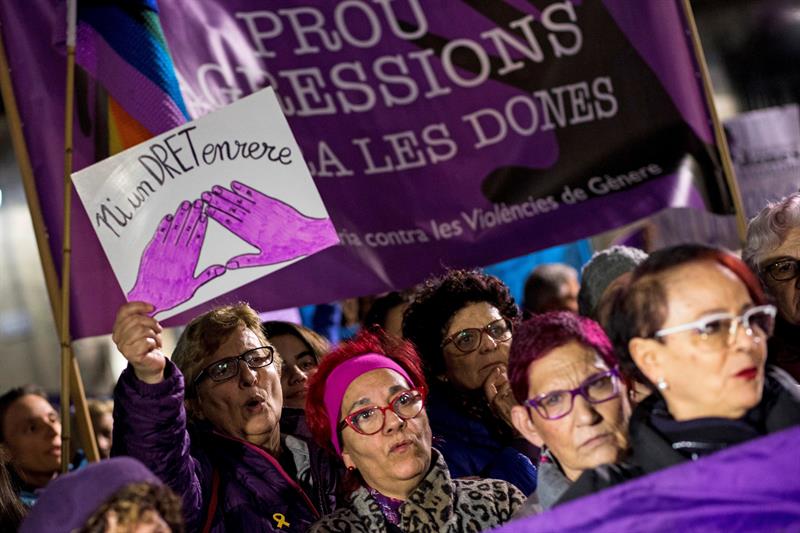
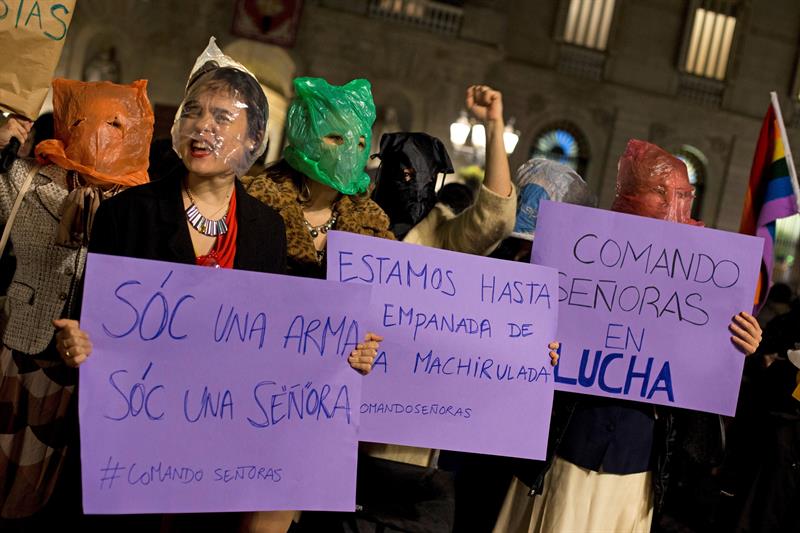
#NiUnPasoAtrás (Not One Step Back) moves from Seville to a hundred cities .
Its the first time since the Dictatorship that openly fascist candidates have been elected and the far right have gained control of the Andalusian local parliament by pacting with them.
The PP got the support of Vox without openly assuming its shocking anti feminist measures, including the repeal of the laws of gender violence and LGTBI equality in Andalusia., but Vox with 10 seats will hold the balance of power and a platform to legitimize and spread their movement..
The news of the despicable Vox in power generated rage on social networks and sparked calls for multiple demonstrations and rallies
The slogans # NiUnPasoAtrásenIgualdad (Not One Step Back In Equality) and #OurRightsNoSeNegocian (Out Rights Aren’r Negotiable) have moved from Andalusia to a hundred cities throughout the State to show the rejection of the PP (Right Wing opposition) agreement with the new openly fascist party Vox to invest their candidate and control the local Parliament in Andalusia.
by Álvaro Minguito El Salto Editorial Staff translatiions from The Free
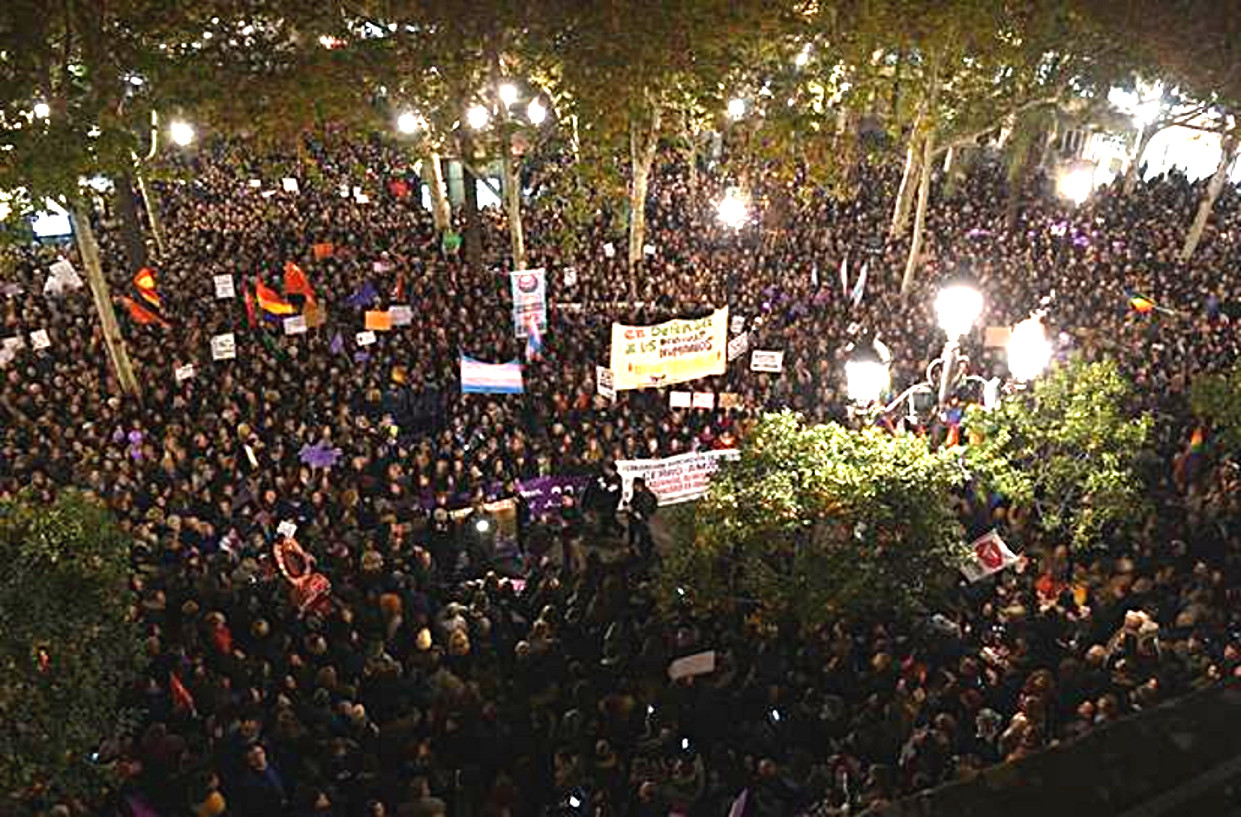
The first session of the Investiture Plenary Session in the Andalusian Parliament took place Tuesday morning while on the street a huge demonstration led by the feminist movements demanded not to negotiate with the rights of women.
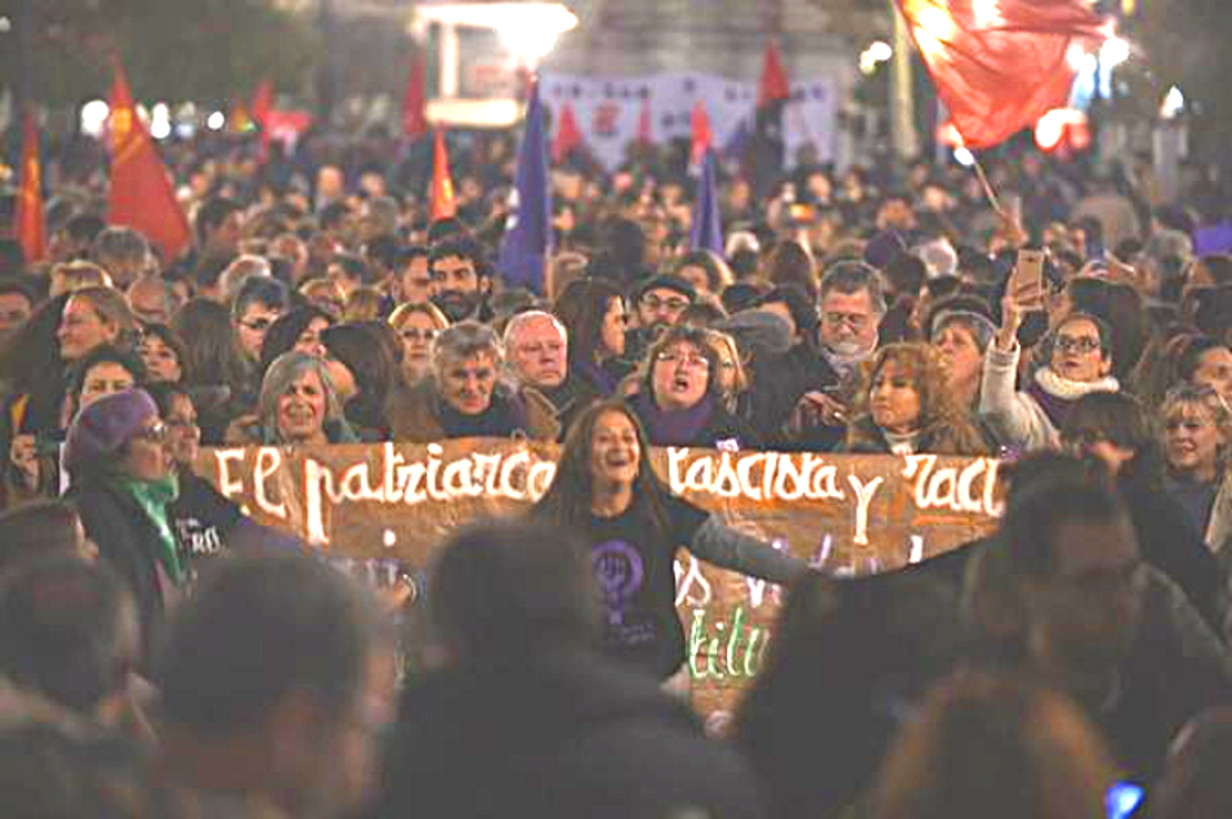
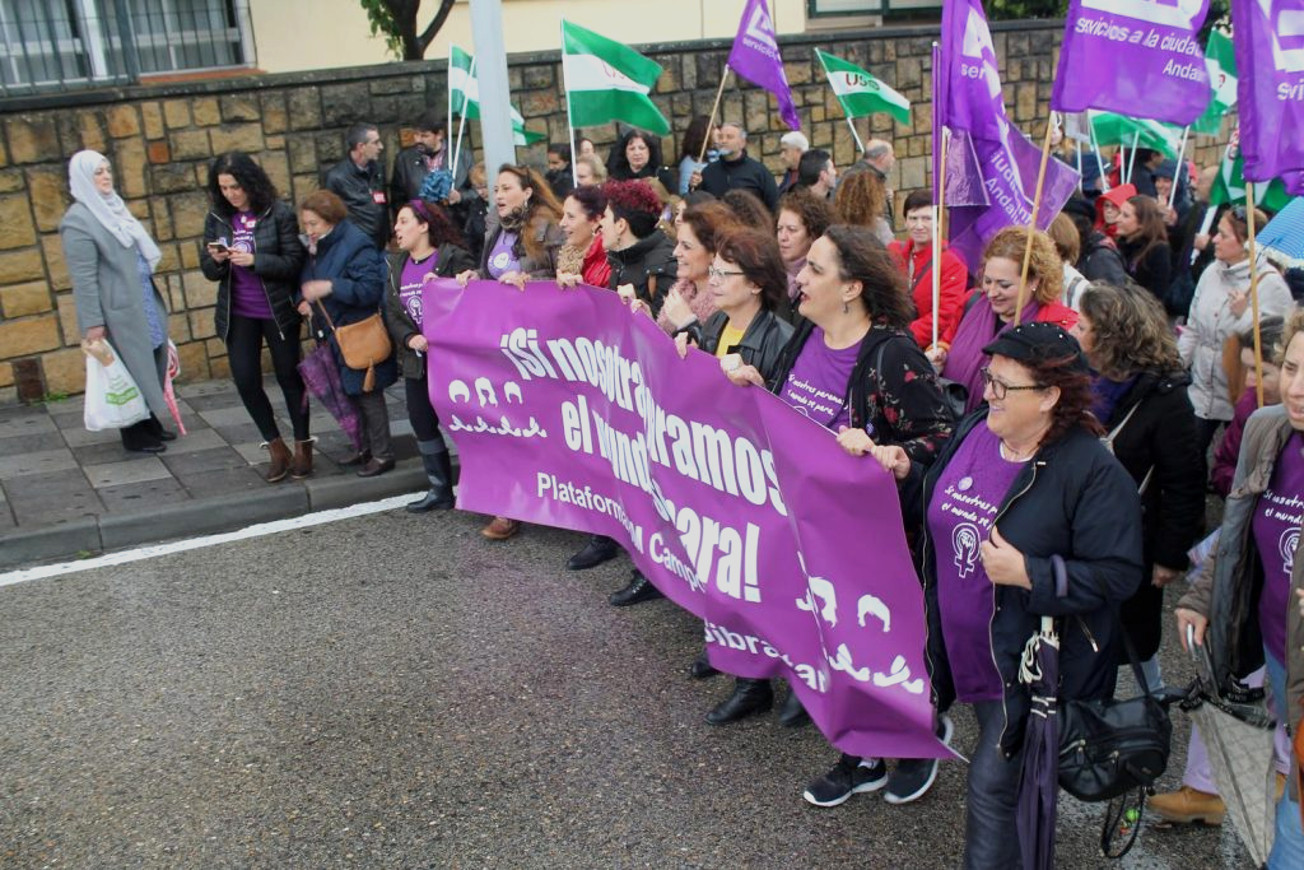
“Not a step back” and “Our rights are not negotiable” have been the main arguments of a mobilization that began at midday before the doors of the Andalusian Parliament, in Seville, and that the feminist movement has supported throughout the State with demonstrations mushrooming and spreading to a hundred cities and towns in the afternoon.
# NiUnPasoAtrás (Not One Step Back)
Manifestation Sevilla Álvaro Minguito
The slogansheard in Seville spread in the afternoon to the main cities of Andalusia and have also to A Coruña, Barcelona, Bilbao, Burgos, Cáceres, Madrid, Valencia or Zaragoza, etc etc.
The mobilization in more than a hundred cities has overflowed the borders of the Spanish State, and there have also been concentrations in Paris amd Berlin.
The voices of feminists is joined by those of LGBT movements. Thus, the entities that make up the State Federation of Lesbians, Gays, Trans and Bisexuals (FELGTB) have supported the mobilizations.
If the right comes for us, we’re going to turn purple ✊🏽 #NiUnPasoAtras pic.twitter.com/iYbzHYjmk7 – Sonia (@lventseasporte) January 15, 2019
The federation is concerned about “the proliferation of hate speech in the governing bodies of Andalusia” and fears “a setback in the degree of respect for the rights and freedoms of the people that make up our society,” in reference to the initial proposals presented by Vox to give their support to Juan Manuel Moreno in the investiture, which included the repeal of the laws of gender violence and LGTBI equality in Andalusia.
Juan Manuel Moreno, candidate of the PP, has revealed in the first Plenary of the session of investiture of the Parliament of Andalusia some of his proposals, among which are the suppression of the inheritamce tax and the limitation of mandates to eight years.
Málaga # Málaga ‘We do not fit into the Plaza Constitución’, 15E # niunpasoatrás # niunpasoatrásenigualdad #FeminismoAndaluz #NoNegociamosYoVoy # Andalucía #parlamentoandaluz #InvestiduraAnd # 15Enero # 15E #feminism #sororidad #visibilidad pic.twitter.com/HtCYo0oINc
some info from – La Poderío (@lapoderiofem) January 15, 2019 translatiions from The Free
#NiUnPasoAtrás se traslada de Sevilla a un centenar de ciudades tras el discurso de investidura de Moreno
Los lemas #NiUnPasoAtrásenIgualdad y #NuestrosDerechosNoSeNegocian se han trasladado de Andalucía a un centenar de ciudades en todo el Estado para mostrar el rechazo al acuerdo del PP con Vox para investir a su candidato en Andalucía.
“Ni un paso atrás” y “Nuestros derechos no se negocian” han sido los argumentos principales de una movilización que comenzaba a mediodía ante las puertas de Parlamento andaluz, en Sevilla, y que el movimiento feminista ha respaldado en todo el Estado con concentraciones en un centenar de ciudades por la tarde.
Las consignas que se han escuchado en Sevilla se han trasladado por la tarde a las principales ciudades de Andalucía y han sido también las mismas en A Coruña, Barcelona, Bilbao, Burgos, Cáceres, Madrid, Valencia o Zaragoza.
A las voces de las feministas se han unido las de los movimientos LGTB. Así, las entidades que integran la Federación Estatal de Lesbianas, Gais, Trans y Bisexuales (FELGTB) han secundado las movilizaciones.
La federación se muestra preocupada por “la proliferación de los discursos de odio en los órganos de gobierno de Andalucía” y teme “un retroceso en el grado de respeto a los derechos y las libertades de las personas que componen nuestra sociedad”, en referencia a las propuestas iniciales presentadas por Vox para dar su apoyo a Juan Manuel Moreno en la investidura, que incluían la derogación de las leyes de violencia de género e igualdad LGTBI andaluza.
Juan Manuel Moreno, candidato del PP, ha desgranado en el primer Pleno de la sesión de investidura del Parlamento de Andalucía algunas de sus propuestas, entre las que están la supresión del impuesto de sucesiones o la limitación de los mandatos a ocho años.
The left takes the streets against the change of government in Andalusia
Feminist collectives, LGTBI, Podemos, IU and the SAT are promoting mobilizations in Andalusia before the investiture of a rightwing coalition including the new fascist party Vox, on Tuesday 15th and 16 Jan..
Its the first time since the Dictatorship that openly fascist candidates have been elected and the far right have gained control of the Andalusian local parliament.
The PP got the support of Vox without openly assuming its shocking anti feminist measures but Vox with 10 seats will hold the balance of power..
The news of the despicable Vox in power generated rage on social networks and sparked calls for multiple demonstrations and rallies on the investiture dates, on January 15 and 16 .
Podemos and Izquierda Unida parties yesterday joined the feminist calls to demonstrate and encouraged their respective militants and supporters to attend the…
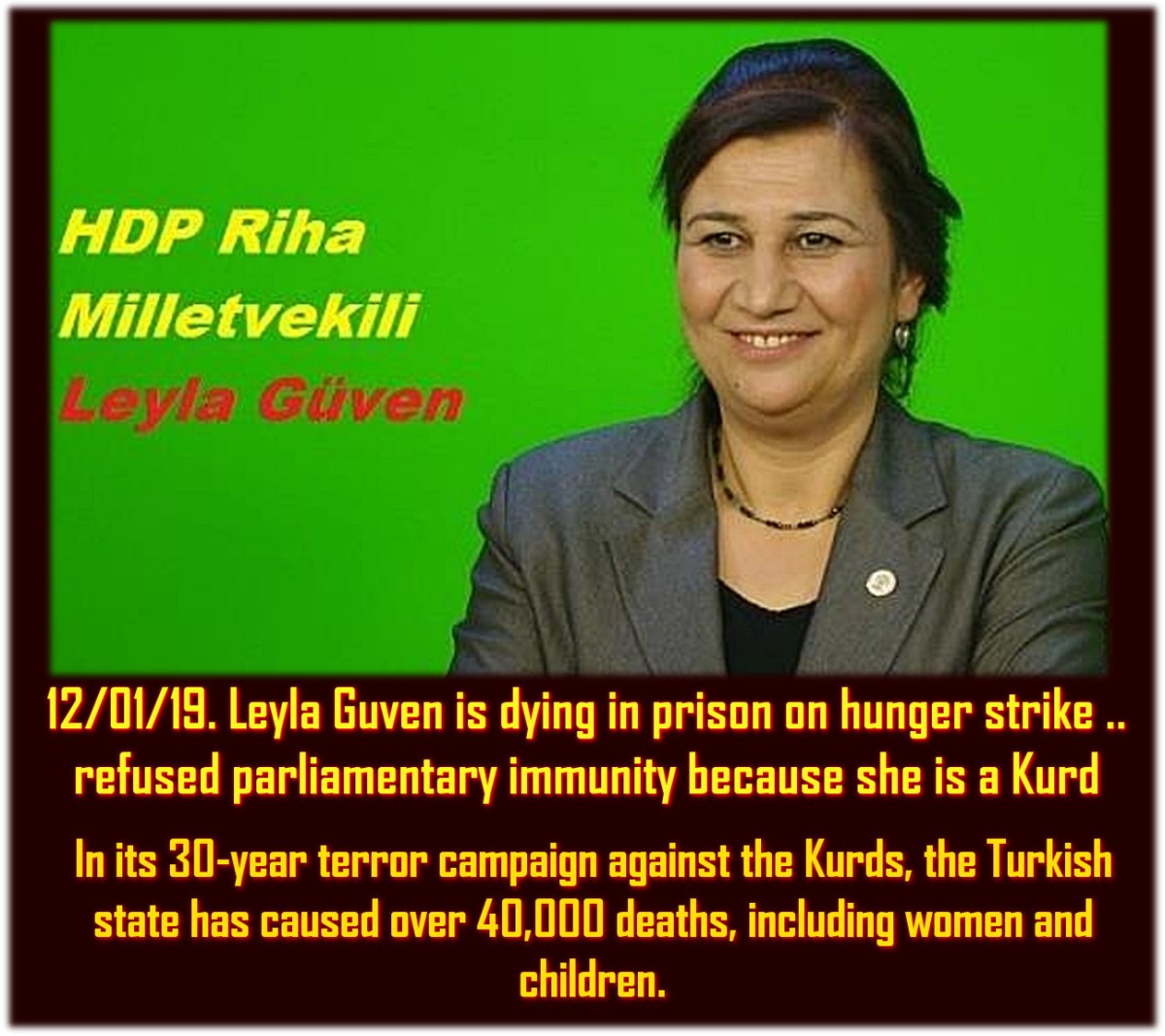
Leyla Guven may be the next Kurdish martyr joining the ranks of Kemal Pir, Mehmet Hayri Durmuş, Akif Yılmaz and Ali Çiçek who undertook their own death fasts in the same city on Bastille Day in 1982.
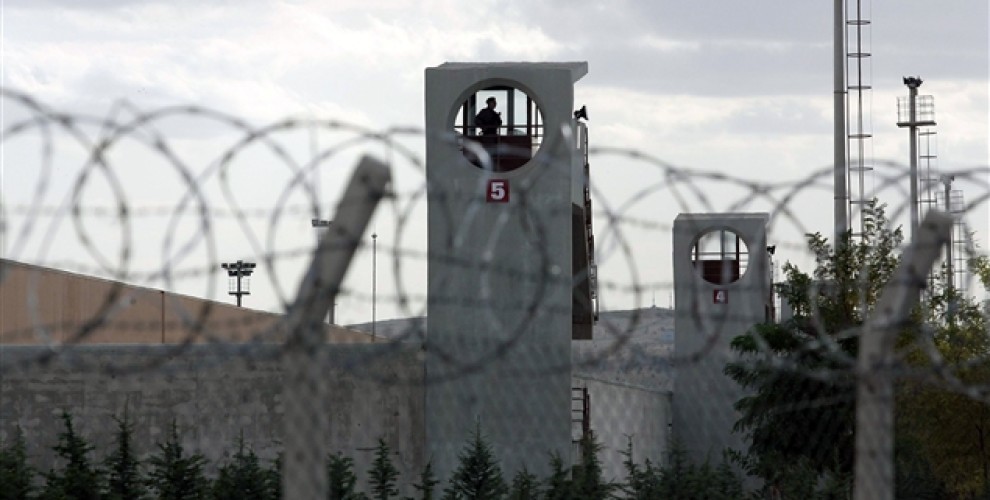
Arrested after criticizing Turkey’s military onslaughts against Kurdish militia in Afrin, she began her somber fasting on November 7, 2018, while addressing a Turkish judge from a jail cell via video link.
She declared she was “starting an indefinite hunger strike” to protest the isolation of Abdullah Ocalan, a founding member of the Kurdistan Workers’ Party (PKK).
Hunger strikes for the end of isolation extend to almost all prisons.
Thousands of prisoners have participated alternately in hunger strikes, while the number of prisoners on indefinite hunger strike (without alternating groups) has reached 156. There are many prisons that can not be contacted for what is estimated that the real number is much higher.
According to an article published by the Mesopotamia Agency, the indefinite non-stop hunger strike launched by 35 prisoners in 9 prisons on December 16 is still underway.
13 more prisoners began an indefinite hunger strike without alternations in 4 prisons on December 17, 5 prisoners from the same prison joined on December 24, 65 prisoners from 15 prisons on December 26, 1 prisoner on December 28 and 23 prisoners from 7 prisons on January 5.
The hunger strike of Leyla Güven has been the trigger for all these protests.
Mr. Ocalan is arbitrarily denied access to his lawyers and loved ones, even though Turkish law guarantees that right to all its prisoners.
No one has heard from him since September 11, 2016. Before that, he was visited regularly by Turkish officials and Kurdish politicians, even hailed as a potential Nelson Mandela of Kurds.
Those days are gone, melted into a hot war between Turks and Kurds.
The fasting Kurdish parliamentarian, Leyla Guven, thinks her death-fast might jumpstart the peace process.
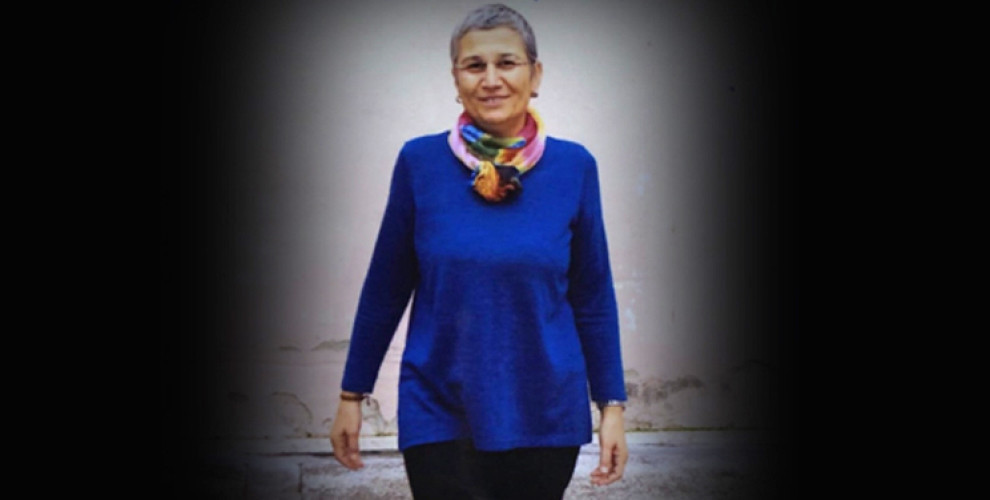
Jailed Kurdish opposition politician Leyla Güven has reached a critical condition and has been unable to see her lawyer for four days due to health problems caused by her long-running hunger strike, Turkish news site Diken reported.
Güven, who is both the co-chair of the Democratic Society Congress, an umbrella organisation for Kurdish groups, and a deputy for the pro-Kurdish Peoples’ Democratic Party (HDP), is imprisoned pending trial in Diyarbakır, south-east Turkey after being arrested in January 2018 for criticising Turkey’s military operation against Kurdish militias in northwest Syria.
The Kurdish deputy is one of nine from the HDP who are currently held behind bars in Turkey, including the party’s former co-chair, Selahattin Demirtaş. The party is particularly vulnerable to prosecution due to perceived links tying it to the Kurdistan Workers’ Party (PKK), an outlawed group that has fought Turkish security forces for Kurdish self-rule since the 1980s.
Day 65 of Leyla Güven’s Hunger Strike in Turkish prison. Her health has rapidly deteriorated & is now at life threatening stage. Silence is no longer viable, in fact, it is complicity at this stage. #LeylaGuven< Morning Star@M_Star
It was the Turkish state’s treatment of Abdullah Öcalan, the jailed leader of the PKK, that drove Güven to begin a hunger strike last November. Öcalan was captured by Turkey in 1999, and after the breakdown of peace negotiations between the ruling Justice and Development Party (AKP) and PKK in 2015, has been subject to severe restrictions on meetings.
Mr. Ocalan is arbitrarily denied access to his lawyers and loved ones, even though Turkish law guarantees that right to all its prisoners. No one has heard from him since September 11, 2016. Before that, he was visited regularly by Turkish officials and Kurdish politicians, even hailed as a potential Nelson Mandela of Kurds.
While Leyla Guven is slowly losing her eyesight and hearing (due to hunger strike) to give peace a chance, the stomach-churning Turkish prosecutor is accusing her of fomenting “terrorism” in Turkey.
The country’s most recent parliamentary elections were held on June 24, 2018. Two jailbirds, Leyla Guven and Enis Berberoglu, put their names on the ballots.
Both got elected. Turkish law stipulates that elected officials enjoy immunity from prosecution while serving the public good.
Mr. Berberoglu, a Turk, was released. Ms. Guven, a Kurd, was not. The Kurdish parliamentarian is barely surviving on a daily diet of three tablespoons of sugar, two teaspoons of salt, water and one 500 mg vitamin B1. She may soon be nothing but a pile of dead bones and dry skin.
HDP politician Leyla Guven began her hunger strike on November 6, 2018. Photo: HDP
The Turkish media treat her as an alien from outer space. The Kurds have written about her case, sparking scores of solidarity fasts in Kurdistan, Turkey, Europe and even Canada
Güven’s health has deteriorated after two months of the hunger fast to the point that she was unable to attend her mother’s funeral last week. The politician has complained of stomach cramps, weakness, low blood pressure and other problems.
Güven won her seat representing the south-east Turkish town of Hakkari in the June 2018 elections. The appointment as deputy conferred on her parliamentary immunity, which should have spared her from serving time in jail. However, prosecutors appealed against the release warrant issued after her victory, and succeeded in having it overturned.
Hunger strikes for the end of isolation extend to almost all prisons.
Thousands of prisoners have participated alternately in hunger strikes, while the number of prisoners on indefinite hunger strike (without alternating groups) has reached 156. There are many prisons that can not be contacted for what is estimated that the real number is much higher.
According to an article published by the Mesopotamia Agency, the indefinite non-stop hunger strike launched by 35 prisoners in 9 prisons on December 16 is still underway. 13 more prisoners began an indefinite hunger strike without alternations in 4 prisons on December 17, 5 prisoners from the same prison joined on December 24, 65 prisoners from 15 prisons on December 26, 1 prisoner on December 28 and 23 prisoners from 7 prisons on January 5. The hunger strike of Leyla Güven has been the trigger for all these protests.
Hunger strikes for the end of isolation extend to almost all prisons.
Thousands of prisoners have participated alternately in hunger strikes, while the number of prisoners on indefinite hunger strike (without alternating groups) has reached 156. There are many prisons that can not be contacted for what is estimated that the real number is much higher.
According to an article published by the Mesopotamia Agency, the indefinite non-stop hunger strike launched by 35 prisoners in 9 prisons on December 16 is still underway.
13 more prisoners began an indefinite hunger strike without alternations in 4 prisons on December 17, 5 prisoners from the same prison joined on December 24, 65 prisoners from 15 prisons on December 26, 1 prisoner on December 28 and 23 prisoners from 7 prisons on January 5.
The hunger strike of Leyla Güven has been the trigger for all these protests.
Leyla Güven: 2019 será un año de resistencia y libertad
“A partir de 2019, nuestro objetivo será mayor que nuestras expectativas. Les deseo a todos, especialmente a los revolucionaros un nuevo año, y que no sea un año de hambre, miseria, desempleo, abuso infantil, agresiones a mujeres, arrestos, y muertes”.
Leyenda Güven, la parlamentaria de Hakkari por el HDP, ha enviado un mensaje de Año Nuevo desde la cárcel de Amed, donde está detenida como presa política.
La parlamentaria del HDP ha estado en huelga de hambre durante 55 días para exigir el fin del régimen de aislamiento impuesto al líder popular kurdo Abdullah Öcalan.
Llamando la atención sobre las presiones sobre los kurdos en 2018, Güven dijo que 2019 será el año de la resistencia.
Al menos 156 presos en huelga de hambre indefinida
Debido a que algunas prisiones han cortado las comunicaciones se estima que el número real de presos en huelga de hambre indefinida y sin grupos alternantes sea mucho mayor.
ANF
Cuando la huelga de hambre comenzada por la copresidenta del DTK y diputada del HDP, Leyla Güven entra en su 61º día, las huelgas de hambre por el fin del aislamiento se extienden a casi todas las prisiones.
Miles de presos han participado de forma alterna en las huelgas de hambre, mientras que el número de presos en huelga de hambre indefinida (sin grupos alternantes) ha alcanzado los 156. Existen muchas prisiones con las que no se puede contactar por lo que se estima que el número real sea mucho más alto.
Según un artículo publicado por la Agencia de Mesopotamia, la huelga de hambre indefinida sin alternancias lanzada por 35 presos en 9 prisiones el 16 de diciembre sigue en marcha. 13 presos más comenzaron una huelga de hambre indefinida sin alternancias en 4 prisiones el 17 de diciembre, 5 presos de la misma prisión se unieron el día 24 de diciembre, 65 presos de 15 prisiones el 26 de diciembre, 1 preso el día 28 de diciembre y 23 presos de 7 prisiones el 5 de enero. La huelga de hambre de Leyla Güven ha sido el detonante de todas estas protestas.
La Directa This Tuesday, January 8, the Casa Àfrica space in Marià Aguiló street, in the Poblenou district of Barcelona, celebrated with a breakfast and lunch solidarity that the eviction of the building, scheduled for that same day has been temporarily stopped .
The expulsion aimed to put about twenty young people on the street, who come from several countries of Africa (Morocco, Guinea, Cameroon, Côte d’Ivoire and Gambia) and who they have no place to live, after having being attended by the Red Cross and the Service of Attention to the Immigrants, Migrants and Refugees (SAIER) of the City council of Barcelona. Seydou O., procedent de la Costa d’Ivori, un dels habitants de la Casa Àfrica | Sira Esclasans
At the moment, two vulnerability reports signed by the same council, the group Apropemos and the Association of Neighbors of Poblenou have taken effect in the courts to delay the eviction.
by Clara Macau | @ ClaraM_18 at La Directa Some of Photos by Sira Esclasans and Victor Serri. translation by The Free
Casa Àfrica is the new name given to the property that, from 2007 to 2018, has hosted the Self-managed Okupied Social Center La Teixidora (CSOA), between evictions.The squatters assembly has organised that it be given over to homeless arriving immigrants and asylum seekers
The building is a house of the beginning of the century with a modernist façade that served as the nucleus of the cultural activities of the Federal Republican Center until 1939. Then it was handed over to the Falange fascist party and fiinally went to a family from Poblenou barrio. Today, it is owned by Poblenou Federals Society 1922 S.L., a subsidiary of real estate company One Peking Road S.L. Despite the mediation efforts of the Barcelona City Council, the firm has not yet come to negotiate with the current occupants.
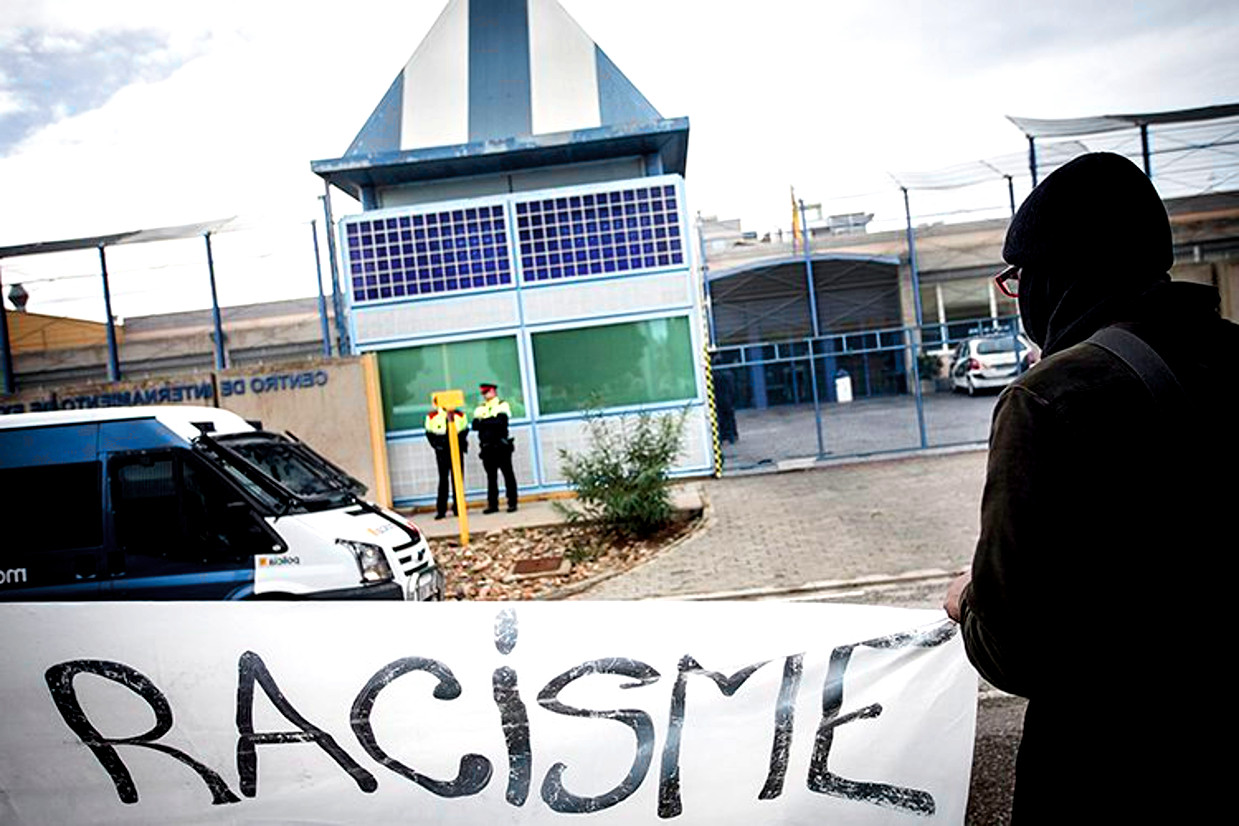
CIEs: The Spanish Guantánamo According to the Spanish Government, a Center for the Internment of Foreigners (CIE) is a non-penitentiary public institution where foreigners are subject to expulsion from the national territory, in short, places of detention for foreigners who, as they usually say , “Have no papers”. However, in practice, and due to lack of regulation and legal regulations, are administrative prisons whose conditions of stay are tougher than the prison itself, where people are interned that without having committed any crime are subjected to a regime Of life harder than those incarcerated accused of a crime.
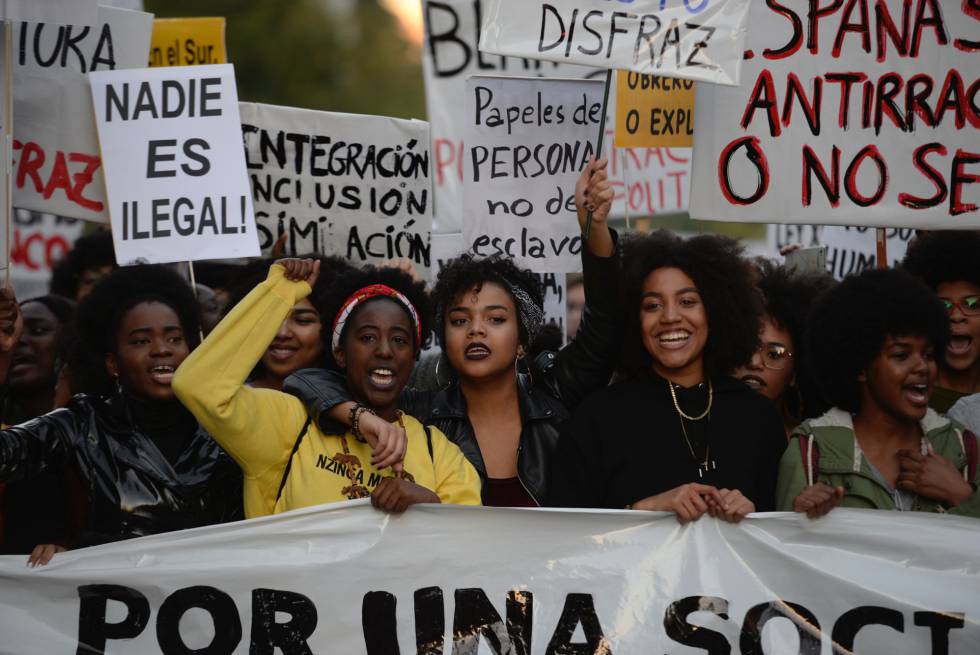
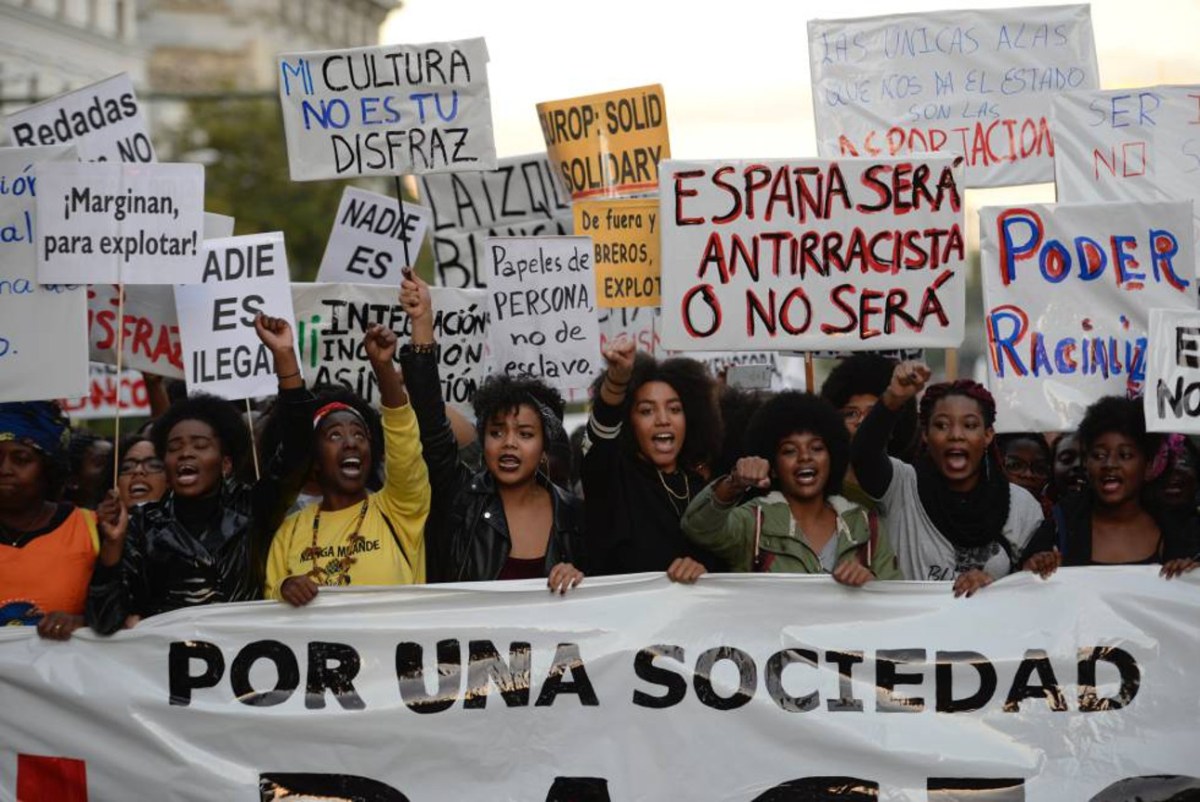
In addition to the solidarity breakfast and lunch, the support platform for Casa Àfrica has called for a demonstration on Friday 11 in defense of the rights of migrants, an announcement that currently has the support of about 150 col Schools, including the Manters Syndicate or the CIE.
Housing exit for asylum seekers
Those responsible for La Teixidora wanted to close their activities on the Marià Aguiló street farm last October, when they contacted the group of activists Emergencia Frontera Sud (EFS). “This summer many people arrived with the Red Cross buses to Barcelona and we were overwhelmed. Finding this house meant that twenty people did not have to sleep in the street, “explains one of the members of the group.
Emergencia Frontera Sur is a citizen network of activists that carries out support and support for migrants. This means that they stay close to the newcomers until they manage to have a stable situation at the place of reception
Casa Africa – Victor Serri
In Barcelona, they pick them up at the North Station when they arrive on the Red Cross buses, they welcome them at home, they give them information about the resources they have to eat, sleep, shower themselves, accompany them to do bureaucratic Procedures for managing the asylum application and trying to give them legal assistance.
According to the data provided by Barcelona City Council and the Red Cross, in 2018 4,758 people arrived in Barcelona from the southern border of Spain. In summer, the City Council authorized 500 new spaces in an emergency organisation to provide basic assistance advice to migrants. “This was launched in August,” says an EFS member, “but in July many people arrived that could not be treated.”
Cartell de la manifestació de suport a les nouvingudes penjat a la façana de la Casa Àfrica – Victor Serri Poster of the demonstration of support for newcomers hanging on the facade of Casa Àfrica – Victor Serri
Most of the occupants of Casa Àfrica are asylum seekers, or they already have the procedures begun to request it. They are listed on the waiting list to enter the hostel and participate in training offered by Barcelona Activa.
The City Council says that it tracks its cases from the district of Sant Martí. Right now, they thank EFS for having achieved a place to live and accompany them with information and legal assistance. The group has volunteer lawyers who help them prepare for asylum interviews.
The limits of the municipal reception
The group says that there is a three months waiting list for access to a municipal shelter. So people who arrive in the city are left on the street. “When you arrive on the bus the Red Cross gives you a map to reach SAIER. And that’s all. They do not know the language. They do not know the city. They do not know what is the SAIER, “says activist Nebon Babou Bassono.
Nebon Babou Bassono is the president of the Burkinabé Association of Barcelona. Since summer, he has been a spokesman for the Emerging Border South community (EFS). We must start the interview, but before we are talking with a young African here. One who has arrived disoriented and angry. He explains the situation: “The first thing we must do is reassure these young people. They have come on a very harsh route and they find themselves with nothing, not even information or directions. “
This is the case of Seydou O., a 27 year old from Ivory Coast, after passing through Morocco and Andalusia. He explains that he arrived at the North Station in Barcelona in the summer and he was received by Red Cross personnel. They moved him to the offices of Calle Sancho de Ávila and there they told him that he could not stay there, so he had to find a solution. Seydou O. adds that he was returned to the bus station with 80 euros and a map to go to SAIER. There, without knowing very well what he had to do, he found the first person of EFS.
EFS was organized last summer to give a roof to people who have just arrived in the city and who do not have family members who can take them. Faced with the saturation of municipal facilities, they are committed to self-management and citizen will. “We do it as we can, in our house, at a friend’s house … the administration does not contemplate the waiting times of the hostels and this means that they have no other exit than the street, if nobody helps them”, explains a member of the group.
Babou Bassono and his colleagues explain that they are neglected when asylum seeks, seeking accommodation or accessing healthcare. In addition to the lack of resources, they indicate that they do not have access to information about the steps that must be followed to establish themselves in the city
Babou Bassono and his colleagues at Emergencia Frontera Sud explain that migrants are told they are neglected when it comes to knowing how to request asylum, search for accommodation or accessing healthcare. At SAIER, they say, there are no translation teams, but staff that can speak English, French or, in some cases, Arabic.
When this is not the case, the team is contacted, by telephone, and after a wait which can be one or two hours, they find a translator that helps to get the information. There are migrants who come from countries in Africa where other languages are spoken and, sometimes, they do not know either French or English. In these cases, it is still harder to find a translator.
The legal assistance provided by SAIER, says Emergencia Frontera Sud, consists of a group appointment with a lawyer. The appointment may take a month. In addition, although the service also provides for individualized advice, of the twenty people that accompany the group and who already have an appointment to request asylum, only two have been able to benefit, due to the waiting periods.
In spite of everything, the Barcelona City Council states that “since the beginning of June, 3,359 people have received first-class service, and all have had access to a translator and a basic legal orientation.”
The council adds that the SAIER, in particular, has a translation service in eight or ten different languages, and offers a free legal orientation. “What we can not offer is accommodation because it is not a municipal responsibility, nor do we have resources to do it,” City Council sources conclude.
Since last summer there have been calls for Spain to fulfill its duties as regards asylum, since, until now, the task of reception must be carried out with the municipal funds .
Neighborhood support in Poblenou district
In the neighborhood of Poblenou, the migrant group has received a warm welcome . The Association of Residents of Poblenou and other entities such as La Flor de Maig have welcomed African young people in their activities and have provided them with clothes and food.
Montse Milà, of the Association of Neighbors, has followed the case together with Emergencia Frontera Sud and the City Council of Barcelona. She is one of those responsible for the vulnerability report by which the eviction of the occupied property has been stopped for the moment. “We know that this is a partial victory,” she says, “because the building is in the middle of the neighborhood and is a speculative candy for the rise of private flats, but we will fight wherever we can to defend that the boys and have them stay in the neighborhood “.
original en Català
La Casa Àfrica del Poblenou, una llar autogestionada per les migrants nouvingudes a Barcelona
gener 8, 2019
Aquest dimarts, 8 de gener, l’espai Casa Àfrica del carrer Marià Aguiló, al barri del Poblenou de Barcelona, celebra amb un esmorzar i dinar solidaris que ha aturat temporalment el desallotjament de l’edifici, previst per aquest mateix dia. L’expulsió havia de deixar al carrer una vintena de joves que vénen de diversos països de l’Àfrica (el Marroc, Guinea, el Camerun, Costa d’Ivori o Gàmbia) i que no tenen cap lloc on viure, després d’haver estat atesos per la Creu Roja i el Servei d’Atenció als Immigrants, Emigrants i Refugiats (SAIER) de l’Ajuntament de Barcelona. De moment, dos informes de vulnerabilitat signats pel mateix consistori, el col·lectiu Apropem-nos i l’Associació de Veïns del Poblenou han fet efecte als jutjats
Casa Àfrica és el nom que s’ha donat a l’immoble que, del 2007 al 2018, ha acollit el Centre Social Okupat Autogestionat La Teixidora. L’edifici és una casa de principis de segle de façana modernista que va funcionar com a nucli de les activitats culturals del Centre Republicà Federalista fins al 1939. Després, va passar a mans de la Falange i d’una família del Poblenou. Avui és propietat de la societat Poblenou Federals 1922 S.L., filial de la immobiliària One Peking Road S.L. Malgrat els esforços de mediació de l’Ajuntament de Barcelona, la firma no s’ha avingut fins al moment a negociar amb les actuals ocupants.
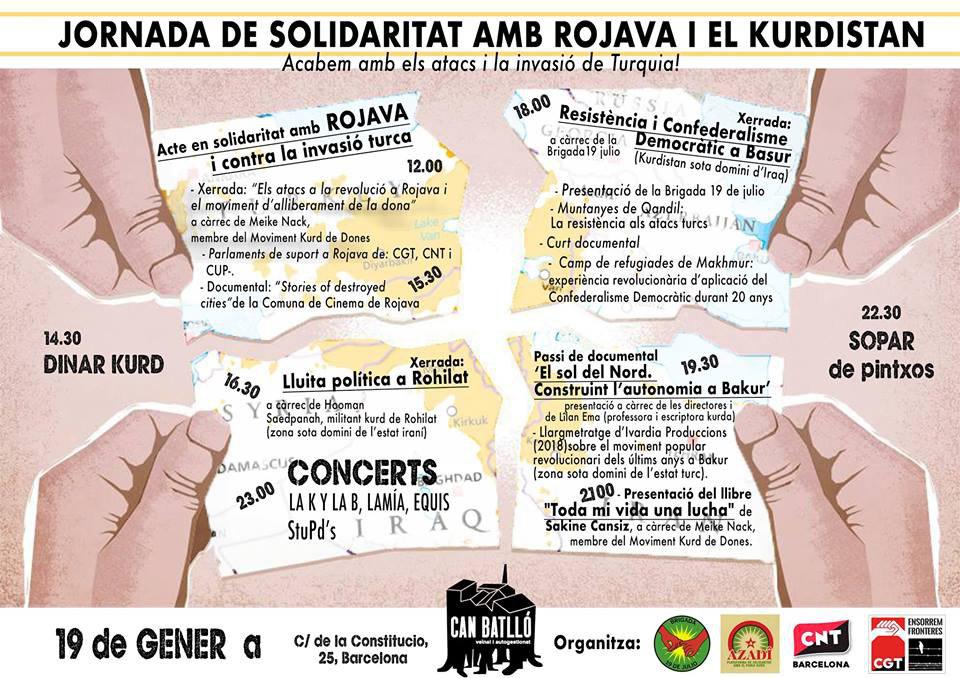
A més de l’esmorzar i el dinar solidaris, la plataforma de suport a Casa Àfrica ha cridat a una manifestació divendres 11 en defensa dels drets de les persones migrants, convocatòria que a hores d’ara compta amb les adhesions d’uns 150 col·lectius, entre els quals hi ha el Sindicat de Manters o Tanquem els CIE.
Sortida habitacional per a sol·licitants d’asil
Els responsables de La Teixidora volien donar per tancades les seves activitats a la finca del carrer de Marià Aguiló el passat mes d’octubre, quan els va contactar el col·lectiu d’activistes Emergència Frontera Sud (EFS). “Aquest estiu van arribar moltes persones amb els autobusos de la Creu Roja fins a Barcelona i ens trobàvem desbordats. Trobar aquesta casa significava que vint persones no havien de dormir al carrer”, explica un dels membres del grup.
Emergència Frontera Sud és una xarxa estatal ciutadana d’activistes que fa tasques de suport i acompanyament a les persones migrants. Això vol dir que són al costat de les nouvingudes fins que aconsegueixen tenir una situació estable al lloc d’acollida
EFS és una xarxa estatal ciutadana d’activistes que fa tasques de suport i acompanyament a les persones migrants. Això vol dir que són al costat de les nouvingudes fins que aconsegueixen tenir una situació estable al lloc d’acollida. A Barcelona, els recullen a l’estació del Nord quan arriben en els autobusos de la Creu Roja, els acullen a casa seva, els donen informació sobre els recursos que hi ha per menjar, dormir, dutxar-se, els acompanyen a fer els tràmits per gestionar la sol·licitud d’asil i miren de donar-los assistència jurídica.
Segons les dades proporcionades per l’Ajuntament de Barcelona i la Creu Roja, el 2018 van arribar a Barcelona 4.758 persones des de la frontera sud de l’Estat espanyol. A l’estiu, l’Ajuntament va habilitar 500 places noves en un dispositiu d’emergència per donar assistència bàsica a més persones. “Aquest dispositiu es va posar en marxa a l’agost”, puntualitza un membre d’EFS, “però ja al juliol van arribar moltes persones que no van poder ser ateses”.
La majoria dels ocupants de Casa Àfrica són sol·licitants d’asil, o bé ja tenen endegats els tràmits per demanar-lo. Estan apuntats a la llista d’espera per entrar a l’alberg i participen en formacions que ofereix Barcelona Activa. L’Ajuntament assegura que fa seguiment dels seus casos des del districte de Sant Martí. Ara mateix, agraeixen a EFS que els hagi aconseguit un lloc on residir i els acompanyi amb informació i assistència jurídica. El grup compta amb advocats voluntaris que els ajuden a preparar les entrevistes per demanar asil.
Els límits de l’acollida municipal
El col·lectiu assegura que hi ha tres mesos de llista d’espera per accedir a un alberg municipal. Així que les persones que arriben a la ciutat, es queden al carrer. “Baixen de l’autobús i la Creu Roja els dóna un mapa per arribar al SAIER. I prou. No coneixen l’idioma. No coneixen la ciutat. No saben què és el SAIER”, rebla l’activista Nebon Babou Bassono.
El col·lectiu Emergència Frontera Sud assegura que hi ha tres mesos de llista d’espera per accedir a un alberg municipal, així que les persones que arriben a la ciutat, es queden al carrer
Nebon Babou Bassono és el president de l’Associació Burkinabé de Barcelona. Des de l’estiu, fa de portaveu del col·lectiu Emergència Frontera Sud (EFS). Hem de començar l’entrevista, però abans ha de parlar amb un jove africà acabat d’arribar que està desorientat i enfadat. Ens explica la situació: “El primer que hem de fer és tranquil·litzar aquests joves. Vénen d’una ruta molt dura i es troben sense res, ni tan sols informació o indicacions”.
Aquest és el cas de Seydou O., jove de 27 anys que ve de Costa d’Ivori, després de passar pel Marroc i Andalusia. Explica que va arribar a l’estació del Nord a l’estiu i el va rebre personal de la Creu Roja. El van traslladar fins a les dependències del carrer de Sancho de Ávila i allà li van dir que no s’hi podia quedar, de manera que havia de cercar una solució. Seydou O. afegeix que el van retornar a l’estació d’autobusos amb 80 euros i un mapa per anar fins al SAIER. Allà, sense saber ben bé què havia de fer, va trobar la primera persona d’EFS.
EFS s’organitza des de l’estiu per donar un sostre a les persones que acaben d’arribar a la ciutat i que no tenen familiars que els puguin acollir. Davant de la saturació dels equipaments municipals, aposten per l’autogestió i la voluntat ciutadana. “Ho fem com podem, a casa nostra, a casa d’algun company… l’administració no contempla els terminis d’espera dels albergs i això vol dir que no tenen cap altra sortida que el carrer, si ningú no els ajuda”, explica un membre del col·lectiu.
Babou Bassono i els seus companys expliquen que queden desatesos a l’hora de demanar asil, cercar allotjament o accedir a l’atenció sanitària. A més de la manca real de recursos, indiquen que tampoc tenen accés a la informació sobre els passos que han de seguir per establir-se a la ciutat
Babou Bassono i els seus companys d’Emergència Frontera Sud expliquen que els migrants els comenten que queden desatesos a l’hora de saber com demanar asil, cercar allotjament o accedir a l’atenció sanitària. Al SAIER, diuen, no hi ha equips de traducció, sinó personal que pot parlar anglès, francès o, en alguns casos, àrab. Quan no és així, des de l’equipament es contacta, per via telefònica, i després d’una espera que pot ser ser d’una o dues hores, amb un traductor que ajuda a fer arribar la informació. Hi ha migrants que vénen de països de l’Àfrica on es parlen altres llengües i, de vegades, no coneixen ni el francès, ni l’anglès. En aquests casos, encara és més difícil trobar un traductor.
L’assistència jurídica que proporciona el SAIER, afirma Emergència Frontera Sud, consisteix en una cita grupal amb un advocat. La concessió de la cita pot trigar un mes. A més, tot i que el servei també preveu un assessorament individualitzat, de les vint persones que acompanya el col·lectiu i que ja tenen cita per demanar asil, només dues se n’han pogut beneficiar, a causa dels terminis d’espera.
Malgrat tot, l’Ajuntament de Barcelona exposa que “des del juny, han passat per servei de primera accolida 3.359 persones i totes han tingut accés a traductor i a orientació jurídica bàsica”. El consistori afegeix que el SAIER, en concret, disposa de servei de traducció en vuit o deu idiomes diferents, i ofereix orientació jurídica gratuïta. “El que no podem oferir és allotjament perquè no és, ni competència municipal, ni tenim recursos per fer-ho”, conclouen fonts de l’Ajuntament. A l’estiu, ja va fer una crida a l’Estat espanyol perquè assumís les competències que li pertoquen en matèria d’asil, ja que, en aquests moments, la tasca d’acollida s’ha de tirar endavant amb els fons municipals.
Suport veïnal al Poblenou
Al barri del Poblenou, el grup de migrants ha rebut l’escalf del veïnat. L’Associació de Veïns del Poblenou i altres entitats com La Flor de Maig han comptat amb els joves africans en les seves activitats i els han facilitat roba i menjar. Montse Milà, de l’Associació de Veïns, ha seguit el cas juntament amb Emergència Frontera Sud i l’Ajuntament de Barcelona. És una de les responsables de l’informe de vulnerabilitat pel qual s’ha aturat, de moment, el desallotjament de l’immoble ocupat. “Sabem que aquesta és una victòria parcial”, matisa, “perquè l’edifici de Marià Aguiló és al centre del barri i és un caramel per a l’aixecament de pisos privats, però lluitarem fins on puguem per defensar que els nois es quedin al barri”.












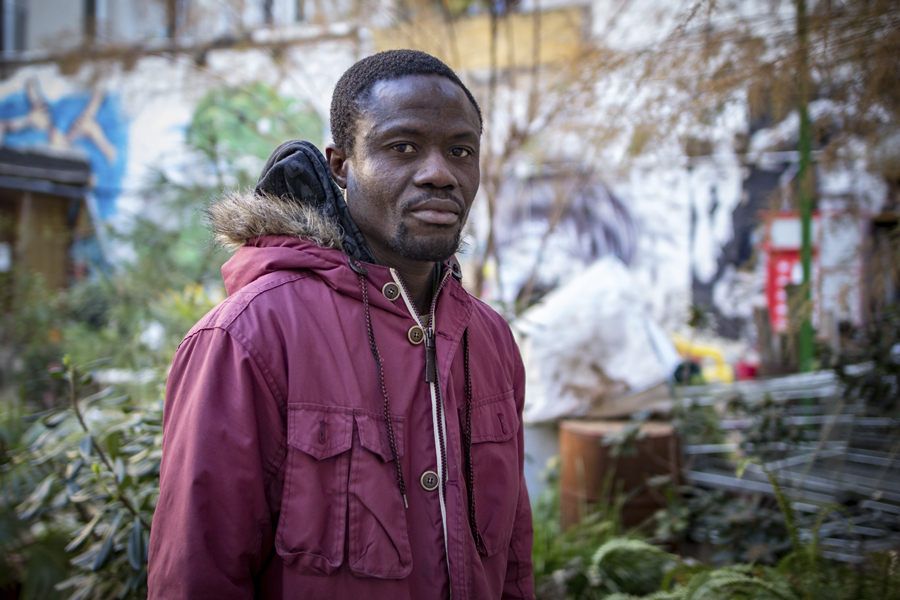 Seydou O., procedent de la Costa d’Ivori, un dels habitants de la Casa Àfrica | Sira Esclasans
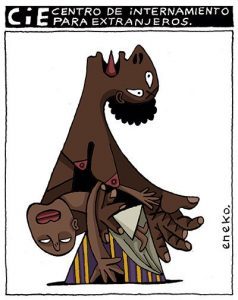 CIEs: The Spanish Guantánamo According to the Spanish Government, a Center for the Internment of Foreigners (CIE) is a non-penitentiary public institution where foreigners are subject to expulsion from the national territory, in short, places of detention for foreigners who, as they usually say , “Have no papers”. However, in practice, and due to lack of regulation and legal regulations, are administrative prisons whose conditions of stay are tougher than the prison itself, where people are interned that without having committed any crime are subjected to a regime Of life harder than those incarcerated accused of a crime.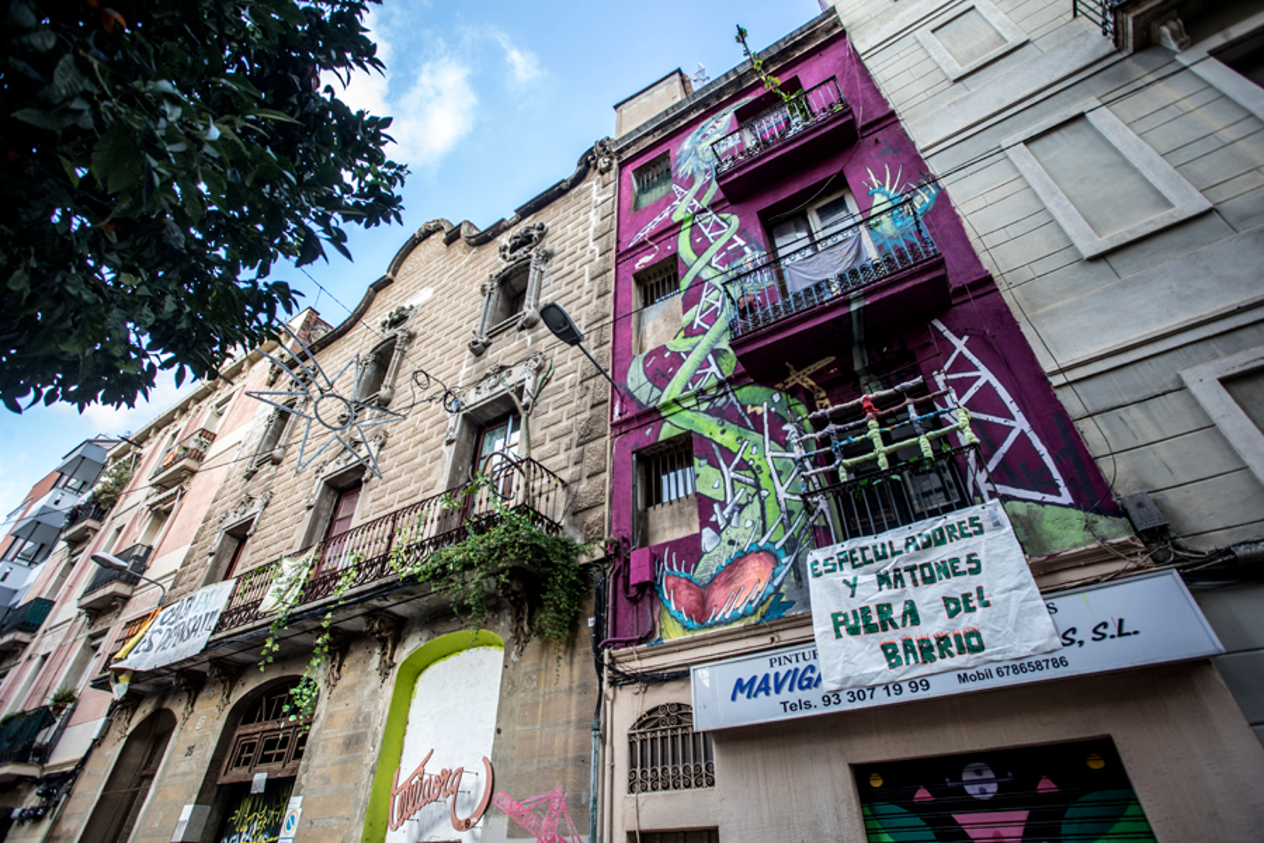
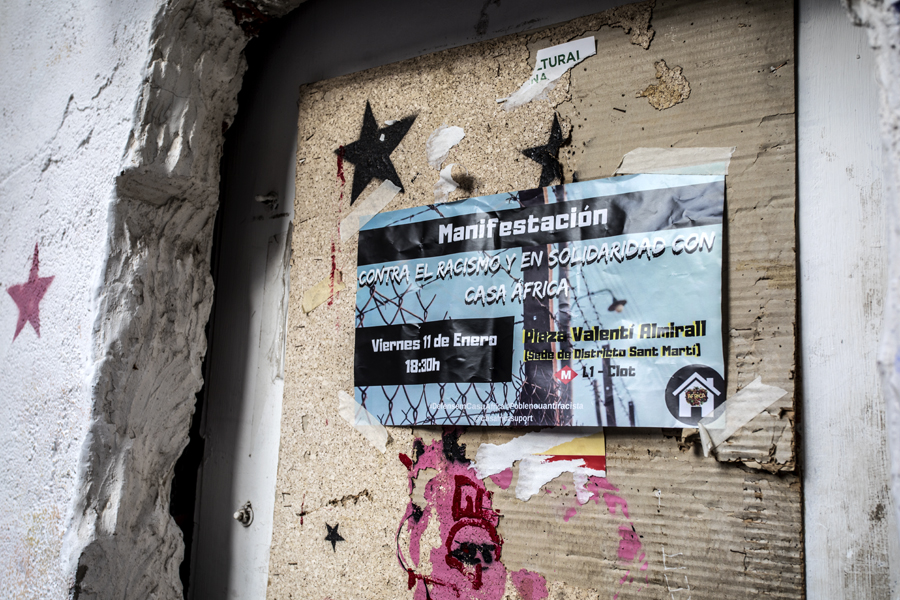 Cartell de la manifestació de suport a les nouvingudes penjat a la façana de la Casa Àfrica – Victor Serri