The original fundraiser was taken down. A new fundraiser can be found HERE
Details of the Fundraiser:
“As you may have heard, at the end of October last year, the military leadership in Sudan lead a coup and overthrew the civilian government after a period of instability following the deposition of the autocrat Omar al-Bashir two years ago. The country has effectively been in revolution since December 2018, however, this latest act saw a wave of violence from the state as thousands poured into the street.
Since October, some 82 revolutionaries have been murdered, with well over a thousand injured with tear gas, stun grenades, and live rounds. This number has been steadily climbing since as the Junta’s violent response has increased, even seeing the use of belt-fed machine guns.
The situation has only gotten worse as the struggle has intensified. There is a vital need for material solidarity. International…
Lenin were he alive today would no doubt point out that Russia today, as well as the U.S., is a capitalist-imperialist country…….. He [Putin] is despicable, but his demand that NATO ceases expansion is as eminently reasonable and Biden’s desire to expand it seems crazier by the day.
Putin, Lenin, Imperialism and the (Real) History of Ukraine, Portside, March 5, 2022 Gary Leupp — The people of this country suffer, I’ve always thought, from a general ignorance of history. ………
In 2014 having, having given little thought to Ukraine to that point, people in this county (self-defined Americans and others) were informed by the most authoritative sources they knew, the cable TV news anchors and commentators. They were treated to a history lesson that went something like this: The country of Ukraine has always been oppressed by Russia. It was colonized by Russia for centuries. Russia still, after the end of…
As Countries Miss Targets, Deforestation Impact Underestimated, Says New Research – Green Queen Media https://ift.tt/NF3CqOZ As Countries Miss Targets, Deforestation Impact Underestimated, Says New ResearchGreen Queen Media Superforest via “deforestation” – Google Newshttps://ift.tt/uexjyAX
The conflict began when several workers decided to create a section in the anarcho-syndical Union to enforce some of their basic rights: existence of a work calendar and compliance with the agreement, among others.
The business response was forceful: close the work centers, lay off half of the workers and relocate the rest of the workforce to other places.
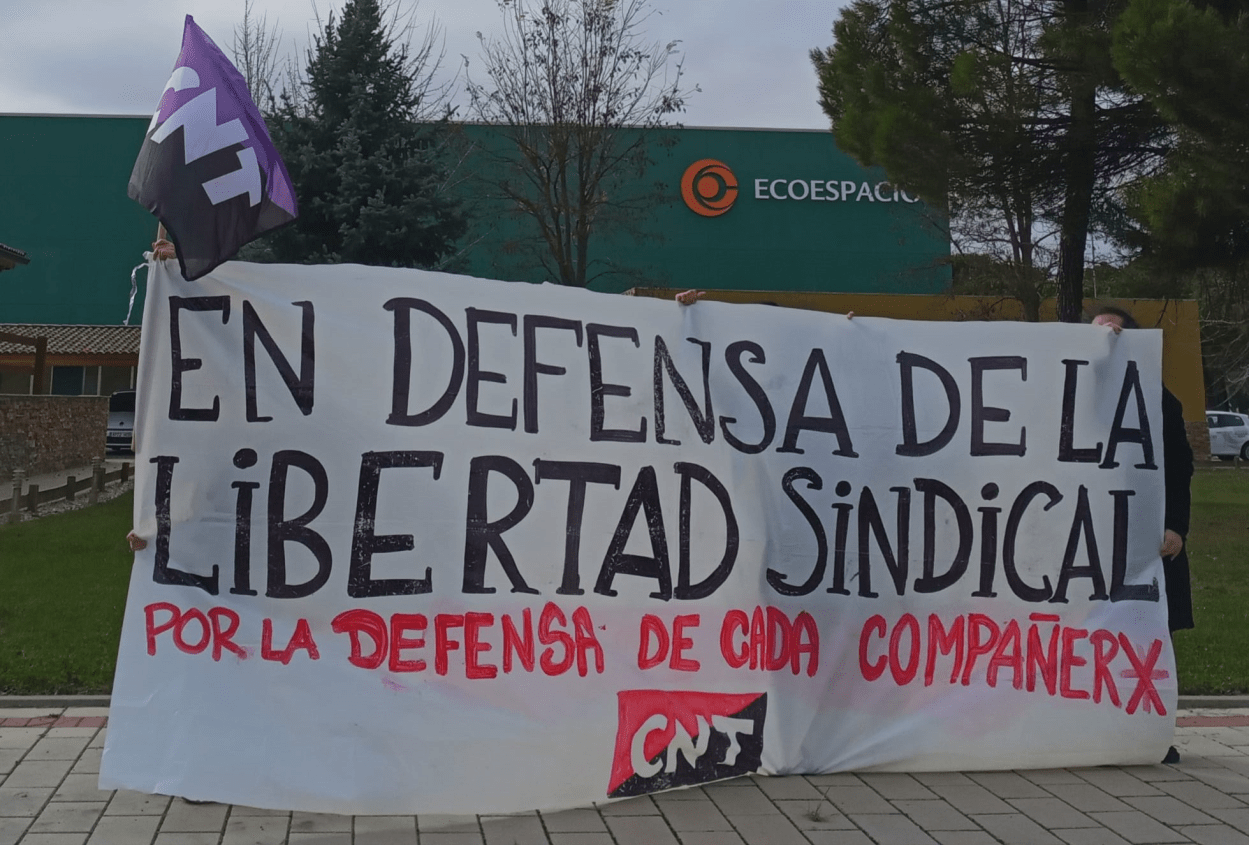
The conflict began in Barakaldo, but since Ecoespacio has its headquarters in Valladolid, it was on the banks of the Pisuerga where the anarchist union decided to demonstrate.
Militants from various places went there: Barakaldo itself, but also the rest of Vizcaya, Navarra, Burgos, Xixón, La Felguera or Madrid, in addition to the rest of the cities of Castilla and León.
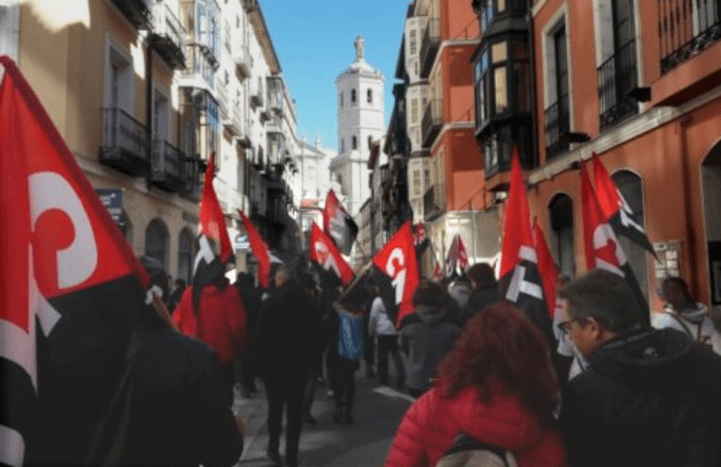
The demonstration brought together several hundred people who walked the streets of the center of Valladolid with the slogans
“Here are the Anarcho-syndicalists”, “Neither Give up nor Sell out- the CNT” and “Union Repression, Bosses’ Terrorism”.
The CNT understands that this is a new case of restriction of labor rights.
According to CNT members, “the company,” they say, “has sought the best way to get rid of unions among its employees for the sole purpose of being able to continue exploiting them.”
For this union, this conflict follows the line that began with La Suiza. In their opinion, in both cases “it is only about intimidating those who fight for their rights.”
“And they are not going to get them,” they add.
The struggle of Ecoespacio, although it began in Euskadi, is waged through various territories of the Spanish State.
In addition to the aforementioned community, the company also has work centers in Castilla y León and Asturias, where several of the dismissed workers reside.
Information provided by: S.O.V. Xixón – National Labor Confederation
Represión sindical y manifestación en Valladolid: La CNT se moviliza
Varios militantes del sindicato CNT de Xixón se desplazaron el pasado sábado 5 de marzo hasta Valladolid para apoyar a los compañeros despedidos por Ecoespacio.
El conflicto comenzó cuando varios trabajadores decidieron crear una sección en la anarcosindical para hacer cumplir algunos de sus derechos básicos: existencia de un calendario laboral y cumplimiento del convenio, entre otros.
La respuesta empresarial fue contundente: cerrar los centros de trabajo, despedir a la mitad de los trabajadores y reubicar al resto de la plantilla en otros lugares.
El conflicto se inició en Barakaldo, pero como Ecoespacio tiene su sede en Valladolid, fue a orillas del Pisuerga donde la sindical anarquista decidió manifestarse.
Hasta allí acudieron militantes desde varios sitios: la misma Barakaldo, pero también el resto de Vizcaya, Navarra, Burgos, Xixón, La Felguera o Madrid, además del resto de ciudades de Castilla y de León.
La manifestación reunió a varios cientos de personas que recorrieron las calles del centro vallisoletano con las consignas de «aquí está la anarcosindical», «ni se rinde ni se vende, la CNT» o «represión sindical, terrorismo patronal».
Y es que la CNT entiende que este es un nuevo caso de restricción de los derechos laborales. Según miembros de CNT, «la empresa», dicen, «ha buscado la mejor manera de deshacerse de los sindicatos entre sus empleados con el único fin de poder seguir explotándolos».
Para este sindicato, este conflicto sigue la línea que se inició con La Suiza. En su opinión, en ambos casos «solo se trata de amedrentar a quienes luchan por sus derechos». «Y no lo van a conseguir», agregan.
La lucha de Ecoespacio, si bien iniciada en Euskadi, se libra a través de varios territorios del Estado español. Además de la citada comunidad, la empresa cuenta con centros de trabajo también en Castilla y León o Asturias, donde residen varios de los trabajadores despedidos.
Información proporcionada por: S.O.V. Xixón – Confederación Nacional del Trabayu
As has been clear for many weeks now, there are many competing narratives about the possibility and causes of the escalating conflict between the US and Russia over Ukraine. The war that started last week marks one of the most important turning points in our rapidly changing world order.
This panel, with experts from Russia, Britain and the US seeks to understand the motivations of the various parties in contention, particularly the US, Russia, Britain and the major continental European powers, and assess the most realistic possibilities of how it will unfold and end.
El 8 de marzo “es una jornada de lucha feminista en todo el mundo en conmemoración del día 8 de marzo de 1908 en el cual las trabajadoras de una fábrica textil de Nueva York llamada Cotton declararon una huelga en protesta por las condiciones insoportables de trabajo.
El dueño no aceptó la huelga y las obreras ocuparon la fábrica. El dueño cerró las puertas y prendió fuego muriendo abrasadas las 129 trabajadoras que había dentro”.
“Siendo conscientes de que no estamos todas las que somos pero sí somos todas las que estamos”
Recogemos concentraciones, manifestaciones, acciones etc.
Súmate y hazlo respetando los protocolos sanitarios que las organizadoras de los eventos y manifestaciones han preparado. #8M2022 #Este8MSeLía # #8mjuntesidiverses #AquíEstamosLasFeministas #FeminismeAraiSempre #AliancesFeministes
#8M2022
ALBACETE Paseo de la Feria (molino) hasta el Altozano a partir de las 18h. Convoca: Coordinadora 8M Albacete
ALCORISA_TERUEL Manifestación a las 19:00 Plza. Bienvenida Argensola Convoca: BajoAragon Feminista @BAFeminista
A May 2021 project report by the U.K. Ministry of Defense, created in partnership with the German Bundeswehr Office for Defense Planning, offersShocking highlights of the dystopian cybernetics future that global technocrats are pushing humanity towards.
The report, “Human Augmentation — The Dawn of a New Paradigm, a Strategic Implications Project,”1 reviews the scientific goals of the U.K. and German defense ministries, and they are precisely what the title suggests. Human augmentation is stressed as being a key area to focus on in order to win future wars.
But human augmentation will not be restricted to the military ranks. It’s really a way to further separate classes of humans, with the rich and powerful elite being augmented “super-humans.” It’s worth noting that anything released to the public is a decade or more behind current capabilities, so everything in this report can be considered dated news, even though it reads like pure science fiction.
“… the field of human augmentation has the potential to transform society, security and defense over the next 30 years,” the report states. “We must begin to understand the implications of these changes and shape them to our advantage now, before they are thrust upon us.
Technology in warfare has traditionally centered on increasingly sophisticated platforms that people move and fight from, or artefacts that they wear or wield to fight with. Advances in the life sciences and converging developments in related fields are, however, beginning to blur the line between technology and the human …
Many technologies that have the potential to deliver strategic advantage out to 2050 already exist and further advances will undoubtedly occur … Our potential adversaries will not be governed by the same ethical and legal considerations that we are, and they are already developing human augmentation capabilities.
Our key challenge will be establishing advantage in this field without compromising the values and freedoms that underpin our way of life …
When we think of human augmentation it is easy to imagine science fiction inspired suits or wonder drugs that produce super soldiers, but we are on the cusp of realizing the benefits in a range of roles now. Human augmentation will help to understand, optimize and enhance performance leading to incremental, as well as radical, improvements.”