Stop Gentrification: Berlin autonomes ”will do €1m damage per crazy police raid”

lunatic police response to attack on traffic warden
Activists in Berlin warned on Sunday that they would exact €1m in revenge for any more mass police raids on their squats and other ‘projects’ in the capital, after luxury cars were burned at the weekend.

Frank-Henkel-„Linken-Chaoten-geht-es-nur-um-Zerstörung“-300x194

Burned-out cars  in Berlin’s Kreuzberg district. 
  “With the burning up of excessive luxury cars, the destruction of a surveillance camera and the smashing in of display windows, we refer to the call of autonomous groups on January 21st to cause €1 million of damage for any attack on projects in Berlin,” the unknown authors wrote on indymedia.
Yuppies OUT
 On Friday and Saturday nights, dozens of cars were destroyed ar damaged in the capital by hooded attackers, none of whom were arrested.

size=708x398 (2)

The claim of responsibility posted online on Sunday seemed to confirm city interior senator Frank Henkel’s belief that “left-wing slobs” were behind the attacks, with the authors saying they would cause €1m of property damage for attacks on left-wing ‘projects’ in Berlin.

Police reported that between 20 and 40 masked people on bicycles had burned four high-value cars and damaged 24 others on Friday night around the Gleisdreieck park in the south-central Kreuzberg district.

Late on Saturday, a similar incident occurred, with witnesses reporting a crowd of between 50 and 100 masked perpetrators damaging around 20 cars.

More cars reportedly burned over the weekend in the Charlottenburg and Gesundbrunnen districts.

“We won’t leave the streets to this far-left mob,” Henkel said on Sunday, adding that the city’s internal security services – who are responsible for politically motivated crimes – were investigating.size=708x398 (3)

Confrontation in ”danger zone”

Henkel, who is responsible for city security policy, has become a particular target figure after declaring the Nordkiez area in eastern district Friedrichshain a “danger zone” in November.

Friedrichshain remains one of the strongholds in Berlin of the squatter movement, with a number of buildings that have remained occupied since the fall of the Berlin Wall in 1989 and German reunification.
Occupied buildings in the district are seen as landmarks in the left and anarchist scene in the capital.

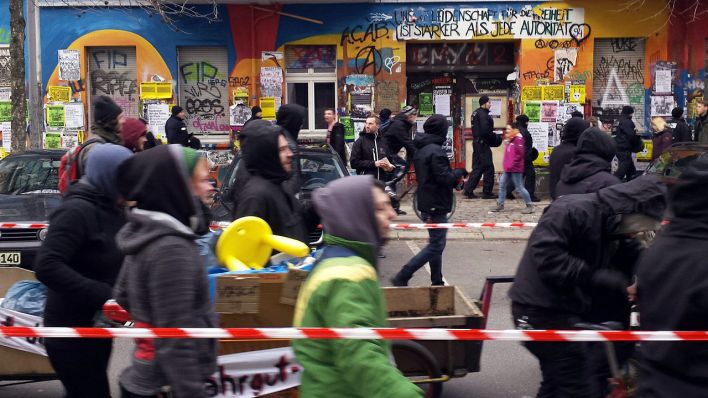
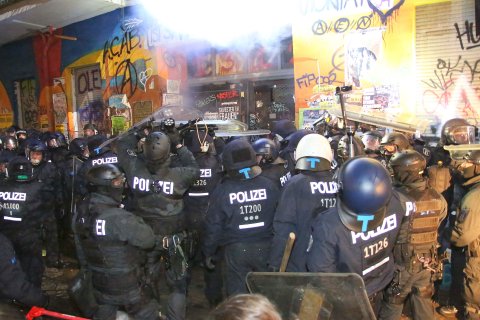
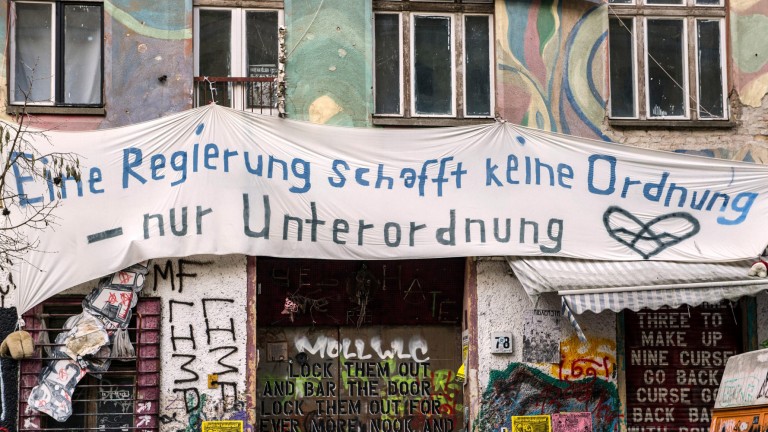
Left-wing activists’ confrontation with Henkel was sharpened in January with a massive raid of 500 police officers on an iconic squat at Rigaer Straße 94, after a police officer was ”attacked” outside while issuing a parking ticket.

Many left-wingers and mainstream politicians criticized the raid as disproportionate at the time and reminiscent of past incidents when squats have been completely cleared to make way for development.

Sunday’s claim of responsibility left no doubt about a link to the raid in Rigaer Straße.demo-014
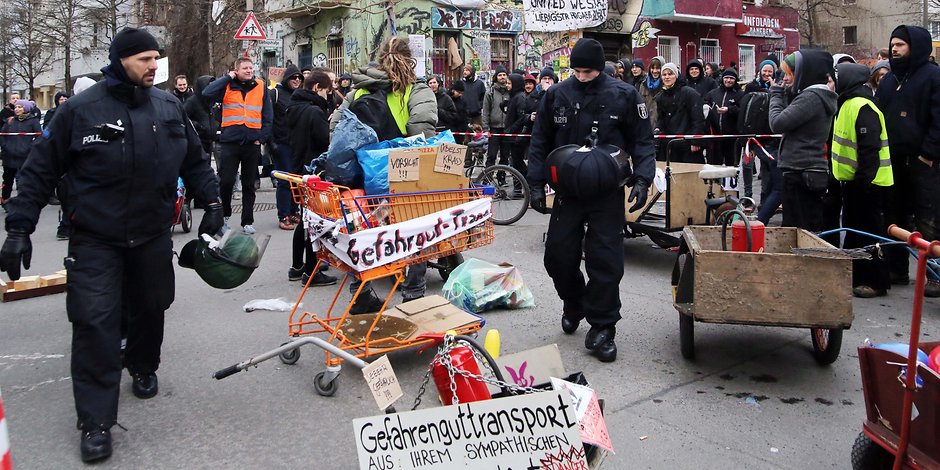
Left-wing demo mostly peaceful

Anger over the “danger zone” and continuous police pressure were also the basis for a demonstration on Saturday under the title “Rebellious Neighours, Neighbourhoods with Solidarity, City from Below”.

Left-wing activists in Friedrichshain believe that the city is using police and security policy to clear them out in preparation for the area to be gentrified like other nearby districts.(Full of luxury cars).

“For people like Frank Henkel… the Nordkiez is an area which has to be totally pacified or a problem that has to be sorted out,” the organizers wrote.

“For those of us who live, reside and work here, the Nordkiez is above all one thing: a place of resistance with a long history and the most variied ways of life based on collectivity and solidarity.”

size=708x398

The demo went ahead under heavy police control, with dozens of police vehicles and around 1,200 officers flooding the streets of Friedrichshain.

While it was mostly peaceful, some bottles and rocks were thrown at police. Five police officers were reportedly injured and two people were arrested.
e00875328ca_1454261894-768x432

              SEE ALSO: 500 cops raid Berlin house after attack

anarchists we love: 1. Emma and Nello

Nello Garavini belonged to a family of well-known anarchists in the small town of Castel Bolognese . His father Pietro (1869-1933), in addition to being a militant with a certain influence in the local area, ran a tavern for many yearsUntitled

Nello joined the anarchist movement when very young, attending numerous  libertarians conferences including those of Errico Malatesta, who influenced him decisively. An avid reader of different social and political texts, he got a good self-education. He also met the anarchist anti militarist Augusto Mazetti, when he was held in the asylum in nearby Imola, and became one of his greatest friends.

June 1914 witnessed the “Red Week”, during which crowds in protest assaulted and destroyed the railway station of Castel Bolognese. When the Great War broke out he joined the anti-intervencionist group and became a remained a radical anti-militarist, even when Italy entered the conflict, which was very risky. 

In 1916, together with a group of young anarchists he founded the “Gruppo Anarchica Giovanile “(GAG  Anarchist Youth) and the Libertarian Library . Among the supporters of the group was his brother Simone (Cino) who was arresteds and jailed for a year. Nello organized protests against interventionism and patriotic demonstrations and secretly spread a subversive manifesto urging desertion among the soldiers. Nello was specially active in the deserters movement which swept through Emilia-Romagne.

During the war, he actively participated in the “Red Biennium” riots and promoted the trend of organizing the anarchist movement on Malatesta’s principles). He actively participated in the uprising against the ‘scarcity of life’  that took place between 2 and 3 July 1919 in Castel Bolognese, as well as other Italian townss.

Nello Garavini set up the Union of Castel Bolognese, which joined the Italian Anarchist Trade Union (USI) and acted as a branch of the headquarters of Imola. At this time Nello also secretly took charge of “material preparation” for the revolution, procuring weapons for his comrades (Brescia, Valdarno, etc.).

GAG was represented at numerous meetings.. Cesena (7 September 1919), Bologna (14 September 1919), etc. the National Congress of the Italian Anarchist Union (IAU), and  the Second National Congress of the IAU held in Ancona.emma garaavini

In 1921 Nello met Emma Neri, a young schoolteacher born into a socialist family, and she soon became his companion. Continue reading “anarchists we love: 1. Emma and Nello”

How Men profit from Women’s “Invisible Labour”


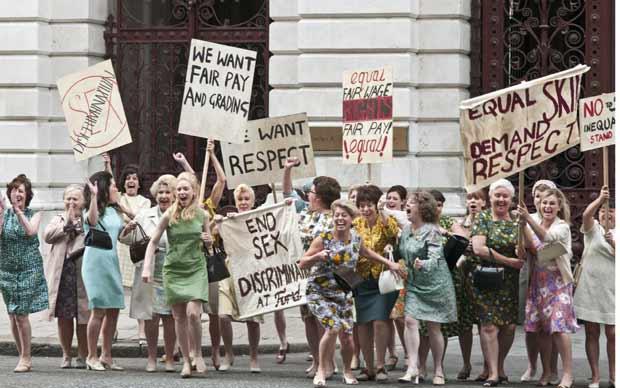
womens' workAt work as at home, men reap the benefits of women’s “invisible labor” (by @schemaly)

SORAYA CHEMALY (piece on QUARTZ):

“Women’s work” and its benefits for men. (Reminded me that someone said to me again the other day: “behind every great man stands a great woman”. We all know what that’s meant to mean but let’s unpick it…)

9f6dc37838de9d2190040c5f5b507295

On any given day, one fifth of men IN THE US, compared to almost HALF OF ALL WOMEN DO SOME FORM OF HOUSEWORK. Each week, according to Pew, mothers spend NEARLY TWICE AS LONG as fathers doing unpaid domestic work. But while it’s important to address inequality at home, it’s equally critical to acknowledge the way these problems extend into the workplace. Women’s EMOTIONAL LABOR—which can involve everything from tending to others’ feelings to managing family dynamics to writing thank-you notes—is a big issue that’s rarely discussed. Continue reading “How Men profit from Women’s “Invisible Labour””

What is ‘Anationalism’? How Bosses exploit Patriotism and Religion

nationalism 2
What is Anationalism?
Anationalism grew out of the radical movements for Internationalism and cosmopolitanism  in the early twentieth century and was a reaction of anarchism against escalating war hysteria. Today few remember this movement.

by Bernat Castany Prado. University of Barcelona

The term “anationalism” was coined in the early twentieth century by Eugène Lanti, an anarchist activist (1879-1947), to designate a new political movement that sought to eliminate the nation not only as a variable in the international workers struggle, but even more as the basic unit of all socio-political organization.

Nearly a hundred years later hardly anyone remembers that project. Neither the Encyclopedia of Nationalism (2000), coordinated by Athena S. Leoussi nor the Encyclopedia of nationalism (1999), coordinated by Andrés de Blas Guerrero, even include the entry “anationalism”.

 today's flags are tomorrow's corpse.shrouds
today’s flags are tomorrow’s corpse-shrouds

Nor does it appear in the main theoretical writings on nationalism (Ernst Gellner, Anthony D. Smith, Ellie Kedourie, Michael Billig or Eric Hobsbawm), nor even in studies that advocate postnationalism (Jürgen Habermas, Pascale Casanova, Edward Said, Bernat Castany) is  Eugène Lanti or anationalism mentioned once.

The purpose of these lines is to put back into circulation a concept that today seems to us necessary to clarify and streamline some of the political identities being debated these days… Continue reading “What is ‘Anationalism’? How Bosses exploit Patriotism and Religion”

Nikos Romanos: “Requiem for a Journey of No Return”

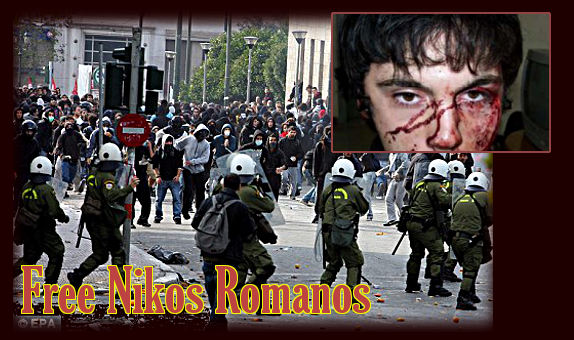
Nikos Romanos is a young anarchist imprisoned in Greece for revolutionary acts.

“Requiem for a Journey of No Return”

by  Nikos Romanos (extract from Contra Infos.)Untitled

…….”If we close our eyes and ears to the ceaseless flow of dominant propaganda, we’ll be able to listen to the thousands of anonymous deaths in police stations, terrestrial and maritime border areas, concentration camps, psychiatric institutions and prisons, war zones across the Middle East, and sweatshops that exterminate contemporary slaves. greeceAnyone can hear the cries of people who are being tortured in police cells, who commit suicide in a confinement facility out of desperation, who are sunk by coast guard cops and drowned in the cold waters of the Mediterranean Sea, who are crippling their bodies over multinationals’ production machines in third world countries, who are buried under rubble after blind aerial bombardments conducted by capitalist empires. Continue reading “Nikos Romanos: “Requiem for a Journey of No Return””

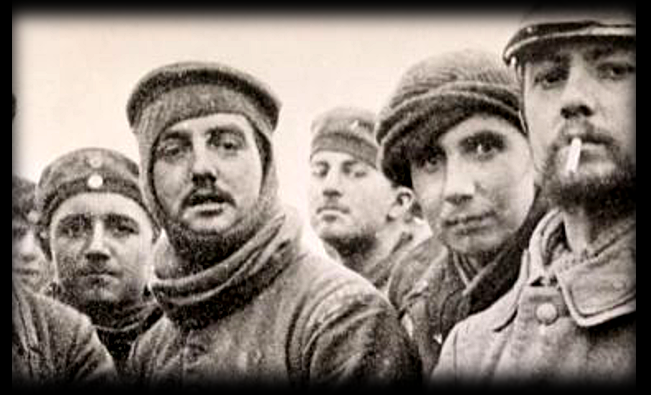
Christmas Truce 1914: when soldiers refused to kill

1914 truce

Christmas 1914: When rank and file imposed a truce during Imperialist War    by Henry Hagins  and John McCutcheon.

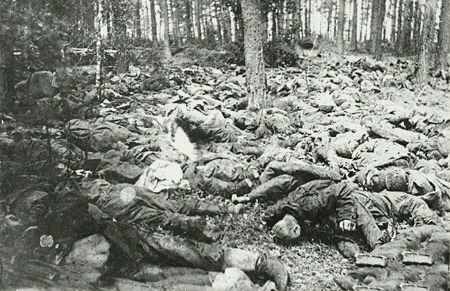
Workers.org, The “Christmas Truce of 1914” was a short-lived, unofficial lull in combat between two antagonistic rival forces, determined to exercise military, political and economic supremacy over each other in Europe and in the colonized world, to which these imperial powers lay arrogant false claim. hundredsdeadOne of the bloodiest episodes in human history, World War I was largely played out on the battle-scarred lands of France and Belgium, starting in August of 1914. Continue reading “Christmas Truce 1914: when soldiers refused to kill”

‘The Little Red Box Of 60 Protest Songs’ ..free download here

CLASSIC ALBUM REVIEW: VARIOUS ARTISTS- ‘The Little Red Box Of Protest Songs’ (2000)iwwAlbum Review, Best Of’s, Biography, Classic Album Reviews,
AND FREE DOWNLOAD!

The Little Red Box Of Protest Songs is a truly outstanding release. A three CD box-set full of the finest protest folk music from the USA of the early 20th century. Celebrating the 100th anniversary of the publication of the first American protest song book, ‘The Little Red Song Book’ this collection traces the roots of protest song in the US from the first half of the last century up to the Fifties illustrating how the stage was set for the folk protest giants of the Sixties such as Bob Dylan and Phil Ochs. Featuring classic performances by Pete Seeger, Woody Guthrie, Josh White, Leadbelly, The Almanac Singers, The Weavers and many many more.

 VA - The Little Red Box Of Protest Songs

The usual suspects – Woody, Pete, Leadbelly, Josh White – are all present and politically correct (or not, depending on your ideological viewpoint!). The 60 tracks are mostly circa the Second World War – more than 60 years old, but all worth preserving and hearing. The best songs here – Leadbelly’s The Bourgeois Blues, Josh White’s Jim Crow Train, Brownie McGhee’s Black, Brown and White – are superb, but even the ones with less artistic value are historically significant.


FOR YOUR FREE DOWNLOAD CLICK ON WHICH DISC YOU WANT

DISC ONE

DISC TWO

DISC THREE

**could download all 3.. mikegilli..20/11/15

Continue reading “‘The Little Red Box Of 60 Protest Songs’ ..free download here”