Here in our occupied center we have about 26 chickens, pretty fat and healthy, and they give us maybe 12 eggs a day, depending on the season. Sometimes they just go on strike.
They run free but are usually locked up at night in case of wild animals getting in. The yard is too small so we feed them kitchen scraps, old recycled bread and market veg, they love it! Sometimes they get a little grain, you can still find GMO-free here in Spain. We all take care of them so sometimes they get fed twice!Continue reading “Chickens have Rights to a Good Clucking Life”
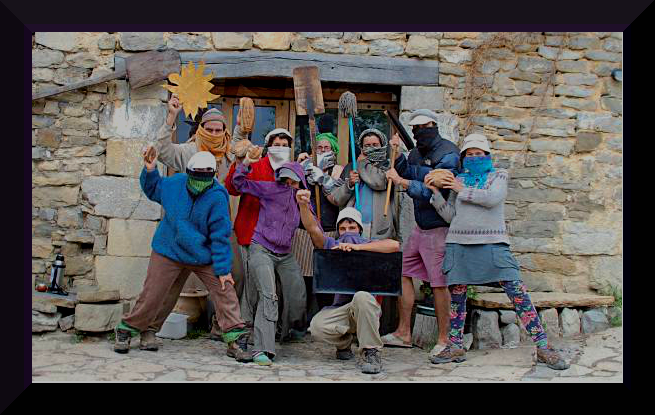
You may have read how the Spanish countryside was successfully collectivized during the short-lived revolution of 1936. Now we see that spirit living on, with small groups occcupying abandoned villages. In Spain the 15M movement is organising a back to the land campaign to reverse the effects of the still increasing abandonment due to agribusiness competition.
This will be the first in a series on Okupa Rural in Iberia
Medieval Spanish ghost town Lakabe becomes self-sufficient eco-village
It’s a utopian fantasy discover a ghost town and rebuild it in line with your ideals-, but in Spain where there are nearly 3000 abandoned villages (most dating back to the Middle Ages), some big dreamers have spent the past 3 decades doing just that.
There are now a few dozen “ecoaldeas” – ecovillages – in Spain, most build from the ashes of former Medieval towns. One of the first towns to be rediscovered was a tiny hamlet in the mountains of northern Navarra.
Lakabe was rediscovered in 1980 by a group of people living nearby who had lost their goats and “when they found their goats, they found Lakabe”, explains Mauge Cañada, one of the early pioneers in the repopulation of the town.
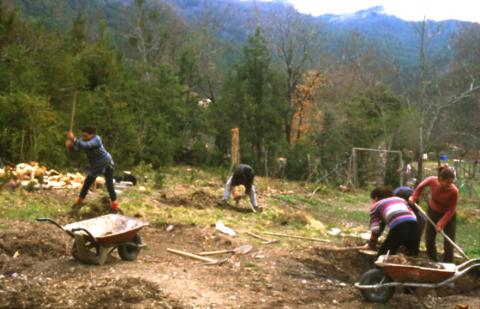
The new inhabitants were all urbanites with no knowledge of country life so no one expected them to stay long. When they first began to rebuild, there was no road up to the town so horses were used to carry construction materials up the mountain. There was no electricity either so they lived with candles and oil lamps.
In the early years, they generated income by selling some of their harvest and working odd jobs like using their new-found construction experience to rebuild roofs outside town. Later they rebuilt the village bakery and sold bread to the outside world.Their organic sourdough breads now sell so well that today they can get by without looking for work outside town, but it helps that they keep their costs at a minimum as a way of life. “There’s an austerity that’s part of the desire of people who come here,” explains Mauge. “There’s not a desire for consumption to consume. We try to live with what there is.”
Today, the town generates all its own energy with the windmill, solar panels and a water turbine. It also has a wait list of people who’d like to move in, but Mauge says the answer is not for people to join what they have created, but to try to emulate them somewhere else.
“If you set your mind to it and there’s a group of people who want to do it, physically they can do it, economically they can do it. What right now is more difficult is being willing to suffer hardship or difficulties or… these days people have a lot of trouble living in situations of shortage or what is seen as shortage but it isn’t.”
Se cree que su nombre viene del euskera, de la combinación de laka y be, que significa debajo de Lakarri, siendo este el monte que tiene a Lakabe en sus …
Hold on to your hats, parents: A court-appointed psychologist recently called a Manhattan father an ‘unfit parent’ because he denied his son’s request to eat at McDonald’s. Yes, you’re reading that right.
London: Grow Heathrow eviction notice 8am, Friday 15 Aug
On Friday 15th August at 8am, bailiffs will make their first attempt to evict Grow Heathrow (previously here and here). Four and a half years after the abandoned greenhouses in the middle of Heathrow Airport’s proposed third runway were occupied by local residents together with activists, Heathrow villagers are organising again to resist airport expansion that’s ruled out by climate science.
Residents of the 700+ homes a third runway would destroy have asked to be trained to protect their own homes. On Thursday 14th, the day before the bailiffs visit, there will be talks and workshops on how to peacefully resist the eviction and on how ordinary people successfully shelved plans for a noisy third runway. At 8am on Friday 15th, hopefully you can help protect our home from the County Court bailiffs, ready to do the same for other homes threatened by airport expansion. Grow Heathrow has been described as the ‘heart of the village’ by BBC News and ‘inspirational’ by the local MP. We are still trying to buy the land instead of having bailiffs at our home.
”There are always oil spills in the Amazon. Because the criminal predator oil companies care nothing for the environment, the health of the people or even the genocide of whole indigenous nations. this has been going on for 50 years, the biggest crimes being the 1000’s of spills and abandoned chemical lakes created over 30 years by Texaco (now Chevron) which even today uses it’s massive wealth to defend its impunity. Today while science proves that 60% of fossil fuels will have to stay in the ground to save us from catastrophic climate change, the race to extract continues worse than ever, with the connivance of ourselves, the 1st world fossil fuel junkies!
Amazon oil spill has killed tons of fish, sickened native people
Barbara Fraser
Dead fish from an oil spill in the Peruvian Amazon are mixed with oil-covered twigs gathered by local residents. Fish are vital to the villagers’ diet and income. Reporters discovered there had been another smaller oil spill only 4 days before which the company claims was a ”normal maintenance procedure”
By Barbara Fraser Environmental Health News July 23, 2014
CUNINICO, Peru – On the last day of June, Roger Mangía Vega watched an oil slick and a mass of dead fish float past this tiny Kukama Indian community and into the Marañón River, a major tributary of the Amazon.
Community leaders called the emergency number for Petroperu, the state-run operator of the 845-kilometer pipeline that pumps crude oil from the Amazon over the Andes Mountains to a port on Peru’s northern coast Continue reading “STOP new Amazon oil devastation”

 Here in our occupied center we have about 26 chickens, pretty fat and healthy, and they give us maybe 12 eggs a day, depending on the season. Sometimes they just go on strike.







 The Free