Lithuanian Ultras vow to force Russian and then NATO Attack.
For the EU to impose even a partial blockade of Russian territory presents a tremendous risk to regional stability and world peace.
The ultra nationalist Lithuanian regime threatens to defy EU orders to back down, thus forcing Russian intervention to defend its 1 million citizens.
Kaliningrad center…the Gibraltar of the Baltic-
Under NATO article 5 it must then also intervene to defend its Lithuanian member. All are talking about the risk of World War III.
The EU commissioner Borrell promised 2 days ago to “sort something out”. Yet still on 27th June Lithuania insists it is going it alone by the 4th round of EU sanctions. Poland is being somewhat more careful, it seems.
Lithuanians hate Russians. In 1940 when Hitler was set to take over the Baltic states Lithuanians rebelled against Russian/Soviet preventive occupation, killing thousands of ethnic Russians and welcoming the nazi takeover.
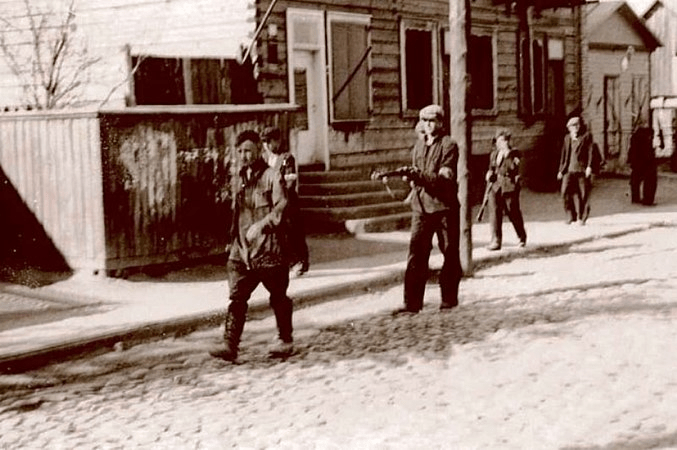
1941..the majority of Lithuanians enthusiastically helped Hitler’s invading fascists to murder 95% of all Jews, men women and kids, nearly 200,000 people and the highest percentage in Europe..
Even after the nazis were finally expelled after killing over 20 million Soviets the Lithuanian resistance (LAF) organized a long suicidal war against Stalin, who was not pleased.
Only 6% of Lithuanians are now ethnic Russian. We don’t know why, but the Lithuanian regime still hates all Russians, especially prosperous Kaliningrad, and are happy to spark off a World War Armageddon to prove it.
***********
Will Lithuania Rail ‘Blockade’ of Kaliningrad Have Unintended Consequences?
Lithuania has blocked a number of rail-transport goods from reaching the Russia exclave of Kaliningrad. Vilnius says it is merely adhering to the EU-mandated sanctions regime, but Moscow warns it has broken international law. Is this a casus belli?
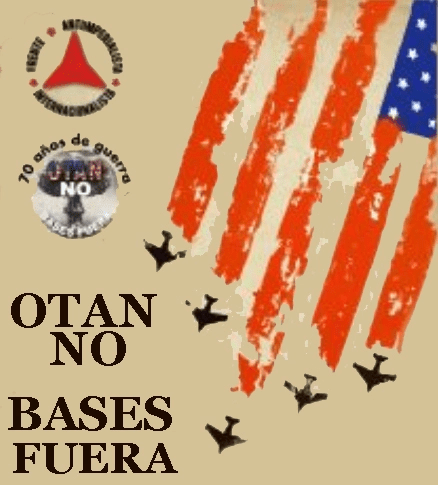
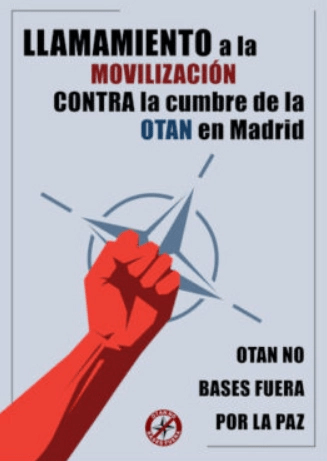
The Coordination of Platforms NATO No, Bases Out, made up of the signatory organizations of the Call for Mobilization Against the NATO Summit in Madrid, called on citizens to celebrate the ‘NATO No’ Counter Summit , Bases Out, Madrid 2022 in response to the Summit of the Heads of State and Government of NATO.
Gathered in the city of Madrid on June 24 and 25, 2022, those attending this Counter Summit DECLARE:
This NATO summit in Madrid must be considered as a historic event that will mark the beginning of a new world order and the beginning of a warmongering period that will involve most of the planet.
It is a crucial event in the present conjuncture of imperialism, reflecting the current stage of the class struggle.
The system in which we live, capitalism, is mired in a crisis that has been defined by its own institutions as structural, systemic and long-term. NATO and the rest of Western war structures, especially US military bases, are key players in this reconfiguration of the world order.
At this time when there is awareness of the decline of the US world hegemony, this country is organizing itself to dominate the world and will defend its privileges in all possible ways, including all kinds of wars and aggressions.
There is no model of the new phase towards which we are moving, but the great international economic institutions and NATO itself have already announced the lines of action to deal with the problems that have already been identified: financialization, debt, creative destruction, technological revolution , social control and warmongering expansion against everything that hinders this capitalist reorganization.
This process will take place outside and within its own borders. It is the definitive start of the World War, a global, arbitrary, unpunished war of aggression, by any means and on any scale, whose purpose is to eliminate all expressions of resistance against imperialist expansion.
The fronts of that war already extend to the Middle East, Central Asia, the Sahel, Taiwan, the South Mediterranean, Latin America and Europe, to which must be added the internal front of the empire.
NATO is present in all of them except in the Asia-Pacific region. The expansive character of this organization is not a forecast; it is a fact, the scope of which was recently announced by the United Kingdom Foreign Secretary: GLOBAL NATO.
Economic Europe has not gone beyond this scope, it has not been able to equip itself with a political structure; failing the attempt to equip itself with a European constitution, the initiative to create a European defense system outside NATO also failed.
What really unites the European Union, due to its class character in favor of monopolies, are the European Central Bank, which determines its economic functioning, and NATO, which determines its foreign relations.
The European Union is united under the discipline of the Atlantic Alliance, and after its actions following US interests in the Ukraine conflict, we will have to talk about the Europe of NATO.
The historical trajectory of NATO shows us that for this organization there are no territorial limits, but neither do they exist for its alliances, for the methods or for the consequences of its warmongering activity.
NATO has resorted to terrorism in all its forms, from the Gladio network in Europe to Takfiri Islamic fundamentalism, in any of its denominations, throughout the Muslim world.
In recent decades, its members and the organization itself have minimized their casualties by hiring companies of mercenary military professionals and arming and training Nazi and Fascist paramilitaries.
Nor are there limits to the suffering caused by their aggressions, the dead must be counted in the hundreds of thousands and the displaced today officially exceed one hundred million.
We can therefore affirm that NATO is a Criminal Organization. At this time, this organization’s priority mission is to isolate and weaken the Russian Federation to create the best scenario to confront China, the final objective of imperialism.
In this drift, they have not hesitated to place us on the brink of a nuclear conflict in order to achieve the separation of Europe from the Russian Federation.
Once again there have been no limits: billionaire spending, thousands of tons of weapons (a good part, out of control), formation of neo-Nazi paramilitary groups, censorship of the media and of Russian culture, creation of a toxic atmosphere that does not only allow the manipulation of public opinion, but also allow justifying all the measures that the new order needs: militarization of society, social control, minimization of the State, inflation, unemployment, precariousness and overexploitation.
All this will be a consequence of the imperialist war, preventing the free self-determination of the peoples. The enormous expenses that these policies entail are justified, but little is said about the immense corporate profits of the arms industry and the reorganization of the hydrocarbon market, of which the United States is fundamentally the beneficiary. The NATO summit will promote this dynamic under indecipherable terms for the general public: Strategic Concept, Extended Security, New Order Based on Rules, Resilience and others that, in generic terms, are accepted without question, such as Technological Development and Digitization and the incorporation of topics of wide media resonance such as Climate Change and Women’s rights.
The introduction of these new themes broadens the areas of intervention on a global scale, and generates new frames of ideological justification for aggression.
Once again, the true objectives of the Summit are hidden, which are none other than to promote the development of a new phase of capitalism, based on the domination of large corporations, the expansion of militarism, social control and the overthrow of the antagonists of the West, Russia and China.
These objectives are raised precisely because the hegemony of US imperialism is in a position of weakness, with the rise of regional powers with the capacity to respond and the willingness to cooperate, both in international institutions and in specific scenarios of interference, distributed throughout the regions of the globe.
The Spanish State, its Congress (with honorable exceptions) and its Government, continue with the agreement reached by Franco and the US in 1953, which meant the alignment of the Spanish oligarchy with the US in conditions of subordination.
Sovereignty was surrendered and submission was accepted in exchange for being admitted by a West that uses us, ignores us and in many cases despises us.
The presence of the bases and the subordination to the US conditioned the Spanish political-economic structure itself after the Transition.
This happened with the collusion of liberal progressivism, which had and has the task of demobilizing social resistance. Our leaders, our elites, are always ready and willing to respond first to any order.
As examples, this was done with the Trio of the Azores, with the European Constitution, with the modification of the Constitution, framing Colombian soldiers in Afghanistan, going to as many conflict fronts as they ask us, handing over the territory to US bases. UU., To the commands and maneuvers of NATO, accepting their budgetary demands, declaring as enemies who they tell us, spreading their propaganda and accepting their restrictions.
In short, to speak of the subordination of the Spanish State to the interests of US imperialism, through NATO and the Bases, is not to refer to a historical event, but to a present reality, especially evident in the most heavily militarized territories, such as the Canary Islands, the surroundings of military bases and sites or the production centers linked to the arms industry.
Let’s put an end to this once and for all, let’s organize a movement with a vocation for the masses and to establish itself as a well-structured political and social subject with strong popular roots, capable of generating transcendental proposals for the development of the class struggle in the Spanish State, which denounce NATO as a criminal organization and demand its abandonment, demand the withdrawal of foreign bases and armies and fight against the militarist and authoritarian plans that are being announced to us and that are already making us feel.
Let us bring to the present and give a new reality to our rich history of popular resistance, especially the anti-fascist struggle. There are peoples who teach us that the defeat of imperialism is possible.
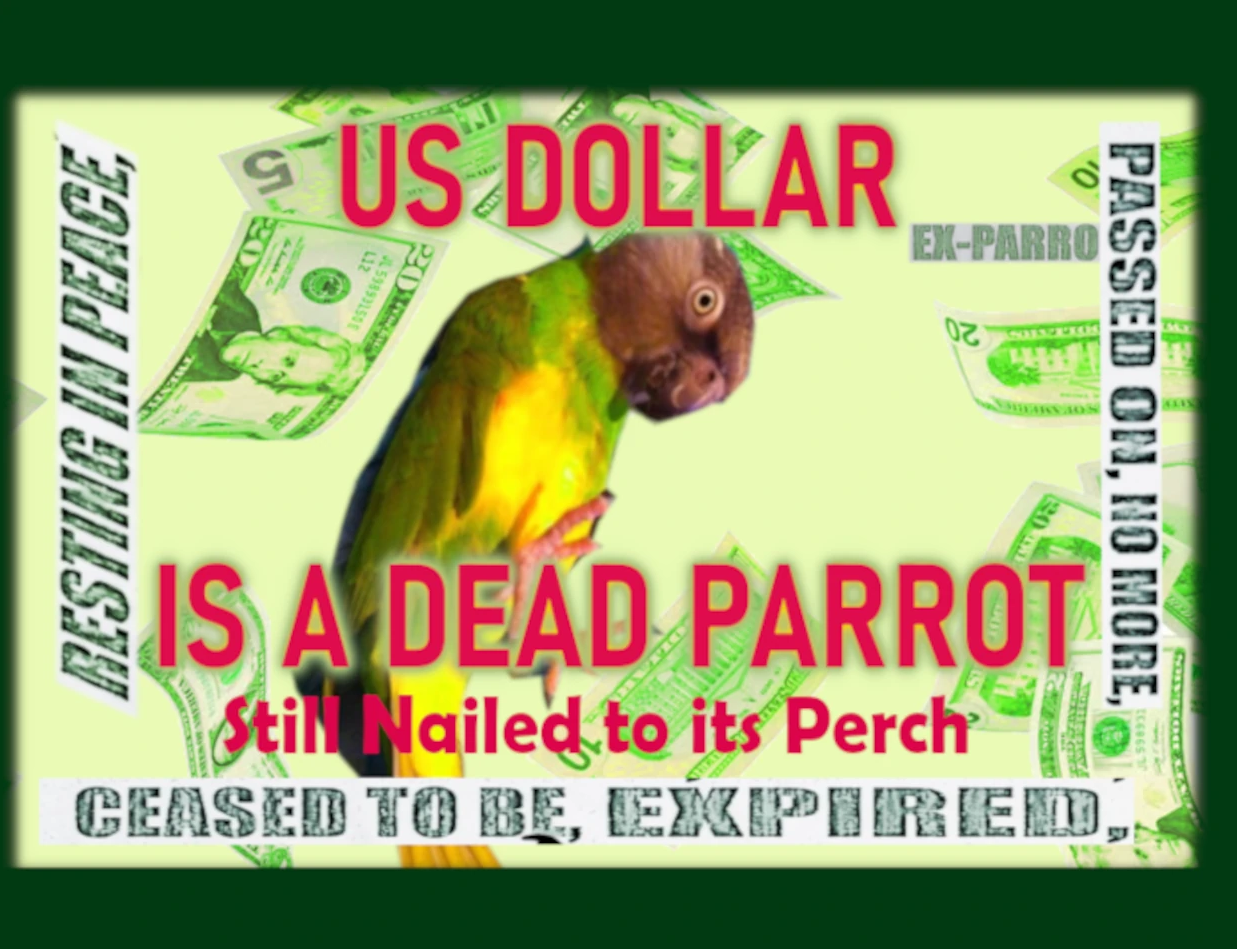
The US Financial Empire may seem stronger than ever. But there comes a point when everyone realizes it’s just a Dead Parrot Nailed to its Perch.
The New Zealand tech guru, Kim Dotcom, said the USA is beyond broke and deliberately so. The total US debt is at $90 trillion, which together with $169 trillion in US unfunded liabilities totals $259 trillion, which is $778,000 per US citizen or $2,067,000 per US Taxpayer.
Now, the value of all US assets combined: every piece of land, real estate, all savings, all companies, everything that all citizens, businesses, entities and the state own is worth $193 trillion.
Total US debt, $259 trillion minus total US net worth, $193 trillion equals negative $66 trillion of debt and liabilities after every asset in the US has been sold off.
Actually, American assets in terms of stocks, bonds and real estate are way over valued so the USA’s hole in the ground is a lot deeper than negative $66 trillion. And corruption is so rampant that Bankers have been allowed to sell trillions of dollars in US Treasury bonds and stick the money in their pockets. ….
In the United States bankers can loan out ten dollars for every dollar on deposit. This makes bank runs impossible to stop. It also means they need to borrow massive amounts money to get out of a Depression. So either everyone starves until businesses make enough money to make humongous loan payments or they go to war.
In the final analysis all money is based on trust. The moment business accepts the Brics reserve currency, for example, the Parrot finally ‘falls off its Perch’.
22 JUNE 2022 All told, the swap of the century is a win-win for Russia in all respects. It could indeed be such for the US and UK too if their governments are mindful enough of global perceptions and especially domestic ones to seriously consider this pragmatic proposal, but their ideologically driven hatred of everything […]
Renee Bracey lloraba desconsolada este viernes. En su camiseta un mensaje: “Yo tuve un aborto”. Delante suyo, la mayoría conservadora del Tribunal Supremo de Estados Unidos acababa de borrar de un plumazo la protección constitucional del derecho al aborto, vigente desde hace 50 años.
Tras emitirse el histórico fallo, miles de mujeres como Renee se concentraron frente a la blindada sede del tribunal, en Washington, donde hicieron escuchar su indignación con mensajes como “Abortemos el Tribunal” o “Fuera sus manos de nuestros cuerpos”.
“ATERRADOR”
“Esto es una gran injusticia. Es aterrador pensar en todas las mujeres que necesitan abortar en este momento y que hoy se levantaron creyendo que podrían acceder a servicios de salud para hacerlo, pero ya no pueden”, explicó a Efe Renee, fundadora de la organización We Testify, que ayuda a mujeres que necesitan abortar.
The US Financial Empire may seem stronger than ever. But there comes a point when everyone realizes it’s just a Dead Parrot Nailed to its Perch.
The New Zealand tech guru, Kim Dotcom, said the USA is beyond broke and deliberately so. The total US debt is at $90 trillion, which together with $169 trillion in US unfunded liabilities totals $259 trillion, which is $778,000 per US citizen or $2,067,000 per US Taxpayer.
Now, the value of all US assets combined: every piece of land, real estate, all savings, all companies, everything that all citizens, businesses, entities and the state own is worth $193 trillion.
Total US debt, $259 trillion minus total US net worth, $193 trillion equals negative $66 trillion of debt and liabilities after every asset in the US has been sold off.
Actually, American assets in terms of stocks, bonds and real estate are way over valued so the USA’s hole in the ground is a lot deeper than negative $66 trillion. And corruption is so rampant that Bankers have been allowed to sell trillions of dollars in US Treasury bonds and stick the money in their pockets. ….
In the United States bankers can loan out ten dollars for every dollar on deposit. This makes bank runs impossible to stop. It also means they need to borrow massive amounts money to get out of a Depression. So either everyone starves until businesses make enough money to make humongous loan payments or they go to war.
In the final analysis all money is based on trust. The moment business accepts the Brics reserve currency, for example, the Parrot finally ‘falls off its Perch’.
Wall Street Bankers love war. Woodrow Wilson was told by his benefactors that they needed WW I to last long enough so they could bankrupt England, France, Germany, Italy and Russia making the US the world financial capital. Four of those five nations were allegedly US allies.
On September 10, 2001 Donald Rumsfeld admitted to CBS Evening News that $2.3 trillion had “gone missing” from the Defense Department (DOD).
Ever since 2018, the US government has not bothered to even answer questions about who stole the taxpayers money. (From MissingMoney.Solari.com/dod-and-hud-missing-money-supporting-documentation/)
By Cindy Harper | Reclaim The Net | June 23, 2022 Dr. Andrew Bostom, an epidemiologist who had over 47,000 followers and who was a significant dissenting figure during the coronavirus pandemic, has been permanently banned from Twitter after posting a peer-reviewed study on Covid vaccination effects. According to a screenshot posted by free-market policy […]