Everyone I know has reported more deaths after vaccination than the number of deaths right before they were going to be vaccinated. That’s impossible if the vaccines are safe, wrote Steve Kirsch.
“If the vaccines are perfectly safe:
The death rates immediately prior to any dose should be exactly the same as the death rate immediately after the dose.
The death rate should not be dose-dependent. It should be 1:1 on every single dose (for the death rate before: after).
“Guess what? Both of these “rules” are violated. Not by a little. By a lot. Like a factor of 5X to 8X increase in ACM [all-cause mortality] in the month after the shot compared to the month before the shot according to 400 independent investigators.”
On 13 May 2022, Kirsch conducted a simple online survey. “Unfortunately, death certificates don’t list when you got vaccinated or when you were planning on getting vaccinated … If you know someone who died and you know when they died relative to their Covid vaccination schedule, please fill out this survey,” Kirsch requested.
Read Steve Kirsch’s full survey analysis, ‘Survey shows over 500,000 killed by the Covid vaccines so far’- HERE Also read Joel Smalley’s relatedanalysis, ‘US Mortality Pre- and Post-Vaccine’- HERE.
Eleven hours later Kirsch had sufficient data to analyse and found he had highly statistically significant results. The analysis provides convincing evidence that the Covid vaccines have killed over 500,000 Americans.
Desmatamento nos primeiros quatro meses do ano é 70% maior do que em 2021. É o pior resultado para o mês de abril desde 2016: o DETER registrou uma área de 1.012 km² sob alerta na Amazônia Em abril de 2022, o sistema de alertas de desmatamento em tempo real do INPE (Instituto Nacional de […] […]
When Putin ordered the Ukraine invasion the West went crazy with unprecedented sanctions, billions in weapons and an orchestrated 24/7 cacophony of largely invented media propaganda.
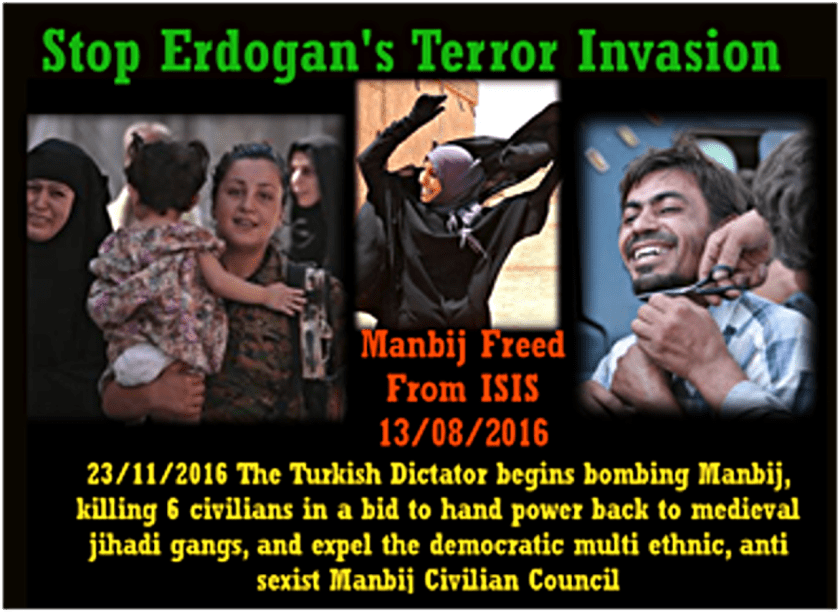
Erdogan knows he can do what he likes. After all this is his 4th invasion, grabbing and ‘Turkifying’ more bits of Syria. Hundreds of thousands of ethnically cleansed Kurds are still trapped and destitute in refugee camps in the desert. Those in Shabha, for example, are regularily bombed by his extreme islamic proxy mercenaries, including Al Qaeda and ex ISIS guerillas.
He can do what he likes. He can bomb and drone again from his NATO base in Incirlik. He can again roll over the self defense militias, the YPG and YPJ in his shiny German tanks, while the West continues to class any resistance or protest as PKK Terrorists.
He can do what he likes and be well rewarded. He is the worst terrorist mass murderer and blackmailer. Ironically demanding armaments and persecution of Kurdish protestors. Ironically blackmailing the NATO terrorists with his veto on Finland and Sweden joining in the great insane US Crusade to destroy and loot Russia.
Enlarging the Turkish occupation of northern Syria will result in certain endless war and suffering. Russia, with its back to the wall, can hardly say no.
And the US, despite cynically backing the YPG defense and SDF multi ethnic fighters (to counter ISIS and Iran and annoy Syria), will hardly resist Turkish blackmail to defend them.
********************
Ankara says it intends to extend a 30-kilometer “safe zone” along entire Syrian border
Turkey will soon launch a new military operation in northern Syria, President Recep Tayyip Erdogan said on Monday. Though he did not provide any specifics, the illegal incursion is likely to target areas held by US-backed Kurdish militias.
“We will soon take new steps regarding the incomplete portions of the project we started on the 30-km deep safe zone we established along our southern border,” Erdogan said after a cabinet meeting, according to AP.
“The main target of these operations will be areas which are centers of attacks to our country and safe zones,” he added, according to Reuters. Operations will begin once Turkey’s military, intelligence and security forces complete their preparations, Erdogan said without elaborating further.
Ankara has sent troops into Syria three times already, starting with Operation Euphrates Shield in 2016. The most recent incursion, 2019’s Operation Peace Spring, was met with US sanctions and a war of words between Erdogan and French President Manu. Turkey currently controls portions of Syria’s Aleppo, Raqqa and Hasakah governorates, in addition to supporting militants in Idlib.
Last month, Turkey also sent troops into Iraq, targeting Kurdish militias in the northern regions of Metina, Zap, and Avasin-Basyan in what it called Operation Claw-Lock. Baghdad condemned the operation as a violation of its sovereignty, but has been unable to do anything about it.
Turkey has accused the Syrian Kurdish militia YPG of links to the Kurdistan Workers’ Party (PKK), which Ankara has designated as a terrorist organization. Since 2015, the US has used the YPG as the basis of the so-called Syrian Democratic Forces (SDF), a proxy militia it has armed and supplied to fight against Islamic State (IS, formerly ISIS) terrorists. The SDF is also tasked with denying the territory to the government in Damascus, which Washington seeks to overthrow.
Backed by as many as 2,000 US troops, Washington’s proxies currently hold` the northeastern portion of Syria, including most of its oil wells and arable land.
Erdogan has recently voiced objections to Finland and Sweden joining NATO, due to the fact the two Scandinavian governments have granted political asylum to a number of Kurdish activists that Turkey considers terrorists.
A historical look at how anarchists in the 1990s mobilized against attacks on reproductive freedom and autonomy by taking direct action and building autonomous infrastructure.
Anarcha-feminist traditions of grassroots struggle and autonomous abortion infrastructure offer alternative strategies. As the anarcha-feminist Liz Highleyman put it in 1992, “the day when abortion is again made illegal may come sooner than we like to think. We must be ready to take our bodies and our lives into our own hands.”
By Spencer Beswick As the Supreme Court prepares to reverse Roe v. Wade under a Democratic president, house, and senate, it is clear that action at the ballot box is insufficient to protect abortion. Reproductive rights were not won by electoral means, and that is not how we will defend them.
Members of the World Health Organization (WHO) are days away from voting on an international pandemic treaty and amendments to the International Health Regulations (2005) which would give the unelected WHO greater control of national emergency healthcare decisions and new powers to push vaccine passports, global surveillance, and “global coordinated actions” that address “misinformation” whenever it declares a “health emergency.”
From May 22 to May 28, representatives of the WHO’s 194 member states (which represent 98% of all the countries in the world) will attend a World Health Assembly meeting in Geneva and vote on this treaty and the proposed amendments to the International Health Regulations (IHR). If passed, both the treaty and amendments to the IHR will be legally binding under international law.
The international pandemic treaty
The World Health Assembly (WHA), the decision-making body of the WHO, established an intergovernmental negotiating body (INB) to draft and negotiate a “global accord on pandemic prevention, preparedness and response” in December 2021. The WHA aims to have this treaty adopted under Article 19 of the WHO Constitution which gives the WHA the power to impose legally binding conventions or agreements on WHO member states if two-thirds of the WHA vote in favor of them.
While the WHO framed this as an international pandemic treaty, the latest draft of the treaty has since evolved to cover all “health emergencies.” Unlike the term “pandemic,” which is limited in scope and refers to the worldwide spread of infectious disease, the WHO’s definition of a “public health emergency of international concern” (PHEIC) is much broader and applies to all types of disease, regardless of whether they’re infectious:
“A PHEIC is defined in the IHR (2005) as, ‘an extraordinary event which is determined to constitute a public health risk to other States through the international spread of disease and to potentially require a coordinated international response.’”
The draft treaty places the “WHO at the centre” and solidifies the WHO as “the directing and coordinating authority on international health” and gives it sweeping, legally binding powers to force member states to adopt many of the censorship and surveillance tools that were imposed during the COVID-19 pandemic.
Some of the key areas of the draft treaty include:
International vaccine passports and contact tracing: Member states will be required to “support the development of standards for producing a digital version of the International Certificate of Vaccination and Prophylaxis” (the WHO’s official vaccine passport). The WHO will also “develop norms and standards” for “digital technology applications relevant to international travel” such as contact tracing apps and digital health forms.
Global surveillance: The WHO will conduct “coordinated global surveillance of public health threats” and member states will be required to build out their surveillance systems and work with “the WHO’s global systems for surveillance.” Non-state actors (which could include Big Tech companies) will also be required to work with governments, the WHO, and other international partners to leverage their “considerable data” to “create the strongest possible early warning and response systems.”
Addressing “misinformation,” “disinformation,” and “too much information:” The draft treaty pushes “national and global coordinated actions to address the misinformation, disinformation, and stigmatization, that undermine public health.” Member states will also be required to strengthen their approaches to “infodemic management” (a term coined by the WHO that refers to “too much information including false or misleading information in digital and physical environments during a disease outbreak.”) Additionally, non-state actors will be required to actors to work with governments to fight disinformation.
Funding: WHO members are set to collectively pay the WHO over $950 million in dues for 2022-2023 and already paid over $270 million in voluntary contributions for 2020-2021. And this draft treaty proposes that G7 countries (Canada, France, Germany, Italy, Japan, the UK, and the US) also pay $11 billion for the “Access to COVID-19 Tools Accelerator (ACT-A).” Additionally, it intends to create an”International Pandemic Financing Facility” that will extract long-term (10-15 year) contributions of $5-10 billion per year.
We obtained a copy of the draft treaty for you here.
If this draft treaty is approved at the May 22 to May 28 WHA meeting, the INB will hold a second meeting on August 1 to discuss progress on the draft. A progress report will then be delivered at the 76th WHA meeting in May 2023. The final treaty will then be presented for adoption at the 77th WHA meeting in May 2024.
Proposed amendments to the International Health Regulations (2005)
On January 18, the Biden administration quietly sent the WHO its extensive proposed amendments to the IHR. The details of these proposed amendments were only made public on April 12, almost three months after they were sent.
Under the current IHR, 196 countries are legally required under international law to build the capability to detect and report potential public health emergencies worldwide and respond promptly to a public health emergency of international concern (PHEIC) whenever it’s declared by the WHO.
These proposed amendments from the Biden administration give the WHO and its Director-General, Dr. Tedros Adhanom Ghebreyesus, sweeping new powers to declare public health emergencies, even over the objection of member states, and implement global surveillance measures that require the mass collection of genetic sequence data.
Some of the key amendments that are being pushed by the Biden administration include:
Increased WHO powers to declare “potential” emergencies: Currently, the WHO can only declare a PHEIC when there’s an actual “public health risk to other States through the international spread of disease.” These proposed amendments allow it to declare a PHEIC when there’s a “potential or actual” PHEIC. This means there doesn’t have to be evidence of the international spread of disease, just the potential for it.
Increased WHO powers to declare health emergencies: Currently, the WHO has to follow the PHEIC criteria when declaring a public health emergency and health emergencies can only be declared by the Director-General. But under these proposed amendments, the WHO Director-General can issue an “intermediate public health alert” to any country in response to events that don’t meet the criteria of a PHEIC and a WHO “regional director” can declare a “public health emergency of regional concern” (PHERC).
Global surveillance and data sharing: The Biden administration’s proposed amendments empower the WHO to develop new “early warning criteria” for monitoring “national, regional, or global risk posed by an event of unknown causes or sources.” Additionally, these proposed amendments expand the scope of data sharing under the IHR and require members to hand over genetic sequence data to the WHO whenever they have an event that “may constitute a public health emergency of international concern.”
We obtained a copy of the proposed amendments to the IHR for you here.
If these amendments are approved at the May 22 to May 28 WHA meeting, nations have six months to reject them. After six months, they’ll enter into force and any rejection or reservation “shall have no effect.”
The WHO’s history of supporting surveillance and acting as an arbiter of truth
Not only could this treaty and the proposed amendments to the IHR empower the unelected WHO to push surveillance, vaccine passports, and global programs that target what it deems to be misinformation but this international health agency already gave the world a taste of how it exercises these powers during the COVID-19 pandemic. As COVID-19 spread, the WHO rigorously supported surveillance tech and was increasingly used as an arbiter of truth on Big Tech platforms, even though it got many things wrong.
Despite having significant influence over how these platforms determine which posts to brand as misinformation, the WHO has got many things about COVID wrong and amplified misleading statements. For example, in an infamous January 14, 2020 tweet, the WHO stated that “preliminary investigations conducted by the Chinese authorities have found no clear evidence of human-to-human transmission” of the coronavirus.
The way the WHO gains its powers gives citizens almost no recourse. Instead of the response to national emergencies in democratic nations being the sole purview of elected officials who can vote on proposed measures that apply to their citizens and be held accountable at the ballot box by those citizens, WHO members vote on legally binding international treaties and agreements on their behalf via the WHA. If two-thirds of the WHA vote to adopt a treaty or agreement, it becomes legally binding under international law.
This global governance system has the support of both parties in most democratic countries. For example, during the 2022 Australian federal election campaign, both of the leadingcandidates expressed full support for the WHO’s expanded powers.
And the WHO Director-General has used the COVID-19 pandemic to push countries to further embrace the WHO’s global governance system by blasting countries that made their own decisions and claiming that their “‘me-first’ approaches… stymie the global solidarity needed to deal with a global threat.”
Countries that support the WHO’s expanded powers
Many countries have expressed support for the international pandemic treaty or the proposed amendments to the IHR.
The US supports both its proposed IHR amendments and the international pandemic treaty.
The treaty also has the support of the UK, Canada, Australia, New Zealand, and the European Council (EC) (which represents 27 European Union (EU) member states). According to the EC, 110 countries supported the decision to launch negotiations on the treaty. If these 110 countries vote in favor of the treaty, it would give the WHA close to the two-thirds of the majority it needs to pass the treaty.
Opposition to the WHO’s expanded powers
While there’s significant member state support for these expanded WHO powers, local politicians, citizens, and rights groups are opposing this power grab.
Several UK Members of Parliament (MPs), including the Conservative MPs Craig Mackinlay and Steve Baker, have also called for the government to provide clarity on the treaty.
May 21st, 2022. Ecuador delivers, in person, a sovereign manifesto to WHO headquarters in Geneva.
In it they have let it be known that under NO CIRCUMSTANCES will the Ecuadorian people tolerate the sovereignty of their homeland being put at risk to ANYONE.