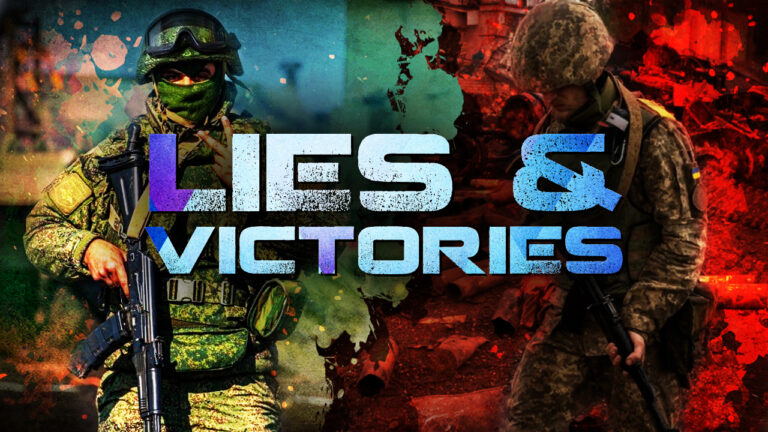
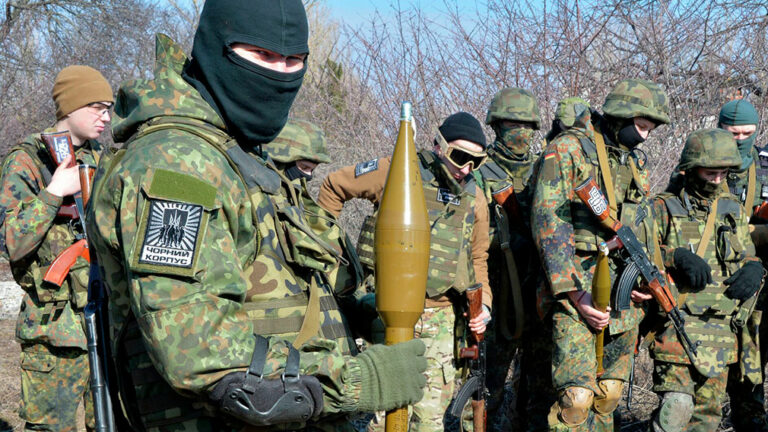
On May 3, the Russian Ministry of Defence shared videos of the staged combat operations of the Armed Forces of Ukraine. Cameras are seen on the videos, and the AFU servicemen follow the orders of the film director.
The roles of the LPR and DPR servicemen are also played by Ukrainian actors who have red armbands which are a tactical sign of the People’s Militias.
” Amid the Kiev’s political catastrophe in Mariupol and military failures in the Donbas, the Kiev regime, with the financial support of the United Kingdom, organized filming of “spirit-lifting” videos for Western and Ukrainian audiences.
In particular, on May 28, staged video footage was filmed near the settlement of Meshkovka in the Mykolaiv region showing the alleged “high efficiency” of the use of Western weapons by Ukrainian nationalists.
To make the future picture more dramatic, at the insistence of the British curators, a “reconstruction” of the never-existing “battle” of the Ukrainian Nazis with the outnumbered “Russian servicemen” was created on the set.
The roles of the “opponents” of the Ukrainian Nazis in the staged short film were performed by members of the local territorial defense unit wearing red armbands. In the absence of captured Russian equipment, the “conditional enemy” appears in the frame on Ukrainian armored personnel carriers and armored vehicles.”
The videos confirm that main weapons of the Kiev regime are lies and fakes.
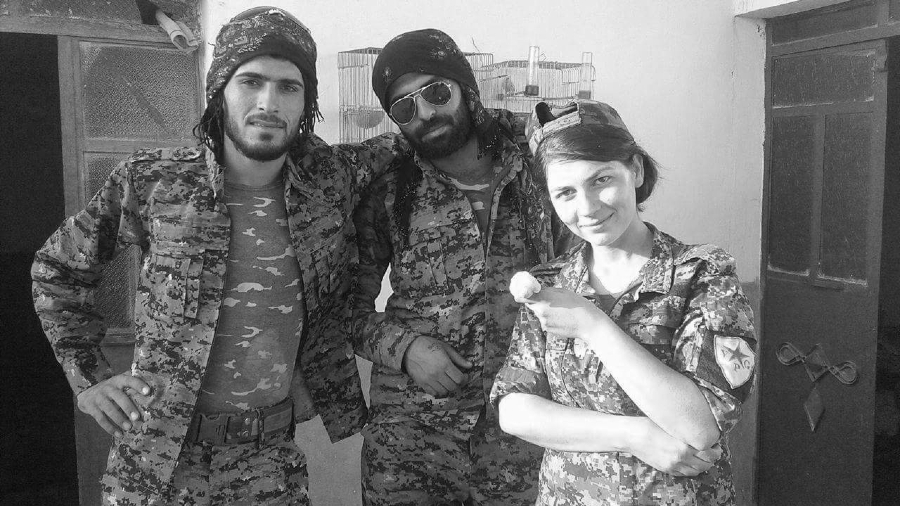
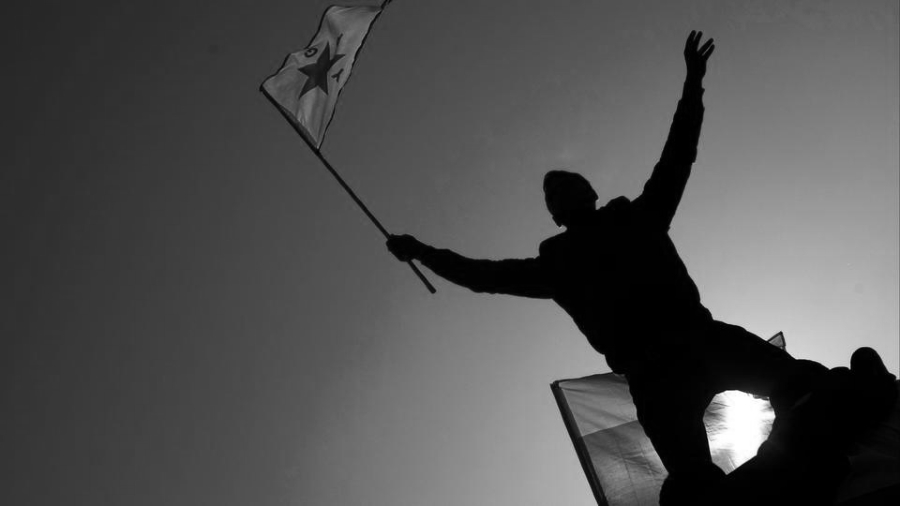
Manbij, Rojava On the right, Comandanta Eylan, who fell in the city of Al Bab. On the left, the combatant Ismael, Kemal’s companion. . “I realized what a historic moment the battle between Daesh and the Kurdish movement was”
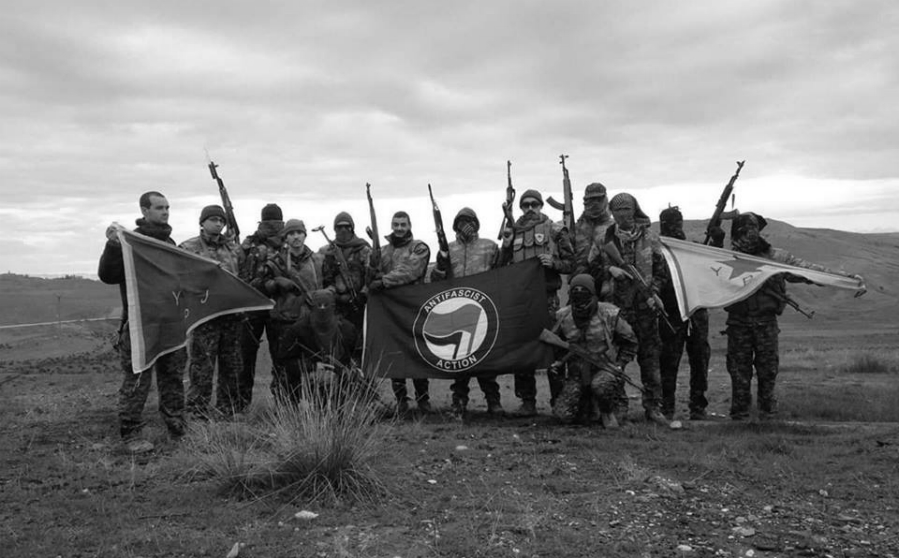
Thousands of men and women came to Rojava to join the fight led by the Kurdish people against the Islamic State. Kemal, a Spanish anarchist, was one of them and tells his story to La Tinta.
Kemal sends me photos. In some, he can be seen practicing shooting, resting, talking with the residents of Rojava (Syrian Kurdistan), where he was twice as an internationalist volunteer, between 2016 and 2018.
His story, where militancy, combats against the State Islamic (ISIS or Daesh), learning that will mark him forever and the ever-living memory of comrades who fell defending the territory, is similar to that of thousands of people from all over the world who decided to come to a Syria in the midst of war to join the resistance led by the Kurdish people.
Of course, Kemal has a first and a last name, but he prefers that I write about him with the nickname he chose in Rojava.
He knows that many other internationalists who returned to their countries -especially to Europe- were victims of judicial persecution.
Although European governments continue to publicly declare their rejection of Daesh, the citizens who went to fight the followers of the Caliphate were classified on more than one occasion as “terrorists” and were brought before the courts.
I speak several times with Kemal, an ocean separates us , but it is not inconvenient for me to tell the story. “About my personal data, I can only tell you that I am from Aragon, Spain,” he summarizes. And he apologizes to me if he prefers to leave his personal life at that point.
Kemal describes himself as “a normal guy” who had “normal jobs”, who “likes to play sports” and with an anarchist militancy that allowed him to develop a “political consciousness”.
His story within the Spanish libertarian movement intersected with the political and social process that emerged in 2012 in Rojava, when the population of northern Syria declared autonomy, and, driven by the Kurdish movement, decided that it was time to change their lives radical.
“I have to tell you that militancy, as we know it in the West, is completely different from what it means in Rojava and in the sphere of the Kurdish movement –says the Aragonese-. I just made the decision to fight for those who didn’t have so much.
I don’t know if I mentioned it to you the other time, but for me the gesture made by so many thousands of foreigners who came to Spain to fight against fascism in the International Brigades has great value. Doing the same for other people seemed like the best way to honor his memory.”
Hevales
With each photo he sent me, Kemal added a comment. In one he says: “Heval Chekdar. A great guy, full of good humor and a good person. He fell in the Raqqa operation”.
In another: “She was our commander in Manbij. Heval Eylan, possibly the best commander I’ve ever had. I could tell you a lot about her, but for another time. She fell just the day after we parted ways, at the hands of a Turkish attack when we were in the Al Bab operation.
I am astonished that in all the brouhaha of Labor kicking out the truly awful Morrison Liberal Coalition government, so far no media noise about the scandalous persecution of Australian citizen Julian Assange.
OK, kindly, I suggest that there’s a lot to digest, a lot to overturn and untangle, in the state of corruption left by the Morrison government.
But now, if ever, is the time for Australia to stop cringing, and stand up to our supposed friend, the USA.
War atrocities happen. Right now there’s a legal case on, all about atrocities committed by Australian soldiers. We have to face up to that. America should have the decency to face up to atrocities committed by its military, instead of viciously persecuting the journalist who revealed them.
Australia could stop its pathetic subservience to the USA and UK, and stand up for an Australian journalist.
We kowtowed 11 years ago, when Australian journalist Wilfred Burchett revealed the humanitarian horrors of Fukushima.
Now, with a decently oriented Labor government, Australia could do the right thing and demand Assange’s freedom. The USA and UK might even respect us for that.
Situation Improving For Ethnic Greeks Following Defeat Of Azov Battalion In Mariupol
from SouthFront by Paul Antonopoulos, independent geopolitical analystvia thefreeonline shared with thanks
Fighters of Azov regiment in Ukraine
Greece’s anti-Russia policies could lead to permanent disconnect from Mariupol’s Greeks.
The surrender of the Azovstal Plant in Mariupol on May 20 was a major victory for Russian forces as they not only gained control of a major port city, but symbolically drove away the neo-Nazi Azov Battalion from their base.
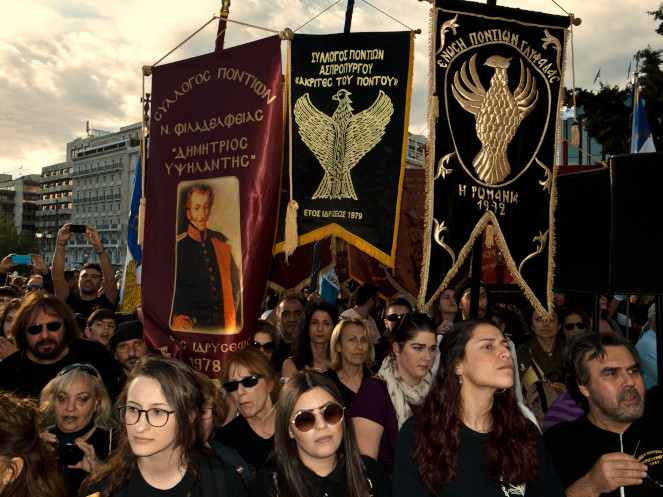
Pontic Greeks in traditional dress
Although consumers of Western mainstream media were bombarded with allegations of war crimes perpetrated by Russian soldiers, such as the Mariupol Drama Theatre (in which local residents warned of a Ukrainian false flag operation days earlier), they had completely ignored the crimes and persecutions faced by non-Ukrainian speakers, including ethnic Greeks.
Mariupol and its surrounding villages are home to 100,000-120,000 ethnic Greeks, who are native Russian-speakers.
Only a small number are currently proficient in either Crimean-Mariupolitan Greek or Modern Standard Greek. Mariupol is a city founded in 1778 by Crimean Greeks on the invitation of Catherine the Great to resettle lands that had been conquered from the Ottoman Turks and to escape persecution in the then Muslim-dominated Crimea.
A second wave of Greek migrants arrived in the Azov region from Pontos to escape the Ottoman Turkish perpetrated genocide in 1913-1923.
Yet, despite Greeks having first colonized Crimea in the 7th century BC, more than a millennium and a half before the Slavs arrived in the mid-10th century after the peninsula was conquered by Prince Sviatoslav I of Kiev, Ukrainian authorities refuse to recognize the Greeks as an indigenous group to Ukraine.
The World Economic Forum and major corporations last month launched its “Defining and Building the Metaverse” initiative, with corporate stakeholders jockeying for a role in defining, developing — and profiting — from the technology.
The World Economic Forum (WEF) and major corporations, following talks at last month’s annual meeting in Davos, Switzerland, launched a new initiative: “Defining and Building the Metaverse.”
As the initiative’s name implies, its stakeholders are still in the process of defining exactly what the term “metaverse” means.
However, according to the WEF, in part, the metaverse involves a moment “at which our digital lives — our online identities, experiences, relationships, and assets — become more meaningful to us than our physical lives.”
One person involved in the talks, Julia Goldin, LEGO’s chief product & marketing officer, expressed optimism about how the metaverse could aid in children’s development:
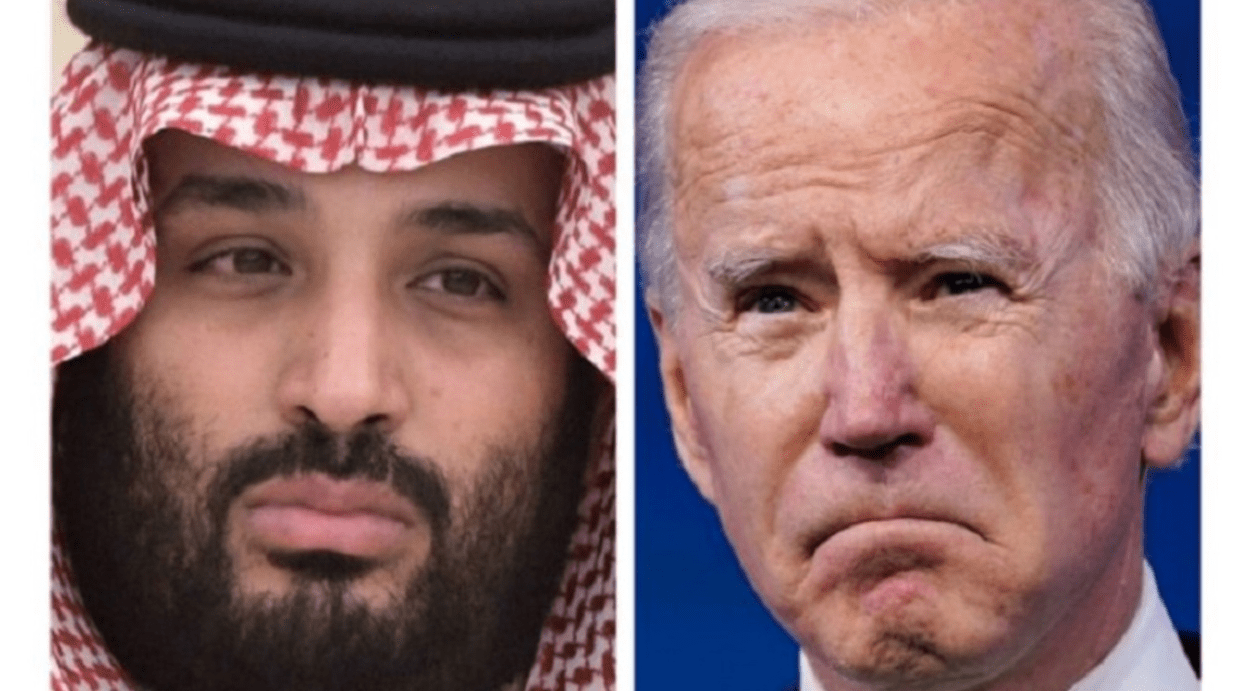
In a major walkback from his campaign pledge to make Saudi Arabia a “pariah” for human rights abuses like the assassination of Jamal Khashoggi, President Biden will reportedly visit Riyadh with the goal of persuading Crown Prince Mohammed bin Salman to help the US alliance win its economic war against Russia.
The Guardian tells us the trip “suggests Biden has prioritized his need to bring oil prices down and thereby punish Russia for its invasion of Ukraine, over his stand on human rights.”
So in order to punish Vladimir Putin for his war crimes and his assault on freedom and democracy, Biden will be courting a tyrannical war criminal whose country has no freedom or democracy.
Washington will be ending its brief diplomatic dry spell with a government that has been waging a horrific war against Yemen while suppressing any semblance of human rights at home in order to more effectively punish Putin for waging a horrific war against Ukraine which we’re told threatens freedom and democracy throughout the western world.
I am not the first to note the risible irony of this development.
Richard Medhurst @richimedhurst The EU literally just banned oil from Russia (mimicking the United States’ actions) because they don’t want to give money to a “dictator”. So Biden is travelling soon to Saudi Arabia to try and bring energy prices down– which is a vibrant democracy, as you all know.June 2nd 2022 792 Retweets 3,106 Likes
“The Biden Administration is openly planning to pay homage to one [of] its closest allies — one of the most despotic and murderous tyrants on the planet, the Saudi Crown Prince — at the same time it convinces Americans its motive for fighting wars is to defend freedom and democracy,” tweeted Glenn Greenwald.
Unless humanity acts now, ‘we will not have a livable planet,’ United Nations secretary-general warns, pleading for world leaders to ‘lead us out of this mess’.
Activists hang a sign on Tower Bridge during a demonstration against the climate crisis in central London in April [Tom Nicholson/Reuters]
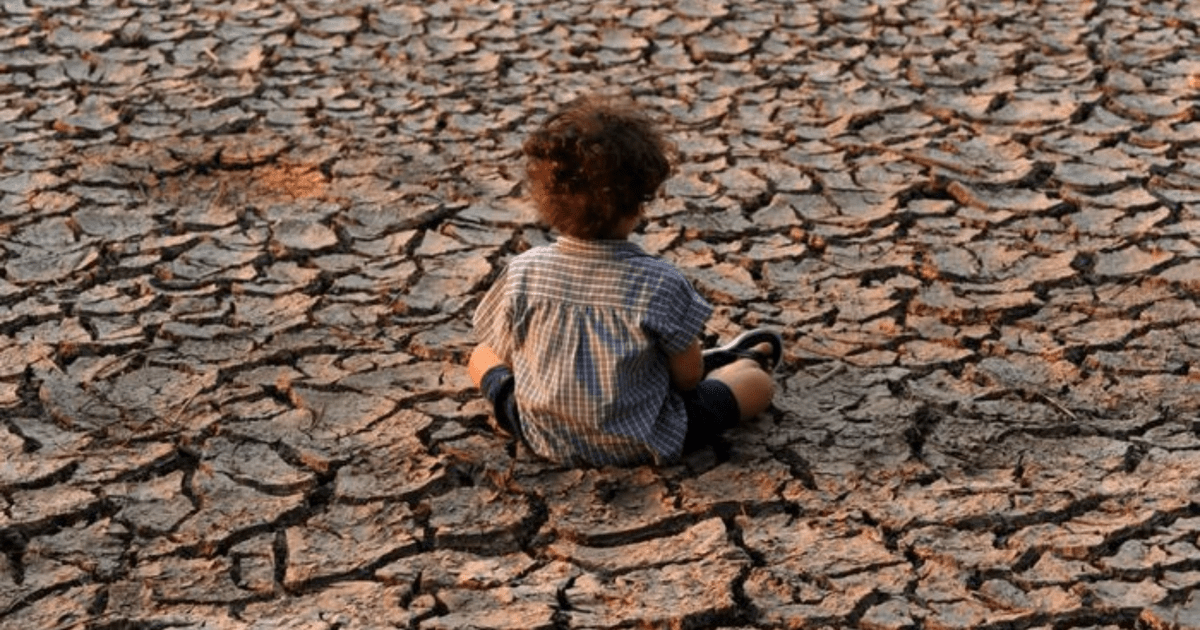
The world must cease its “senseless and suicidal war against nature”, UN Secretary-General António Guterres said, singling out developed nations and their gluttonous use of the planet’s resources.
Guterres said if global consumption were at the level of the world’s richest countries, “we would need more than three planet Earths”.
“We know what to do and increasingly we have the tools to do it, but we still lack leadership and cooperation. So today I appeal to leaders in all sectors – lead us out of this mess,” Guterres said on Thursday.
Developed nations must at least double financial support to developing countries so they can adapt and build resilience to climate disruptions that are already happening, the UN chief said.
“The 17 Sustainable Development Goals and the Paris Agreement show the way, but we must act on these commitments. Otherwise, they are nothing but hot air – and hot air is killing us.”
Guterres was speaking in Stockholm where he met Swedish Prime Minister Magdalena Andersson in advance of a two-day climate and environment conference.
Humanity has less than three years to halt the rise of planet-warming carbon emissions and less than a decade to slash them almost in half, a recent UN report said.
Global emissions are now on track to blow past the 1.5°C warming limit envisioned in the 2015 Paris Agreement and reach 3.2 degrees Celsius (5.76 degrees Fahrenheit) by the century’s end.